
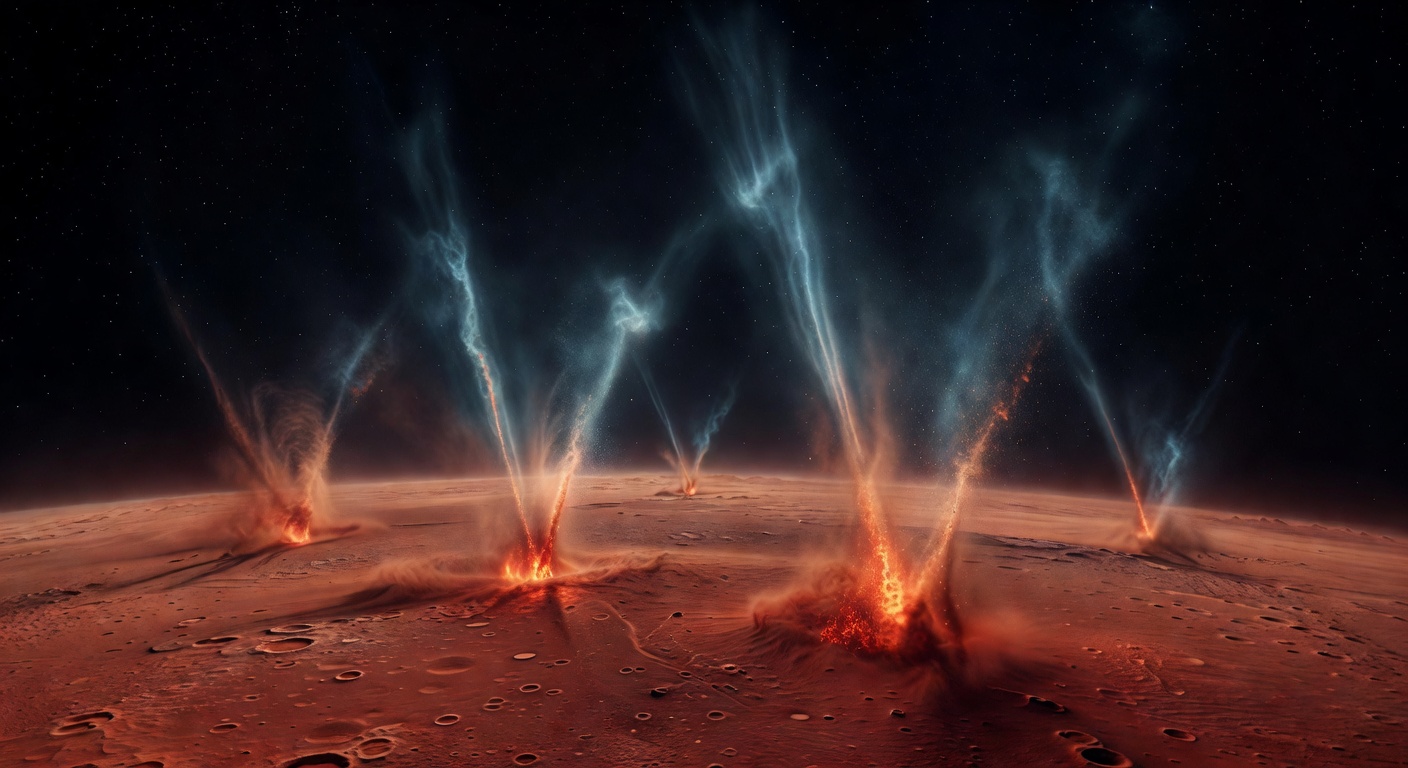
The Ghost of Mars' Watery Past
Here's something that blows my mind: look at Mars today, and you see a frozen, dusty wasteland. But rewind billions of years, and it's a completely different story. The planet was covered in rivers, possibly oceans, and had a thick atmosphere. Something catastrophic happened that turned Mars into the barren desert we know today—and scientists have been scratching their heads trying to figure out exactly how.
The biggest mystery? Most of that water just... vanished. And not in a way they can fully explain with the processes we already know about.
A Breakthrough Nobody Expected
Fast forward to some recent research that just made the Mars science community go "wait, what?" International researchers found something surprising: it's not the massive, planet-wide dust storms that are the real culprits—it's the smaller, sneaky regional ones.
Think of it like this. Imagine you're trying to figure out how all the water disappeared from a swimming pool, and you've been studying the big drain at the bottom. Turns out, there are also these tiny leaks coming from unexpected places that add up to a lot more than you thought.
The Storm That Changed Everything
During 2022-2023 (or "Martian year 37" if you want to sound cool at parties), something unusual happened on Mars. A localized dust storm kicked up in the Northern Hemisphere during what scientists call summer. Here's the crazy part: it launched water vapor way higher into the atmosphere than normal—we're talking 10 times the typical amount.
Previously, everyone thought the Northern Hemisphere summer wasn't really a major player in water loss. It was the Southern Hemisphere that got all the attention. This storm basically said "surprise! We matter too!"
Following the Hydrogen Trail
Here's where it gets detective-like: when water molecules get blown that high into Mars' atmosphere (into an area called the exobase, which is basically where the atmosphere says goodbye and space says hello), they get broken apart by ultraviolet radiation. When that happens, hydrogen gets released.
So the researchers started tracking hydrogen levels—basically following the breadcrumbs of lost water. Sure enough, hydrogen spiked to 2.5 times its normal levels during the same period. It's like watching the smoking gun of water escape in real-time.
Why This Matters (Beyond Just Mars Trivia)
This isn't just interesting science trivia—it's the missing puzzle piece that explains one of planetary science's biggest mysteries. For years, researchers calculated how much water Mars should have lost, but the numbers didn't add up. There was always missing water they couldn't account for.
These smaller storms, happening sporadically and intensely, could be the explanation. If you keep having short bursts of violent dust activity sprinkled throughout Mars' history, those "small" events compound into massive water loss over billions of years.
A Team Effort Across the Solar System
What's also cool is how this discovery happened. It took data from three different Mars missions working together—the European Space Agency's ExoMars Trace Gas Orbiter, NASA's Mars Reconnaissance Orbiter, and the United Arab Emirates' Mars Mission. Scientists basically had to stitch together observations from multiple spacecraft to piece together this story.
It's like they each had one part of the puzzle, and only when they put them together did the picture become clear.
What Comes Next?
This discovery opens up new avenues for research. Climate models for Mars will need updating, and scientists will probably start paying way more attention to these regional storms. They might also help us understand storms on other planets and how atmospheres evolve over time.
Plus, if we ever want to establish a human presence on Mars (which lots of people are talking about), understanding how the atmosphere works and changes is pretty crucial.
The Takeaway
Mars' transformation from a potentially habitable world to a frozen desert didn't happen because of one big catastrophic event. Instead, it was probably a combination of processes—including these intense but localized dust storms that we're only now learning to properly appreciate. Nature's way of saying that sometimes, the quiet villains matter just as much as the dramatic ones.
Pretty humbling reminder that even with all our telescopes and satellites, the universe still has some plot twists up its sleeve.