
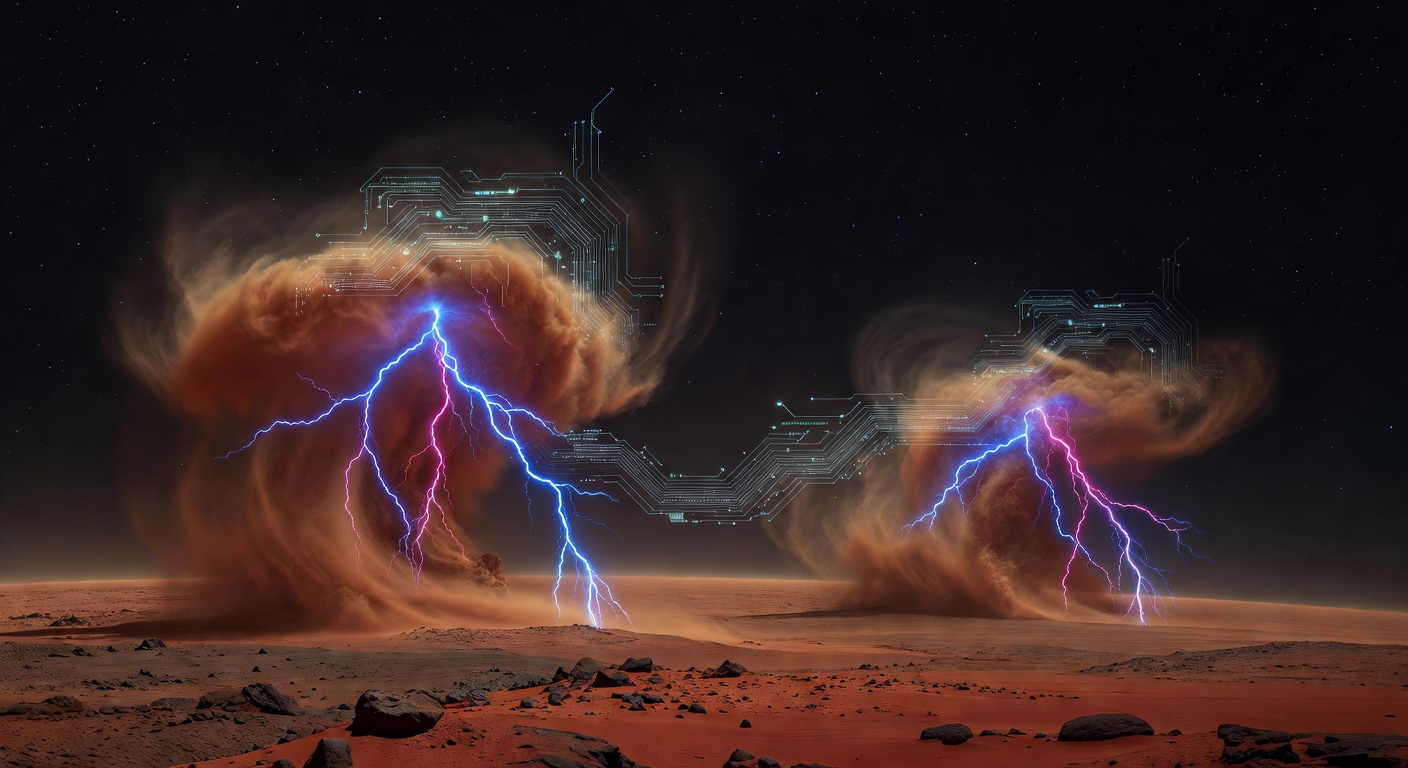
The Red Planet's Electric Secret
When you think of Mars, you probably picture endless red dunes and rust-colored rocks. It's easy to imagine the planet as dead and unchanging, just sitting there in space waiting for rovers to explore it. But here's the thing—Mars is actually constantly moving, constantly changing, and it's doing it in some pretty wild ways that scientists are only now starting to really understand.
The culprit? Dust. Specifically, dust that's electrically charged and sparking off reactions all over the place.
Static Electricity on a Planetary Scale
Imagine the last time you got shocked touching a doorknob. That little zap happened because your body built up static electricity. Now imagine that same thing happening across an entire planet, millions of times a day, with dust particles smashing into each other in massive storms.
That's basically what's happening on Mars right now.
Because Mars has such a thin atmosphere (we're talking about 1% of Earth's atmospheric pressure), the conditions are actually perfect for static electricity to build up and discharge. When dust particles collide during storms and those famous spinning dust devils, they create electrical fields that trigger something called electrostatic discharges (ESDs). It's like the planet is constantly snapping its own fingers and creating tiny lightning bolts.
These discharges might show up as faint glows in the Martian atmosphere—kind of like miniature auroras—and when they happen, they kick off a whole cascade of chemical reactions. We're not talking about small stuff either. These reactions are actually shaping Mars' chemistry at a fundamental level.
Building a Martian Laboratory
Here's where it gets really interesting. A researcher named Alian Wang at Washington University in St. Louis decided to stop guessing about what's happening on Mars and actually recreate it in the lab.
Her team built two special simulation chambers—with the delightfully geeky names PEACh and SCHILGAR—that mimic Martian conditions as closely as possible on Earth. Then they basically created dust storms and electrical discharges inside these chambers and watched what happened chemically.
The results were eye-opening. During these simulated Martian electrical events, the team observed tons of different chemical products being created: chlorine compounds, activated oxides, carbonates, and perchlorates. These aren't random laboratory oddities either—they're actually the same compounds that NASA rovers have detected on Mars itself. That's a pretty compelling match.
The Chlorine Mystery
One of the biggest puzzles Mars scientists have been trying to solve involves chlorine. The Martian surface is full of chloride deposits—salt basically—that were left behind by ancient water billions of years ago. But here's the weird part: the chlorine that rovers have detected shows a strange isotopic signature. The planet seems to have an unusual amount of lighter chlorine isotopes and a shortage of the heavier ones.
Wang's team thinks they've figured out why: the dust-driven electrical reactions are responsible.
By running their simulations and carefully analyzing the isotopes created during the electrical discharges, they found a consistent pattern. Heavy isotopes of chlorine, oxygen, and carbon were being depleted—which is basically the fingerprint of a process that's been running continuously on Mars for a long time.
Think of isotopes like a detective's clue. If you find the same pattern showing up again and again in different elements, it points to one major process being responsible. And that's exactly what Wang's findings show: dust-induced electrochemistry is the culprit.
Mars Isn't Like Earth at All
Here's what really blows my mind about this research: it shows just how fundamentally different Mars is from our own planet.
On Earth, we think about chemistry mostly happening through conventional chemical reactions—things dissolving in water, reactions with oxygen in our thick atmosphere, that sort of thing. Mars doesn't have liquid water at the surface anymore, and its atmosphere is so thin you'd need a spacesuit to breathe.
So instead, Mars has developed this completely different system. Electrical discharges in dust storms are driving chemical changes that are as significant as major chemical processes on Earth. The dust storms release chemicals into the thin atmosphere, where they get carried around, and eventually they settle back down and get redeposited on the surface. Some even penetrate into the subsurface. It's like Mars is running on a completely different energy source.
This helps explain features that rovers have been measuring and puzzling over. The unusual isotopic signatures, the presence of perchlorates, the way certain minerals form—all of it starts making sense when you realize that electricity in dust storms is a major player in Martian chemistry.
The Bigger Picture
What I find genuinely fascinating about this research is what it represents. For decades, we've been looking at Mars and wondering how it works. We've sent rovers and orbiters and mapped the planet pretty thoroughly. But understanding how it actually functions at a chemical level? That's been harder than you'd think.
Wang's work is filling in some real gaps. By doing controlled experiments and measuring isotopic ratios—basically using chemistry as a detective tool—her team has shown that a process we might have thought was minor is actually major.
And honestly, that's what good science does. It challenges our assumptions and reveals that the universe is often doing something far more interesting than we realized.
The next time you look up at Mars in the night sky, remember: that rusty-colored planet isn't sleepy or dormant. It's actively crackling with electricity, driving chemical reactions that reshape its surface bit by bit. It's a world that's very much alive in its own strange way.