
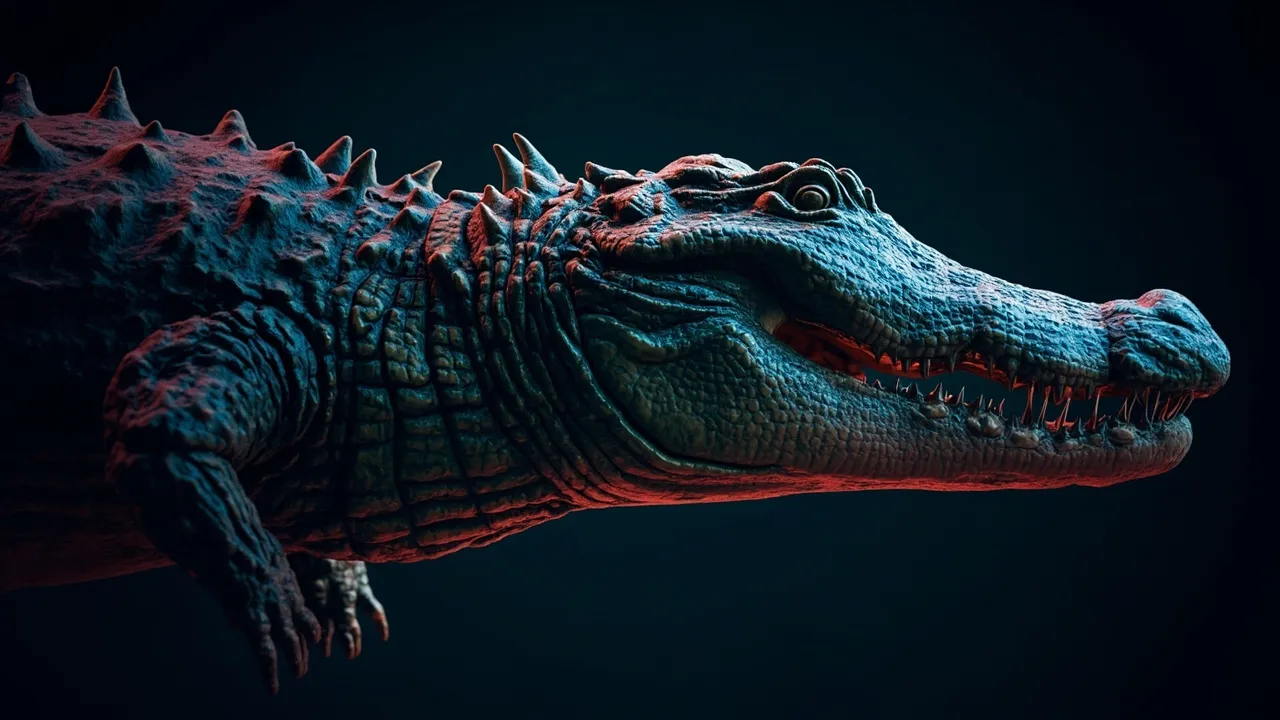
🦖 The Nightmares Are Real, People
Okay, I need you to picture this with me.
You're a dinosaur. Maybe you're a hadrosaur just trying to get a drink of water by the river. Life is good. Then suddenly, a 31-foot monster — longer than a school bus — launches itself out of the water with enough force to make Jaws look like a pet store goldfish.
This wasn't a scene from a bad monster movie. This was real life, about 80 million years ago.
Meet Deinosuchus schwimmeri — and honestly, "terror croc" might actually be underselling it.
The First Look at This Beast (In Scientifically Accurate Form)
Here's what's got paleontologists — and honestly, the rest of us — completely geeking out.
For the first time ever, scientists have created a life-size, museum-quality replica of this ancient nightmare. The full skeleton just went on display at the Tellus Science Museum in Georgia, and it's making quite the entrance.
Dr. David Schwimmer, who's been studying this creature for over four decades, helped make it happen. The man literally has a dinosaur-era crocodile named after him. That's not something you earn by being casual about your research.
And here's the wild part: while Deinosuchus looked like an enormous alligator, it wasn't actually an alligator. It belonged to an ancient crocodilian lineage that's now extinct. So we've got no modern equivalent to truly compare it to. It was basically in a league of its own.
What Made This Creature So Special?
Let's talk size for a second.
Thirty-one feet. That's how long these things could grow. When I first read that, my brain didn't really process it. So I did the math: that's about the length of a typical school bus, but with more teeth and significantly fewer seatbelts.
But here's what really gets me — it hunted DINOSAURS. Not scavenged them. Not grabbed the weak ones. Actually hunted them.
Think about that ecosystem for a second. We're talking about the Late Cretaceous period, when dinosaurs dominated the land. But in the rivers and along the coastlines? Deinosuchus was the apex predator. Everything that came to drink had to worry about what was underneath the surface.
That's a different kind of terror, honestly.
Why Did It Take So Long?
Here's something that caught my attention: paleontologists only formally recognized Deinosuchus as its own distinct species in 2020. Before that, it was kind of this mysterious creature that nobody was quite sure about.
Dr. Schwimmer spent over 40 years searching for fossils, analyzing evidence, and essentially building the case for this species. He literally wrote the book on it back in 2002. The scientific community finally said "yep, you're right, let's give it a proper name."
And they named it after him. Deinosuchus schwimmeri. That's the kind of legacy most of us can only dream about.
What Can We Learn From This?
Dr. Schwimmer had something interesting to say about why these reconstructions matter. He pointed out that these replicas are about more than just scaring museum visitors (though honestly, it's doing a pretty good job of that).
Understanding how predators like Deinosuchus operated can teach us about survival strategies — what works, what evolved, and how ecosystems function under the pressure of serious apex predators.
Plus, let's be real: it gives us a glimpse into a world that was far more terrifying than anything in the Jurassic Park movies. At least those dinosaurs didn't have to worry about something lurking beneath the water that was longer than a bus and had a bite force we can barely imagine.
The Bigger Picture
The folks at Tellus Science Museum are pretty excited about what this means for education. Students from across Georgia and neighboring states visit every year, and now they get to see what was essentially the ultimate nightmare of Cretaceous-period creatures.
Rebecca Melsheimer from the museum put it well: you can tell someone Deinosuchus is 30 feet long, but seeing it? That's a completely different experience.
She's absolutely right. Numbers on a page don't capture the "oh no, this is real and it could eat my entire family" feeling you get when you're standing next to a reconstructed skeleton of something that once ruled the ancient waters.
Final Thoughts
I'm genuinely fascinated by creatures like Deinosuchus because they remind me that the natural world has always been more creative — and more terrifying — than we often give it credit for.
We've got dinosaurs on land, massive flying reptiles in the air, and now this absolute unit of a crocodilian lurking in the water. The Cretaceous period was not messing around.
If you happen to be near Cartersville, Georgia, I'd highly recommend stopping by Tellus Science Museum. The exhibit is apparently the only place in the world where you can see this particular reconstruction.
And if you're like me and nowhere near Georgia? Well, just be grateful that when you go swimming today, the biggest threat is probably just a goose.
Source: https://www.sciencedaily.com/releases/2026/08/260801093740.htm