
Okay, friends. Let me tell you about something genuinely cool that I can't stop thinking about.
Picture this: You're floating in water so dark that sunlight will never touch you again. The temperature hovers just above freezing. The pressure is crushing—about 790 times what you feel standing on the beach. And somewhere down there, in this forgotten corner of the ocean off the coast of Chile and Peru, something hungry is waiting.
Meet Dulcibella camanchaca.
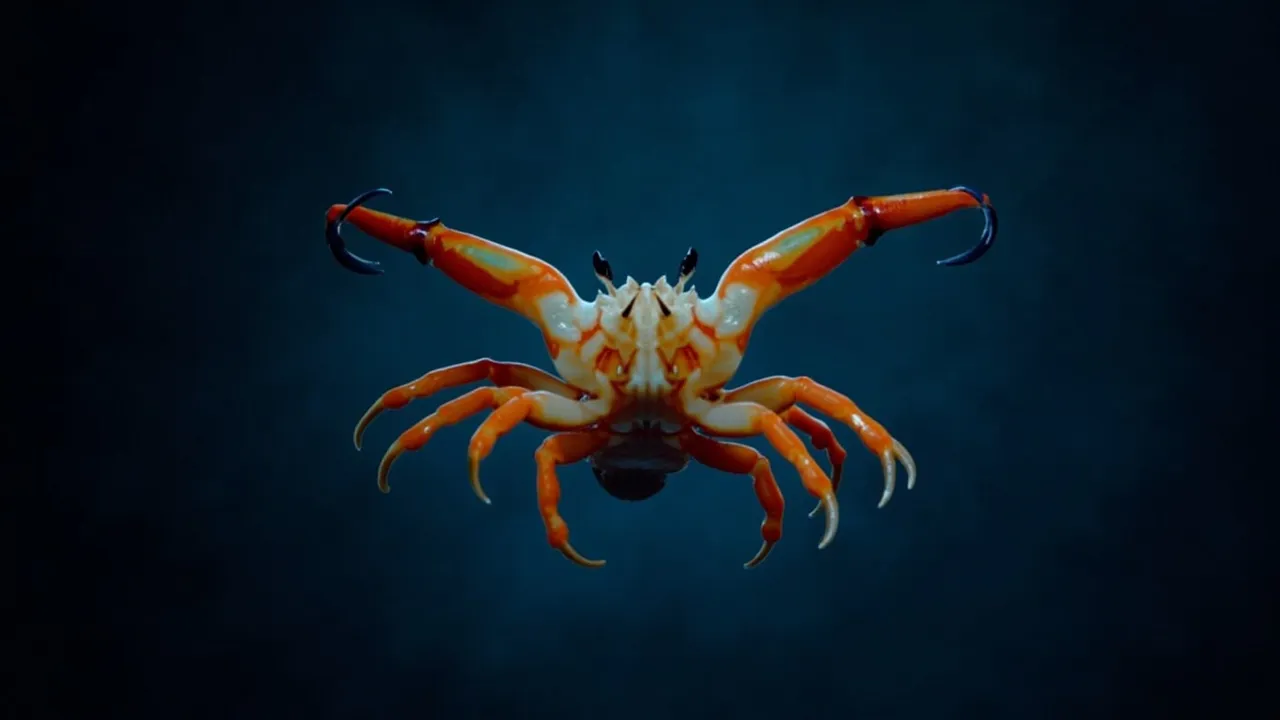
No, it's not a spell from a fantasy novel. It's a newly discovered amphipod—a type of crustacean related to the tiny scavengers you might have seen in streams or tide pools. But D. camanchaca is nothing like those harmless little creatures. This two-inch terror has been lurking 7,902 meters deep in the Atacama Trench, and scientists have recently given us our first real look at what lives in this extreme environment.
So What Exactly Did They Find?
The story starts in October 2023, when researchers from Chile's Instituto Milenio de Oceanografía dropped some baited traps into the Atacama Trench (also called the Peru-Chile Trench, because geographers apparently lack creativity with names). When they hauled those traps back up, they found four specimens of something that didn't match anything in their records.
One of those specimens—a small female about 1.5 inches long—got the full treatment. The team froze it, dissected it, photographed every inch, and sequenced its DNA. They checked its genetic markers against known species, and... nothing matched closely. This wasn't just a new species. It might be an entirely new genus.
The researchers published their findings in the journal Systematics and Biodiversity, and the scientific community got understandably excited.
Built for Bloodshed
Here's what makes D. camanchaca special: it's clearly a predator, not a scavenger.
Most deep-sea amphipods are basically the ocean's cleanup crew. They drift around waiting for dead stuff to sink down from above—a nice, easy meal that requires minimal effort. Their mouthparts are designed for filter-feeding or picking at whatever drifts their way.
D. camanchaca? Different beast entirely.
This little guy has a slender, fast-looking body. Its mouthparts are built for shredding. And those front limbs? They're enormous and powerful—described as "spring-loaded claws" that dominate the animal's front end. In most amphipods, those limbs are no big deal. In D. camanchaca, they're the anatomical signature of something that grabs living prey and doesn't let go.
Nobody has actually watched this creature hunt yet. But when you look at its body, the story is pretty clear: this is an ambush predator in a place where most residents are just trying to survive on scraps.
Why the Atacama Trench?
Let me give you a quick geography lesson, because this location is kind of the point.
The Atacama Trench runs roughly 3,700 miles along the western edge of South America. Off northern Chile, it plunges to over 26,000 feet deep. That's deep enough to earn its own special name: the hadal zone. Scientists use this term for the deepest parts of the ocean, where sunlight never penetrates and conditions are about as extreme as it gets underwater.
It's not the deepest spot on Earth—that honor belongs to Challenger Deep in the Mariana Trench, which bottoms out around 35,876 feet. But the Atacama is plenty deep enough to be its own world. More importantly, it's isolated from other trenches by thousands of miles of open ocean. This geographic separation is what made scientists suspect the Atacama might harbor species found nowhere else on Earth.
The lead author of the study, Johanna Weston from the Woods Hole Oceanographic Institution, put it this way: the Atacama appears to be an "endemic hotspot"—a place where unique species have evolved in isolation.
The Mystery Lingers
Here's where things get interesting—and a little uncertain.
While D. camanchaca has only been found in one location, recent research suggests that "endemic hotspot" might be overstating things. A 2026 survey found another amphipod species living in three widely separated trenches, and a major study catalogued similar communities across multiple hadal regions. It turns out trenches can share residents, even when they're on opposite sides of the Pacific.
So while D. camanchaca is definitely a cool new find, scientists are still gathering evidence to confirm whether it's truly unique to the Atacama or just happens to prefer that neighborhood.
The Next Chapter: Humans in the Deep
Here's what really excites me about this story.
In early 2026, researchers went back. But this time, they didn't just drop traps and wait. They sent people.
The Joint China-Chile Atacama Trench Expedition deployed Fendouzhe, a crewed submersible designed for extreme depths. Scientists actually descended into the trench with cameras and sampling equipment, watching the seafloor in real-time. The team completed more than 36 dives, surveying about 112 miles of terrain. They collected sediment cores, environmental DNA, and hours of video footage.
This is a huge deal. The original discovery was based on a simple baited trap—a method that's been used for decades. But actually seeing these creatures in their habitat, watching them move and (hopefully) hunt, opens up entirely new questions.
Why Should You Care?
I know what some of you might be thinking: "That's cool for scientists, but why does a tiny crustacean in a trench I'll never visit matter to me?"
Fair question. Here's my answer:
First, we're still discovering basic facts about our own planet. We know more about the surface of Mars than we do about the deepest parts of Earth's oceans. Every expedition to these extreme environments teaches us something new about how life adapts, how evolution works, and what limits life can push against.
Second, D. camanchaca is a reminder that Earth is full of surprises. We're not done cataloguing the incredible diversity of life on this planet. The hadal zone—once thought to be essentially lifeless—keeps yielding unexpected discoveries. These findings challenge our assumptions and expand our understanding of where life can exist.
And honestly? There's something wonderful about the idea that deep beneath the surface of the Pacific, in crushing darkness and near-freezing water, there's a tiny creature with spring-loaded claws hunting for its dinner. The deep ocean is strange and alien and endlessly fascinating, and we're only just beginning to meet its inhabitants.
What's Next?
The researchers aren't stopping here. Carolina González, co-lead author of the study, put it simply: "More discoveries are expected as we continue to study the Atacama Trench."
And she's probably right. With crewed submersibles now reaching these depths and genetic technology making identification faster than ever, we're entering a new era of deep-sea exploration. D. camanchaca might just be the opening act.
So the next time you hear something about the deepest parts of the ocean, pay attention. They're not as empty as we once thought—and the creatures down there are weirder than we ever imagined.