
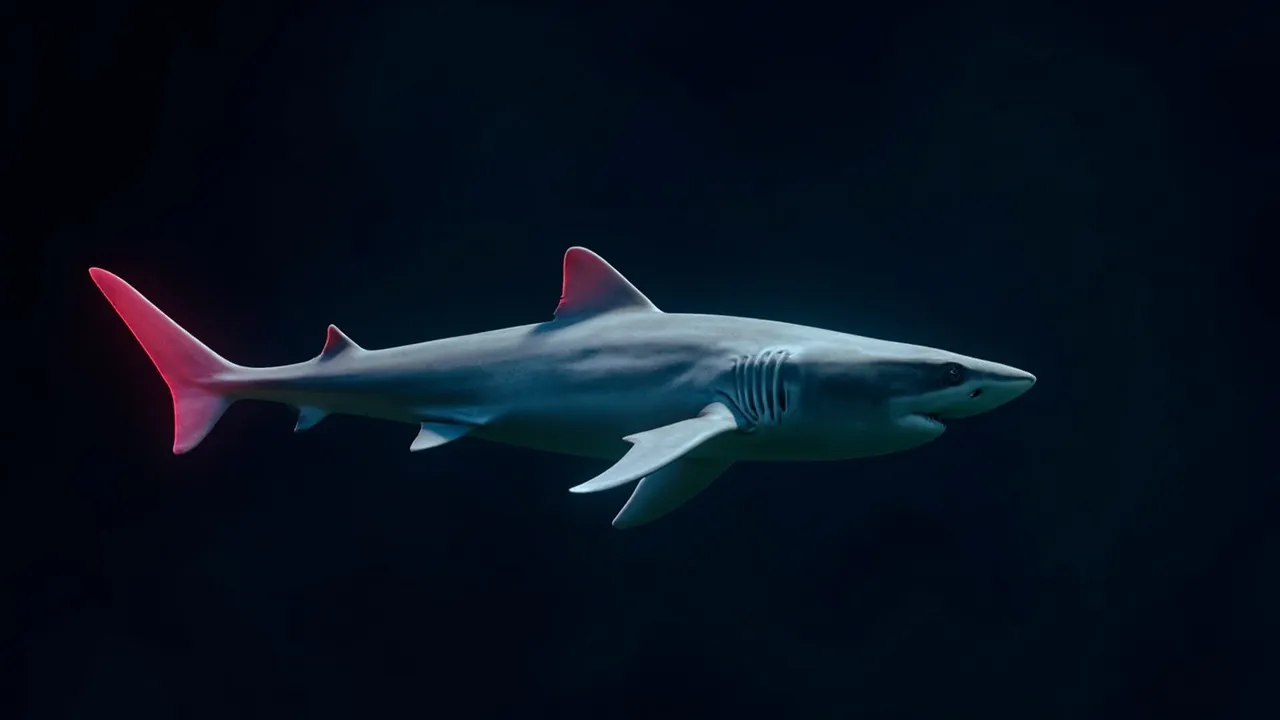
The Ancient Shark With Impossible Eyes
Picture this: You're a scientist in a lab, and a package arrives on your desk containing an eyeball. No big deal, right? Except this eyeball belonged to a shark that was swimming through Arctic waters back when George Washington was still alive. And that eyeball? It's basically pristine.
That's exactly what happened to Emily Tom, a PhD student at UC Irvine, when she opened a shipment of preserved shark eyes. "I opened the package, and there was a giant, 200-year-old eyeball sitting on dry ice just staring back at me," she recalled. "We're used to working with mouse eyeballs, which are the size of a papaya seed, so we had to figure out how to scale up to a baseball-sized eyeball."
I don't know about you, but I find that both horrifying and absolutely fascinating. But here's where it gets really interesting: unlike our eyes (and pretty much every other vertebrate's eyes), these ancient shark eyes showed zero signs of age-related damage.
The Blind Shark Myth
For a long time, scientists assumed Greenland sharks were essentially blind. Why? Because their eyes are often covered in parasites, and they live in the murky, perpetually dark waters of the Arctic. It made sense to assume these creatures had simply given up on seeing.
But then researchers noticed something odd. "After watching many videos, I realized this animal is moving its eyeball toward the light," said Dorota Skowronska-Krawczyk, the UC Irvine researcher who led the new study. "Evolutionarily speaking, you don't keep the organ that you don't need."
She had a point. If these sharks truly didn't use their vision, evolution would have phased out their eyes entirely over hundreds of years. Instead, it seems like evolution had other plans entirely.
A 400-Year-Old Shark, Perfect Vision
When the research team (a collaboration with scientists from the University of Basel) examined these shark eyes under the microscope, they found something that left them genuinely stunned: no retinal cell death. None. Zilch.
Let me put this in perspective for you. By the time most of us hit middle age, we're already dealing with some degree of vision decline. Our retinal cells start dying off, and conditions like macular degeneration become real concerns. It's just part of getting older, right?
Well, maybe not for these sharks.
The researchers also discovered that the sharks' vision was specifically tuned for the blue wavelengths of light that penetrate deepest into Arctic waters. They're essentially built for seeing in almost total darkness. How cool is that?
What This Means for Human Aging
Here's where this gets really exciting for the rest of us. Skowronska-Krawczyk actually studies age-related eye diseases in humans. She got interested in Greenland sharks after reading a 2016 paper about their longevity, and something clicked.
If these sharks can keep their eyes functioning perfectly for four centuries, what are they doing that we're not?
The answer might lie in their DNA repair mechanisms. Somehow, the Greenland shark's visual system has evolved to maintain itself indefinitely. No gradual decline. No deterioration. Just centuries of crystal-clear vision in some of the darkest waters on Earth.
This research, published in Nature Communications, is still in its early stages. But the implications are genuinely mind-blowing. Understanding how these sharks preserve their vision could eventually lead to new treatments for human conditions like glaucoma and macular degeneration. We're talking about potentially unlocking secrets to keeping our own eyes healthy as we age.
More Than Just Cool Science
I don't know about you, but I find this stuff absolutely thrilling. We're living in an age where scientists are literally cracking the code on how some creatures bypass the aging process in specific tissues. The Greenland shark isn't just a curiosity — it's a potential roadmap to healthier aging for all of us.
And honestly? The fact that there's a shark swimming around in the Arctic right now that was born before the United States even existed, with eyes that work just as well as the day it was born, feels like something straight out of science fiction.
As Tom put it, "Not a lot of people are working on sharks, especially shark vision. We can learn so much about vision and longevity from long-lived species like the Greenland shark."
She's absolutely right. The ocean is still full of mysteries, and sometimes the strangest creatures end up teaching us the most valuable lessons about being human.
Source: Science Daily — https://www.sciencedaily.com/releases/2026/08/260821012232.htm