
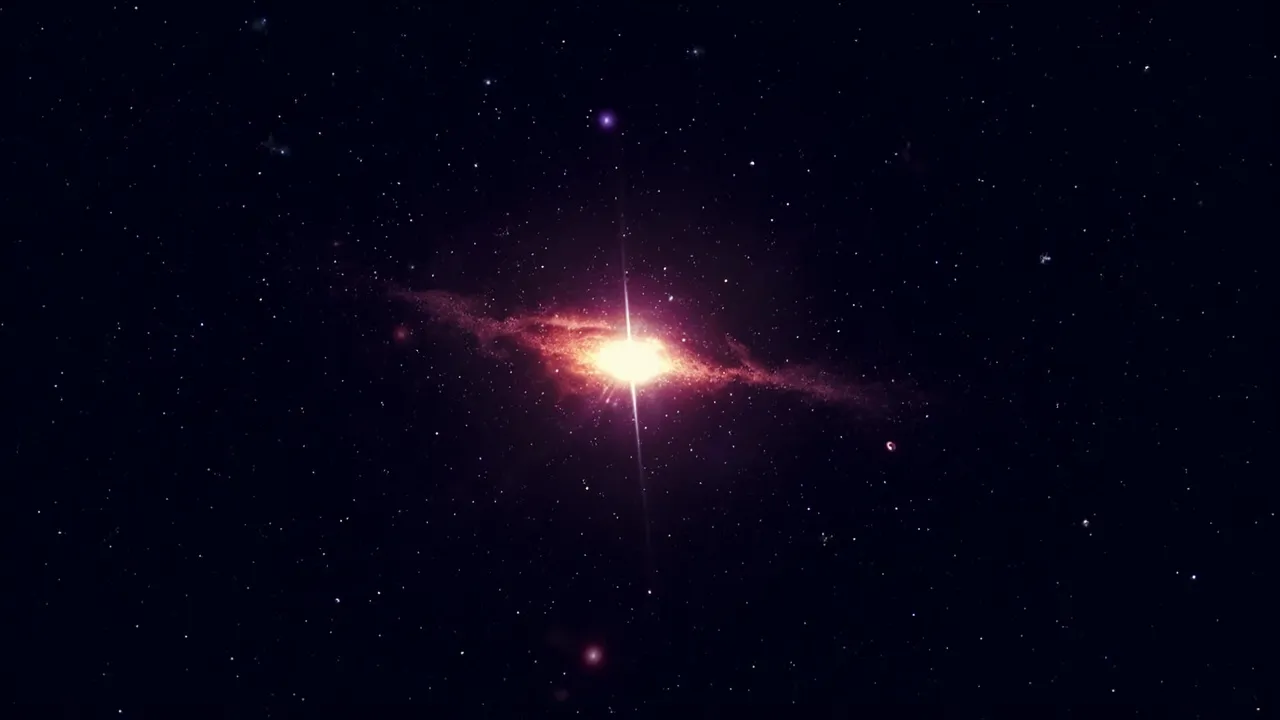
The Universe's Oldest Fireworks
Okay, I have to admit — when I first saw this image, I did a double-take. Is that... a patriotic greeting card from space?
NASA released this stunning Hubble photo to celebrate Independence Day, and honestly, it's perfect. A glittering swarm of red, white, and blue stars? That's basically the universe's way of waving a tiny flag. But here's the thing that really got me: these aren't just pretty lights. These stars have been shining for nearly the entire history of everything.
Let me introduce you to NGC 6426 — and trust me, you're going to want to remember this name.
Meet One of the Oldest Things in the Milky Way
NGC 6426 is what's called a globular cluster. Picture a giant cosmic snow globe, but instead of glitter suspended in water, you've got hundreds of thousands of stars all gravitationally locked together in a beautiful, dense sphere. Our Milky Way has about 150 of these clusters scattered throughout its outer halo, kind of like ancient jewelry scattered around a cosmic vanity table.
But NGC 6426 isn't just any globular cluster. Astronomers estimate it's approximately 13 billion years old.
Let that number sink in for a moment.
The universe itself is about 13.7 billion years old. Which means this cluster formed just a few hundred million years after everything began. If the universe were a 70-year-old person, NGC 6426 would be about 66 years old. These stars have been around basically forever.
Why Do the Stars Look Like Different Colors?
Here's where things get fun. When you look at this image, you're probably drawn to the mix of blue and red stars. But here's the cool part: those colors aren't just decoration.
Blue stars are hotter. Red stars are cooler. It's basically the opposite of what you'd expect from, say, a campfire, where red embers are hottest. In space, smaller, older stars tend to run cooler and appear reddish, while the more massive, younger ones burn hot and blue.
Hubble captured this image using different filters that pick up specific wavelengths of light, then processed them into what you're seeing. It's not an Instagram filter — it's actual science making the invisible visible.
The Chemical Secret of Ancient Stars
Now here's where NGC 6426 gets really interesting. The stars in this cluster have something astronomers call low metallicity.
"Metals" in astronomy doesn't mean your smartphone or jewelry. It refers to anything heavier than hydrogen and helium — carbon, oxygen, iron, all that good stuff. And here's the thing: when the universe first formed, there basically was nothing but hydrogen and helium. Everything heavier was created later, inside massive stars, through nuclear fusion.
When those stars died in spectacular supernova explosions, they scattered those newly-created elements into space. Those heavier elements then became the building blocks for the next generation of stars, and eventually, planets, moons, and everything else.
The stars in NGC 6426 are old enough that they still carry that primordial chemical fingerprint — relatively little "metals" in their composition. They're essentially time capsules from the universe's early days.
But Wait — There's More Than One Generation
Here's something that really fascinated me: scientists discovered that NGC 6426 contains two chemically distinct populations of stars. Not just one generation, but two.
The slightly younger stars in the cluster formed after an earlier generation lived, died, and scattered heavy elements through supernova explosions. Those explosions essentially "enriched" the surrounding gas with new elements, creating the raw material for a second wave of star formation.
It's like finding out your great-great-grandparents had a family recipe that got better with each generation — except the recipe is literally creating the chemistry needed for planets and, eventually, life itself.
What This Tells Us About Our Galaxy
This image wasn't just captured for the Fourth of July vibes (though let's be honest, the timing is magnificent). NASA is systematically studying globular clusters throughout the Milky Way's halo, and there's a reason.
These ancient clusters are like archaeological dig sites. By measuring their ages and chemical compositions, astronomers can piece together how our galaxy formed and evolved over billions of years. Every globular cluster is a data point in the story of the Milky Way.
And honestly? We're living in an incredible era for this kind of work. Hubble has been revolutionizing our understanding of the cosmos for over 30 years, and now it's getting help from the James Webb Space Telescope, which peers deeper into the infrared than Hubble ever could. Plus, the Nancy Grace Roman Space Telescope is expected to launch soon and will give us yet another set of cosmic eyes.
Looking Back at the Dawn of Time
I don't know about you, but I find something deeply moving about this image. Those tiny points of light in the Hubble photo? They're individual stars that were already ancient when our Sun, Earth, and everything on our planet hadn't even formed yet.
We're literally looking at light that left those stars over 13 billion years ago. We're seeing them as they existed when the universe was still young and chaotic, before galaxies settled into their current shapes, before our own Milky Way looked anything like it does today.
Every time I see an image like this, I'm reminded that we're not just observers of the cosmos — we're part of it. The atoms in our bodies were forged in stars that died billions of years ago. We're literally made of cosmic history.
So when you look at that "sparkler" image, remember: those aren't just patriotic colors. They're a glimpse into our own origins, sparkling away in the darkness, waiting for someone to look up and wonder.
Happy Independence Day, everyone. The universe has been celebrating for 13 billion years.