
Space Travel's Best Kept Secret: The Gravity Assist
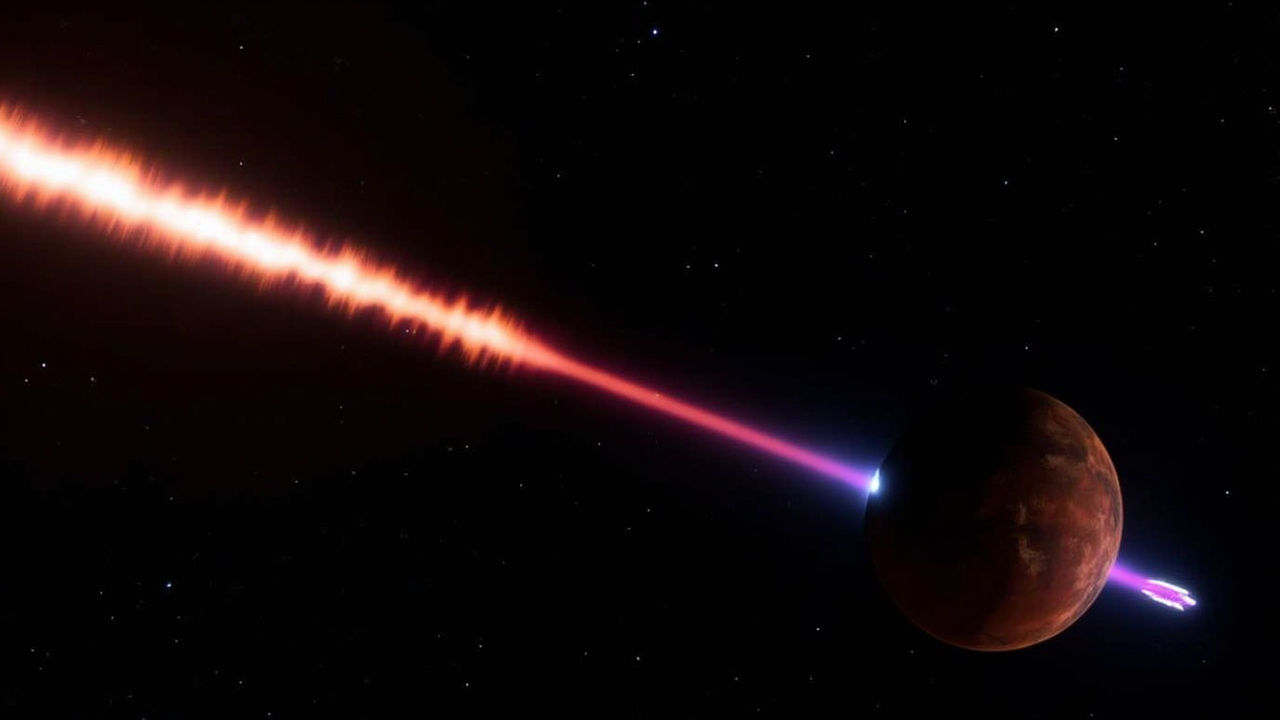
Here's something wild: sometimes the best way to get somewhere in space is to intentionally fly toward another planet first. Sounds counterintuitive, right? But that's exactly what NASA's Psyche spacecraft is doing on May 15th, and it's a perfect example of how clever mission planning can save enormous amounts of fuel.
Think of it like this—imagine you're on a highway, and instead of just accelerating yourself, you hitch a ride behind a massive truck that's already moving. The truck's slipstream helps you speed up without burning your own gas. Mars is doing something similar for Psyche, except on a cosmic scale.
The Numbers Are Absolutely Bonkers
The Psyche spacecraft will zoom past Mars at just 2,800 miles above the surface while traveling at 12,333 mph. To put that in perspective, that's faster than any commercial airplane, faster than a speeding bullet, and just... genuinely mind-boggling. And Mars' gravity is going to grab this spacecraft, alter its path, and essentially give it a free speed boost toward its ultimate destination: a weird metal-rich asteroid also called Psyche (creative naming, I know).
The spacecraft launched back in October 2023 with a solar-electric propulsion system powered by xenon gas. So it's not exactly a spaceship with giant rocket engines—it's more like a high-tech solar-powered bicycle that's also moving faster than anything you've ever seen.
Why This Matters Beyond Just Speed
Sure, getting a free boost from Mars is cool, but NASA isn't wasting this opportunity. The entire encounter is basically a dress rehearsal for the real mission ahead.
The mission team is planning to use Psyche's multispectral imager to snap thousands of observations of Mars. Why? Because when Psyche finally reaches the asteroid in 2029, the team needs to be really good at operating these instruments. It's like practicing your lines before the big performance—except the performance is millions of miles away from Earth.
Engineers have already started collecting "raw" images (basically unprocessed pictures that look pretty unimpressive to us regular folks), but they'll eventually turn these into something spectacular. They're planning to create a time-lapse sequence of the entire encounter. I'm genuinely excited to see what that looks like.
What Makes This Flyby Visually Unique
Here's something I find genuinely cool: the view of Mars is going to look totally different from the Instagram-ready images you see from orbiters and telescopes. Because Psyche is approaching from Mars' night side, the planet will first appear as a thin crescent—almost like a cosmic sliver of light. After the spacecraft zooms past, Mars will look nearly full from Psyche's perspective.
One scientist described it perfectly: "thin crescent on approach and the nearly 'full Mars' view after we fly past." It's the kind of thing that reminds you how weird and wonderful space exploration really is.
The Bonus Hunt for Martian Rings (Yes, Really)
Here's where things get speculative, but intriguing: scientists think Mars might have a faint dusty ring—sometimes called a torus—surrounding the planet. We're talking about dust particles kicked up by micrometeorites striking Mars' moons, Phobos and Deimos. If the sunlight lines up just right during this flyby, Psyche's cameras might actually catch a glimpse of this ring.
Even if that doesn't pan out, the imaging team will be conducting "satellite search" observations. Basically, they're practicing how to look for tiny objects around a celestial body—training that'll be essential when they're searching for possible moonlets orbiting asteroid Psyche later on.
Other Instruments Get Their Moment Too
The magnetometer aboard Psyche might observe Mars' magnetic field interacting with charged particles from the Sun. The gamma-ray and neutron spectrometer will study cosmic rays as the spacecraft passes by. It's like every instrument on this spacecraft gets to do a little warm-up exercise before the main event.
As the principal investigator put it: "the only reason for this flyby is to get a little help from Mars to speed us up and tilt our trajectory." But having everything powered up and working? That's definitely the icing on the cake.
The Reality Check
Mission controllers will be glued to their screens, monitoring radio signals between Psyche and NASA's Deep Space Network. They'll be able to detect even tiny changes in the spacecraft's velocity through something called Doppler shift—basically the same principle that makes a siren sound different as an ambulance drives past you.
The whole thing is a beautiful example of how modern space exploration isn't just about building bigger rockets. It's about understanding physics, planning meticulously, and using the universe's own gravity to help you get where you need to go.
May 15th is going to be a good day for space nerds everywhere.