
When Evolution Goes Into Overdrive
Have you ever wondered why some creatures seem to change and adapt lightning-fast while others barely budge over millions of years? I mean, we humans basically look like our ancestors from thousands of years ago, right? But in Lake Malawi in Africa, something totally different is happening.
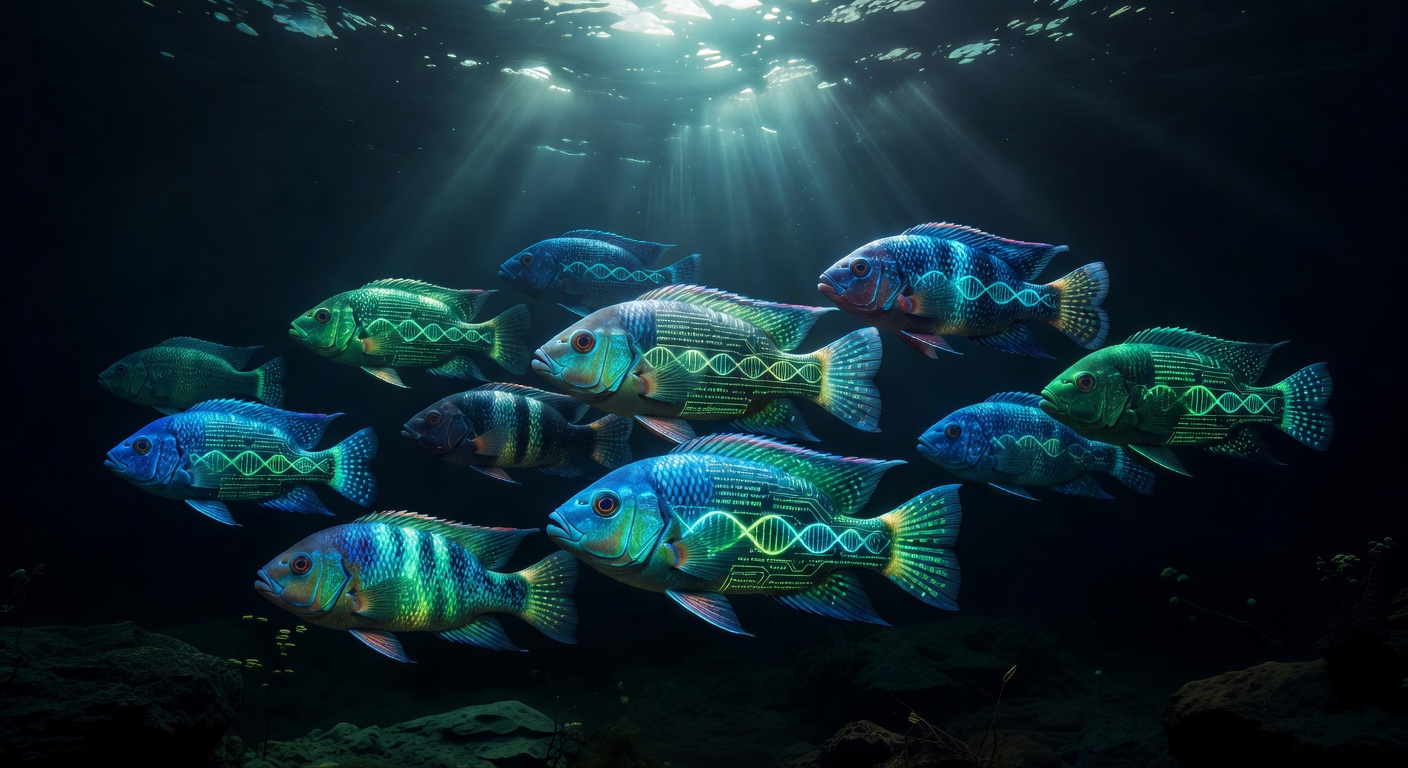
Scientists recently made a mind-bending discovery: cichlid fish in that lake have somehow managed to evolve into over 800 different species in what amounts to a genetic blink of an eye. To put that in perspective, that's like one family tree exploding into hundreds of wildly different branches in just a few thousand years. It shouldn't be possible. But it is.
The Problem Evolution Normally Faces
Here's where it gets interesting. Evolution usually works through a slow, grinding process. Genes get shuffled around through reproduction, mutations happen, and sometimes—if you're lucky—the new combo is actually better for survival. But here's the catch: when genes get shuffled, beneficial combinations often get broken apart.
Think of it like shuffling a deck of cards that has a perfect hand already arranged. Sure, you might randomly get lucky, but usually you're just destroying the good combo you already had. That's why evolution is normally slow. It's frustrating for nature to keep breaking up winning combinations.
Enter the Supergenes
But then nature found a loophole. It's called a chromosomal inversion, and it's basically DNA's way of saying "I'm keeping this winning combo intact."
What happens is pretty wild: a segment of DNA literally breaks, flips backward, and reattaches. When it does, all the genes in that segment stay bundled together in the same order—they're just reversed. Scientists call these bundled gene clusters "supergenes," and honestly? The name is perfect.
The advantage is huge. Instead of beneficial genes getting separated when DNA shuffles during reproduction, they all flip as one unit. It's like having a super-powered genetic backpack that keeps all your best adaptations together. You can't accidentally break them apart because they're all linked as a single flipped section.
How Fish in One Lake Became 800 Kinds of Fish
Researcher Hannes Svardal and his team wanted to understand how cichlids exploded into so many species so quickly. So they did something ambitious: they sequenced the genomes of over 1,300 cichlid fish.
What they found blew my mind. Multiple supergenes were scattered throughout these fish populations, and each one appeared to be specifically designed for adapting to different parts of the lake. Some fish had supergenes that helped them see and sense things in the murky depths. Others had genetic packages that helped them survive under high pressure where oxygen runs thin. It was like each supergene was a cheat code specifically calibrated for a particular lake zone.
One group of fish adapted to live in deep water. Another went for the shallow areas. Some became predators, others became algae-eaters. Each time a supergene popped up in a population, it gave that fish population a massive advantage in a specific environment. And because supergenes stay intact across generations, the advantage stuck around.
The Secret Ingredient: Genetic Remix
But here's the thing that makes this even more fascinating—supergenes didn't work alone. The scientists also found evidence of introgression, which is a fancy word for "genes from different species getting mixed together."
Basically, fish from different groups sometimes bred with each other, reintroducing old genetic variants into populations and recombining them in totally new ways. Then, supergenes would lock those beneficial new combinations in place. It's like evolution got access to a remix button alongside the fast-forward button.
Why This Actually Matters
So what? Why should we care that some fish in Africa figured out how to evolve super efficiently?
Well, this might actually explain a ton of stuff about evolution that we've never fully understood. There's this famous event called the Cambrian explosion—this moment in Earth's history when life seemingly exploded into wild diversity almost overnight. Scientists have always wondered how that could happen so fast. Supergenes might be a big part of the answer.
It also shows us that evolution isn't just this random, purposeless process. Nature actually has mechanisms for making evolution work better when circumstances demand it. It's not conscious planning, but it's definitely elegant problem-solving on a genetic level.
The Takeaway
What I find genuinely cool about this discovery is that it reveals something humble: nature is better at innovation than we gave it credit for. We often think of evolution as this slow, bumbling trial-and-error process that just happens to work. But here we see evidence that evolution has its own built-in tools for speeding things up when the environment creates opportunities.
Those Lake Malawi cichlids didn't just randomly get lucky. They had supergenes doing the heavy lifting, keeping winning combinations intact, and allowing their species to branch into new forms at a pace that should theoretically be impossible.
If fish can figure out how to hack their own evolution, I'm genuinely curious what other tricks we'll discover in nature's genetic toolkit. Evolution just got a lot more interesting.