
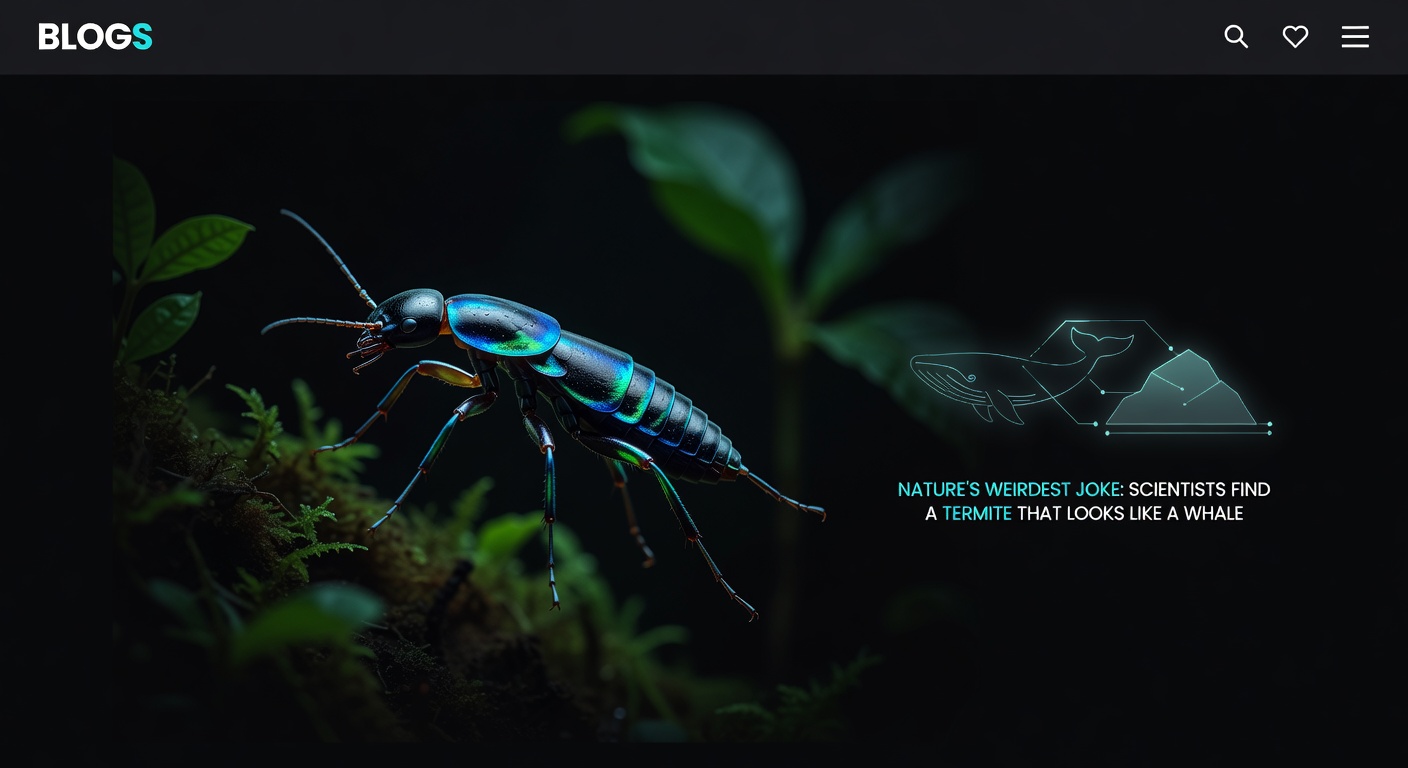
When a Bug Looks More Like a Whale Than a Bug
I have to start by saying: nature has a sense of humor. And I mean that seriously.
Picture this: You're a scientist deep in a South American rainforest, minding your own business, studying termites. Then you find one that looks like... a sperm whale. Not metaphorically. Literally. Its head is rounded and elongated, its mandibles (those jaw-like parts) tuck away just like a whale's features, and the overall vibe screams "tiny marine mammal trapped in an insect's body."
So what did the researchers do? They named it Cryptotermes mobydicki. Moby Dick. Seriously. And honestly? I'm here for it.
The Discovery That Made Scientists Do a Double-Take
Rudolf Scheffrahn from the University of Florida led the team that identified this peculiar little creature, and you can practically hear the excitement in his description. He noticed that the soldier termite's head profile, when viewed from the side, genuinely resembled a sperm whale. The eye placement, the shape, even the way those hidden mandibles disappear beneath the rounded head—it all just works.
"This termite is unlike anything we've ever seen," Scheffrahn said. And coming from someone who studies insects for a living, that's saying something.
The wild part? The research team actually wondered if this might be an entirely new genus of termite, not just a new species. That's how different it looked from anything cataloged before.
Why This Matters (Beyond the Adorable Naming)
Here's where it gets genuinely interesting. This discovery brings the total number of known Cryptotermes species in South America up to 16. But more importantly, it tells us something fascinating about how these termites evolved and spread across the Neotropics—that's the tropical regions of South and Central America.
Scientists found DNA evidence connecting this new species to termite populations in Colombia, Trinidad, and the Dominican Republic. It's like finding breadcrumbs that help us understand a massive puzzle of how creatures migrated and adapted across an entire continent.
The colony itself was just chilling in a dead tree about 26 feet up in the canopy. These aren't ground-level bugs—they're living high above the forest floor, which probably explains why it took humans so long to find them.
How Many Other Surprises Are Out There?
Here's the part that should genuinely blow your mind: there are only about 3,000 known termite species on the entire planet. And scientists estimate there are way more out there that we haven't discovered yet.
This one termite discovery is a perfect reminder of something scientists have been saying for decades: we basically have no idea how many organisms are actually living on Earth. In tropical rainforests especially, there's still an unimaginable number of creatures waiting to be found and studied.
It makes you wonder: what else is up there in those treetops right now? What other animals look like entirely different things? What other species are out there with ridiculous names waiting to be discovered?
The Good News for Florida Homeowners
Before you start worrying that whale-headed termites are coming to eat your house, here's some reassuring news: this species poses absolutely zero threat to buildings. It's a drywood termite, sure, but it's strictly a rainforest creature. It doesn't invade homes, doesn't spread beyond its native habitat, and isn't interested in your property.
So you can appreciate the weirdness of nature without losing sleep over it.
Why I Love This Story
Honestly? I think this discovery is perfect. We live in a world where biodiversity is constantly under threat, where species are disappearing before we even know they exist. Finding a new termite species—especially one that looks like a whale—reminds us that nature is still out there creating wild, unexpected things.
And the fact that scientists named it after a classic novel? That's the kind of playful, human touch that makes science fun. Not everything has to be deadly serious. Sometimes you can be rigorous about your research while also appreciating the sheer absurdity and beauty of what you're discovering.
There are real Moby Dicks out there right now, living their best termite lives in trees we'll probably never visit. And somehow, that's oddly comforting.