
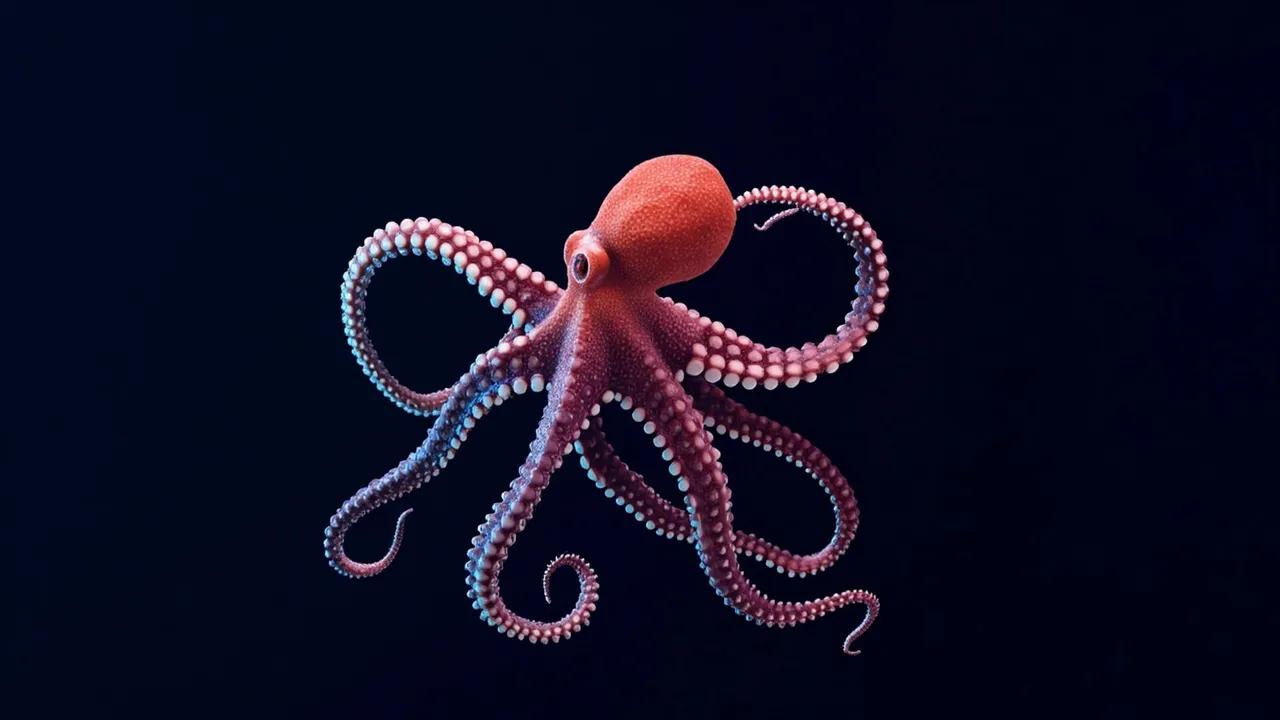
Okay, confession time: I am absolutely fascinated by octopuses. They're intelligent in ways that feel almost alien to us—solving puzzles, opening jars, escaping from aquariums, and even showing what might be personalities and moods. And let's not even get started on their ability to change color and texture faster than you can blink.
So when I stumbled on this new research from the University of Vienna, I had to dig deeper. And honestly? The findings are way cooler than I expected.
The Plot Twist: It's Not Just About the Genes
Here's what I always assumed about evolution: complex traits come from genes mutating or new genes appearing. Simple enough, right?
Wrong. Or at least, incomplete.
The researchers found something surprising: the secret to cephalopod (that's octopus, squid, and cuttlefish) brain power might not be what genes they have, but how their DNA is organized inside their cells. Specifically, it's about the 3D structure of their genome—how DNA folds and loops around itself.
Think of it like this: you could have the same ingredients as a fancy restaurant, but if you throw everything in a pile instead of organizing your kitchen properly, you're not making that dish. The arrangement matters as much as the components.
When DNA Went Through a "Renovation"
Hundreds of millions of years ago, something wild happened in the cephalopod family tree. Their DNA underwent what the researchers call a massive reorganization—like someone came in and completely rearranged the furniture.
Previously separated sections of chromosomes got shoved next to each other. Distant genetic neighbors suddenly became roommates.
This created new opportunities for genes to "talk" to each other in ways they never could before. And here's where it gets interesting: once these new connections formed, they started influencing each other's activity. Over time, these interactions became more and more entangled (the scientists even use this word—"regulatory entanglement"—which I think is delightfully dramatic).
The beautiful part? This whole process didn't break anything essential. By creating new connections while keeping crucial systems intact, the genome could experiment with different patterns of gene activity. Evolution got to try out new features without risking the organism's basic survival functions.
Stable Domains vs. Flexible Loops
Now here's where the scientists got really granular (pun intended). They discovered that different parts of the genome responded very differently to this evolutionary chaos.
Some large structural regions called chromatin domains stayed surprisingly stable—like the load-bearing walls of a house. These domains help organize DNA into broad sections, and their persistence suggests that some features of genome architecture are simply too important to mess with.
But smaller structures called chromatin loops? Those were chaos.
These loops form when distant sections of DNA get brought together in three-dimensional space, and they varied dramatically between species, between tissues, and even across different stages of development. The flexible little rebels.
And here's the kicker: many of these adaptable loops appeared near genes associated with nervous system development and function. So while the stable architecture kept things running, these flexible connections potentially gave evolution room to innovate on cognition.
Why This Matters Beyond Cephalopods
Here's what really got me thinking: this challenges a traditional view of genome architecture as something that primarily responds to evolution. The findings suggest that the physical organization of DNA might be a more active player than we realized.
It's not just that evolution shapes the genome. The genome's structure itself might be part of what enables evolution to create complexity in the first place.
That's a pretty profound shift in how we think about where new biological features come from.
The Bottom Line
So next time you watch an octopus Jet through a maze or pry open a latched container, you might be watching the result of an ancient genetic house party that happened hundreds of millions of years ago. DNA sections that were once strangers got thrown together, started chatting, and eventually helped build one of the most impressive nervous systems on the planet.
Evolution, it turns out, is less about building from scratch and more about clever reorganization. And sometimes, rearranging the furniture creates something unexpectedly brilliant.
I'm definitely going to be looking at octopuses differently now. They're not just intelligent animals—they're walking (well, crawling and jetting) monuments to what can happen when DNA gets a little tangled up.