
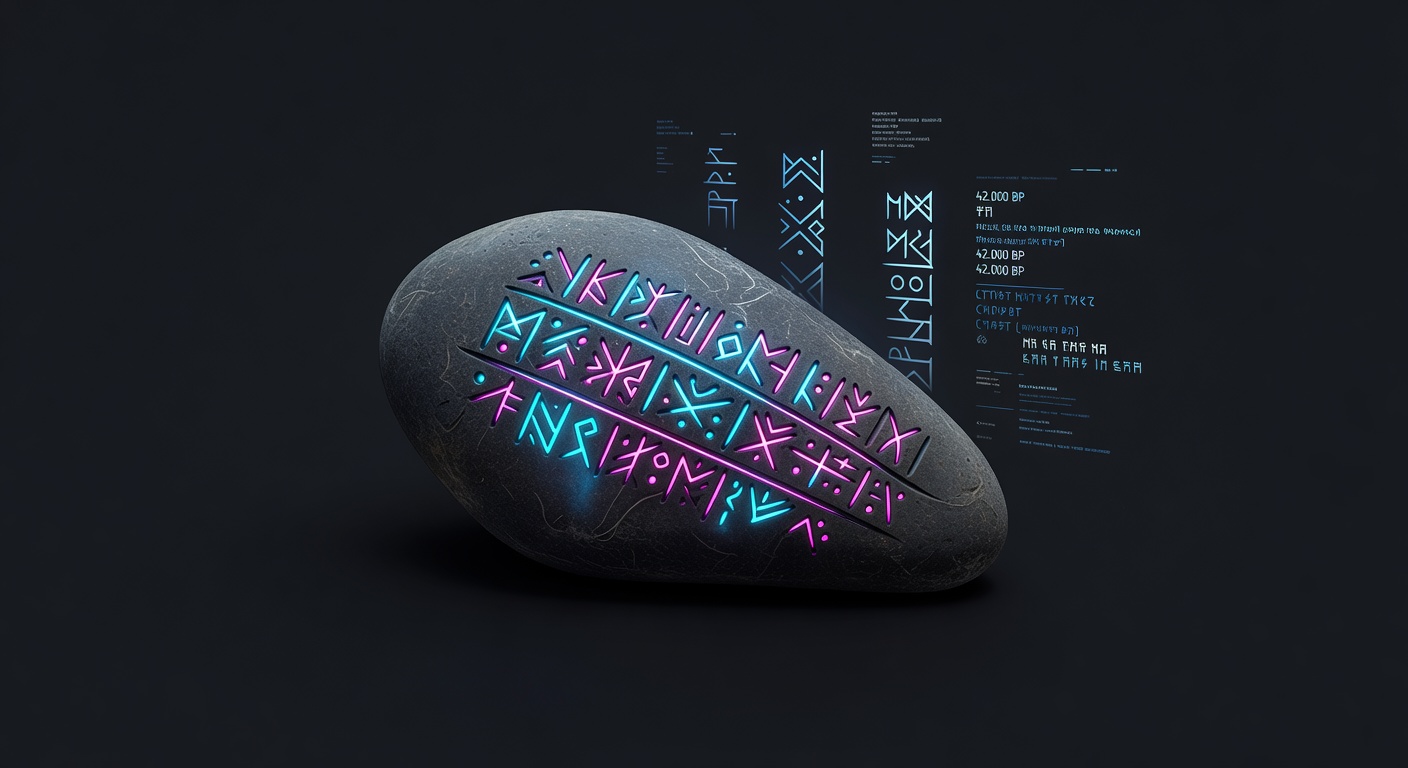
The Dawn of Human Information Storage
You know that feeling when you can't remember something important, so you write it down on your phone or stick a Post-it note on your computer? Well, it turns out our ancestors had the same brilliant idea – about 40,000 years ago.
Scientists have just published some fascinating research that's completely changing how we think about early human communication. They've been studying hundreds of carved objects from the Aurignacian culture – basically the first modern humans who settled in Central Europe during the last Ice Age.
More Than Pretty Decorations
Here's what blew my mind: these weren't just random scratches or artistic doodles. The researchers analyzed over 200 mobile objects (think tools, figurines, and other portable items) covered with thousands of geometric signs. Using fancy statistical analysis and classification algorithms, they discovered something remarkable.
These symbol sequences were deliberately organized and followed consistent patterns. In fact, they were so sophisticated that they share statistical properties with some of the earliest known writing systems, like protocuneiform tablets from ancient Mesopotamia.
The Information Density Game-Changer
But wait, it gets even more interesting. The researchers found that our ancestors weren't just randomly slapping symbols on everything. They were strategic about it.
Ivory figurines contained way more complex symbol sequences than everyday tools. This suggests they understood that different objects could carry different amounts of information – kind of like how we use smartphones for complex data but might just carve a simple initial into a walking stick.
What Does This Actually Mean?
Now, before we get too excited, the researchers are careful to point out that we can't definitively say these symbols represent a full writing system like we know it today. But here's what we can say:
- Early humans were thinking symbolically in ways we didn't fully appreciate before
- They had systematic approaches to information storage tens of thousands of years before "official" writing emerged
- They understood the concept of encoding information for later retrieval or communication
The Bigger Picture
This research is making me think differently about human cognitive evolution. We often imagine that our ancestors were just focused on basic survival – finding food, staying warm, avoiding predators. But this study suggests they were also grappling with much more abstract concepts: How do we remember important information? How do we share knowledge across time and space?
These questions led them to develop what researchers call "artificial memory systems" – basically external storage for their thoughts and knowledge. Sound familiar? It's not that different from what we do when we save files to the cloud or bookmark important websites.
From Cave Walls to Keyboards
What I find most fascinating is that this research connects our ancient past directly to our digital present. The human drive to externalize information – to get important stuff out of our heads and onto some kind of permanent medium – appears to be much older than we thought.
Those carved symbols from 40,000 years ago were humanity's first baby steps toward the information age. They represent our species figuring out that we could extend our memories beyond our own minds, creating a foundation for everything from cuneiform tablets to smartphones.
The next time you save a document or send a text message, remember: you're participating in a tradition that goes back to some very clever ice age humans who decided that carving symbols into ivory was a pretty good idea.
Source: https://www.pnas.org/doi/pdf/10.1073/pnas.2520385123?download=true