
- Introduction about stars like our Sun dying
- The new discovery about kicks
- Explain the science in simple terms
- Random walk analogy
- Evidence from binary stars
- Predictions about collisions
- What this means for us (connecting to our Sun)
So Your Star Is About to Have a Rough Time
Here's something that kept me up at night after reading about this new research: our Sun, that steady, reliable source of warmth and light, is eventually going to turn into an absolute mess.
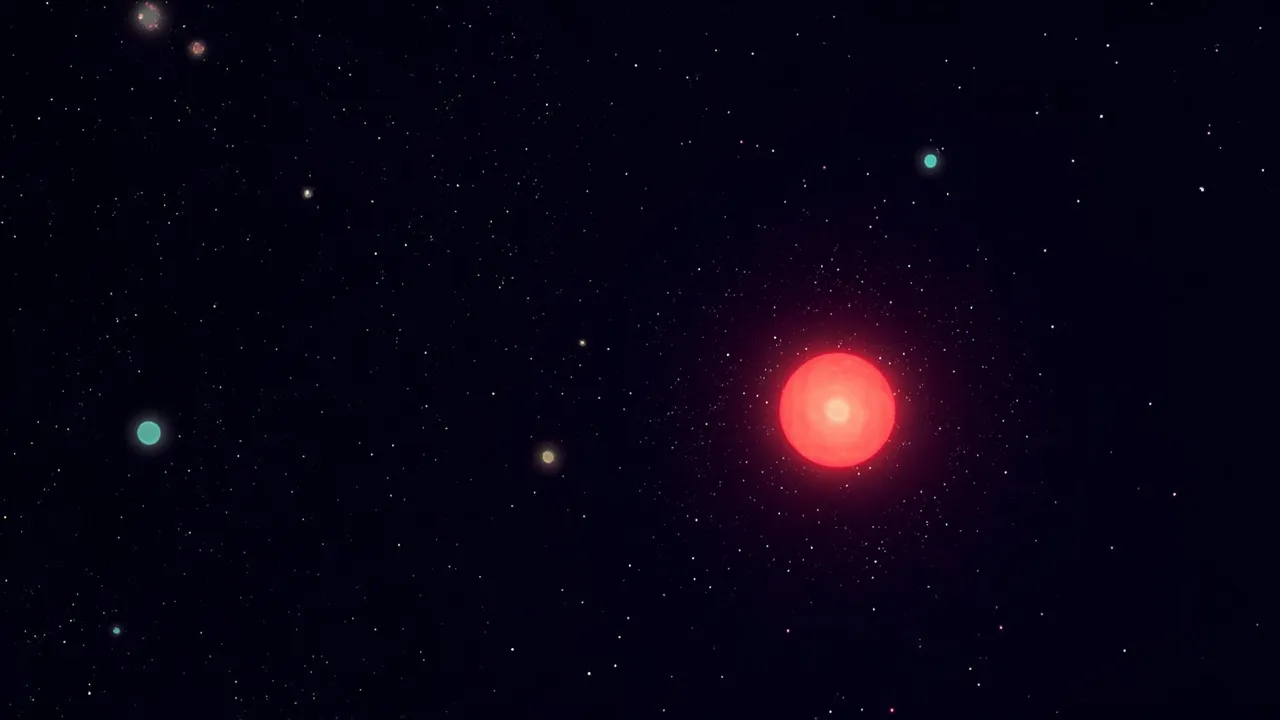
I mean, it already has a pretty dramatic future ahead of it. In a few billion years, our friendly yellow star will bloat up into something called a red giant—a massive, puffy version of itself that will probably swallow Mercury and Venus whole. Not exactly a peaceful retirement.
But now there's a new model from Caltech astrophysicist Jim Fuller that reveals something I never expected: when stars like our Sun die, they don't just slowly fade away. They essentially kick themselves through space. Thousands of times. Like they're trying to make a getaway.
Wait, Stars Kick Themselves?
Yep, you read that right. Let me break it down.
As a red giant ages, its outer layers stop being well-behaved. The material on the surface starts churning around chaotically, and sometimes chunks of it just... launch off into space. Think of it like solar burps, except each one sends the star itself in the opposite direction.
"Blobs of matter are chaotically being ejected from the surface of the bloated stars in an asymmetric fashion," Fuller explains. "And every time that happens, the star gets a little kick in the opposite direction."
You probably remember from high school physics: for every action, there's an equal and opposite reaction. It's the same principle here. The star spits out some material, and the star itself recoils.
The wild part? This happens roughly 10,000 times over several hundred thousand years. That's a LOT of tiny cosmic nudges.
The Slow Jog to Freedom
Now, here's where it gets funny. Each individual kick only moves the star at a few meters per second. Fuller helpfully notes that this is "a slow jogging pace for humans."
So picture our Sun, billions of years from now, just... casually jogging through the galaxy after every burp of stellar material. Not sprinting, not drifting majestically—just a gentle, determined shuffle through the cosmos.
If that image doesn't make you smile, I don't know what will.
The Coin Flip That Adds Up
Here's the really interesting mathematical bit (and yes, I'll keep it simple, I promise).
Each kick goes in a random direction. So you might think they'd cancel each other out, right? Like pushing someone left, then right, then left again—eventually they end up roughly where they started.
But Fuller calculated that this isn't quite what happens. It's similar to a concept called a random walk.
Think of it like this: if you flip a coin to decide which way to take a step—heads, step left; tails, step right—after many flips, you probably won't be exactly where you started. There might be a slight bias in one direction just by chance.
Over 10,000 random kicks, all those tiny movements add up to something significant. The combined effect could send a dying star drifting at about 1 kilometer per second. That's not fast by cosmic standards, but it's enough to matter.
Why Astronomers Actually Care About This
Now, here's where this becomes more than just a fun space fact. Astronomers have noticed something strange: binary star systems where one star has become a white dwarf are less common than they should be, especially the wide-spread ones.
Kareem El-Badry from Caltech found this pattern, and it puzzled him for years.
The new model offers an explanation. When a star gets these kicks after turning into a white dwarf, it can throw off its orbital dance with any companion star. If the kick speed exceeds the orbital speed of a wide binary pair, gravity can't hold them together anymore. They go their separate ways.
"It was nice to finally see a physical model that can explain this observation," El-Badry says. Honestly, I love that even scientists find satisfaction in finally understanding something that's been bothering them.
Could These Kicks Cause Stellar Car Crashes?
Here's where things get even more dramatic (and a little bit funnier).
According to the model, in some binary systems, all these repeated kicks to a dying red giant could eventually change its orbit enough that it crashes into its companion star. You know, like cosmic road rage.
Such a collision could potentially trigger an explosion. So not only do dying stars jog through space—they might also cause fender benders that go boom.
Astronomers are already thinking about how to look for evidence of these stellar mergers. If we find them, it would be a great confirmation that Fuller's model is on the right track.
What This Means for Us
I don't know about you, but I find this oddly comforting in a weird way.
Our Sun, that constant, unchanging presence in our sky, is eventually going to bloat, burp, and jog its way across the galaxy. It won't be here forever, and its death won't be this neat, tidy event we might imagine.
Instead, it'll be messy and chaotic—a star shuffling away from its own expanding corpse, thousands of tiny rejections of its former self, each one a tiny act of cosmic independence.
And someday, billions of years from now, wherever our Sun has jogged off to, it'll still be moving. Still in motion. Still part of the grand dance of the universe.
That, to me, is kind of beautiful.