
The Thing That Shouldn't Work (But Does)
Here's a wild fact: literally everything around you—your phone, your coffee cup, your actual body—is held together by a cosmic game of tug-of-war between different forces. The strong force glues particles together inside atoms, while electromagnetism keeps electrons orbiting the nucleus. They work as a team, like Batman and Robin, each doing their job to keep matter from falling apart.
But what if we removed one of them? What if we created something that only relied on the strong force?
For decades, physicists have wondered if this was even possible. Now, a team of researchers in Japan have actually done it—and the results are genuinely mind-bending.
The Quest for the Perfect Particle
The trick was finding the right ingredient. You can't just use regular atoms because their pieces—protons and electrons—are electrically charged. They're like magnets that want to interact. Everything gets attracted or repelled electromagnetically, whether you like it or not.
What you need is something with absolutely no electric charge. Something that can't participate in electromagnetic interactions at all.
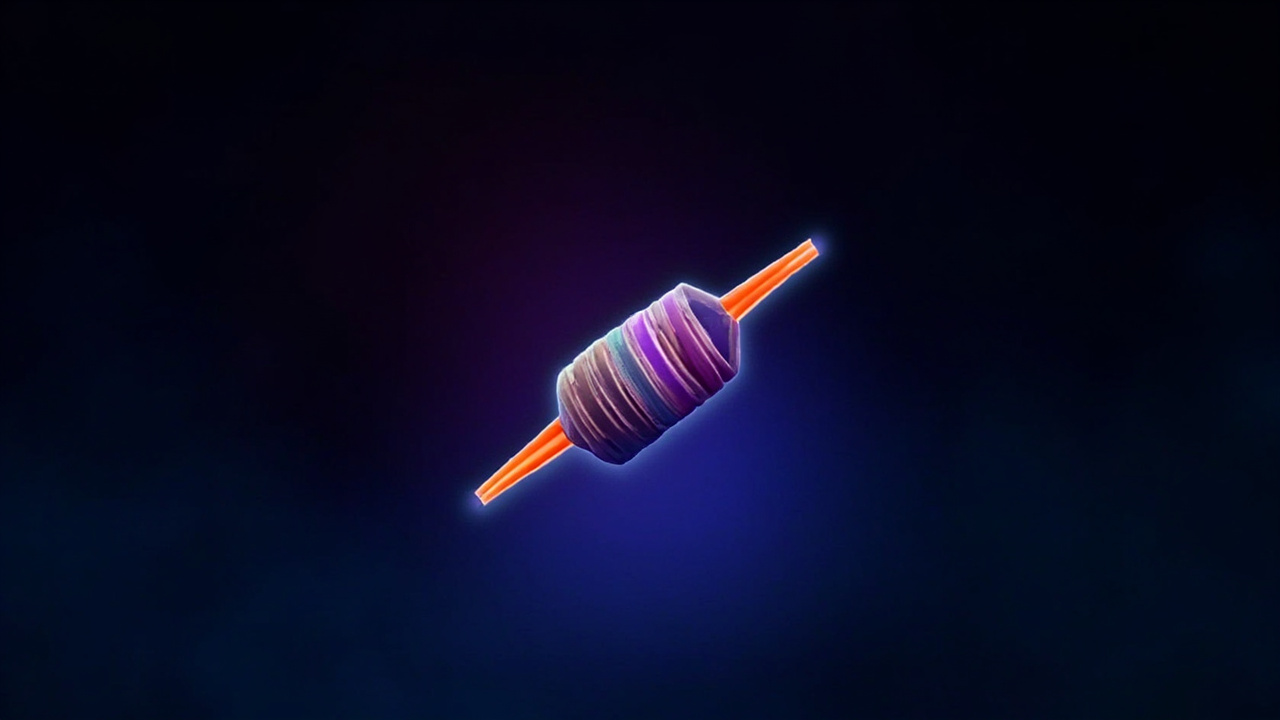
Enter the eta prime meson (written as η′, if you're into that sort of thing). This is a subatomic particle that's basically nature's perfect wallflower—completely neutral, electrically speaking. But here's the interesting part: it's weird heavy for a particle its size. Scientists have been scratching their heads about this for like 50 years.
The 50-Year-Old Mystery
Back in the 1970s, physicist Steven Weinberg noticed something that didn't add up. According to the simple math that should explain how heavy particles are, the eta prime meson shouldn't weigh as much as it does. It's like discovering that a golf ball weighs as much as a bowling ball—the numbers just don't match reality.
The explanation that physicists came up with involves something called "chiral symmetry breaking" (and yes, I know that sounds like science fiction). Think of it this way: some particles are like your hands—they have a "handedness" or orientation. When these symmetries break down inside nuclear matter, it actually creates extra mass. Like, a lot of extra mass. According to modern particle physics, this symmetry-breaking phenomenon is responsible for much of the eta prime's weight.
The mind-bending part? Scientists theorized that if you embed this particle inside a nucleus, its mass should actually decrease. It's like the particle loses weight in a different environment.
The Experiment Nobody Thought Would Work
The research team (led by folks from RIKEN in Japan) decided to test this prediction by doing something absolutely bananas: they smashed a proton beam at carbon-12 atoms traveling at a fraction of the speed of light.
Here's what happened: the protons knocked a neutron loose, which then stuck with a proton to form something stable and zoom away. This left behind a carbon-11 nucleus loaded with excess energy—basically the nuclear equivalent of throwing your friend in a pool and walking away.
That energy? Sometimes it creates an eta prime meson that sticks to the carbon-11 nucleus for the tiniest fraction of a second. We're talking about a thousandth of a trillionth of a trillionth of a second here. Catching one of these events is like trying to photograph a lightning bolt with a disposable camera.
Why This Matters More Than You'd Think
The team used a specialized detector called WASA to spot these fleeting interactions. The challenge? The background noise from other particle interactions was 100 to 1,000 times stronger than the actual signal. Imagine trying to hear someone whisper at a rock concert—that's basically what they were dealing with.
But they found it. The data showed signals that matched exactly what the theory predicted. The eta prime meson's mass dropped by about 60 megaelectronvolts inside the nucleus—solid confirmation that chiral symmetry breaking is real and responsible for particle mass.
What This Tells Us About Reality
Here's the big picture: this experiment is actually a window into why things have mass in the first place. See, most of the mass of ordinary matter doesn't come from the particles themselves—it comes from the energy of the forces holding them together. It's like saying a suitcase weighs more when it's full because of how tightly everything's packed in.
By studying how the eta prime meson's mass changes in different environments, physicists are learning how the vacuum itself—empty space—has structure and properties that contribute to mass. It's not just esoteric nerd stuff (okay, it kind of is, but hear me out)—understanding the fundamental nature of mass is part of solving some of the biggest mysteries in physics.
The Real Takeaway
What gets me about this discovery is how it proves that we still have so much to learn about the basic fabric of reality. Scientists made a prediction twenty years ago that seemed almost too exotic to test. Then someone actually tested it, found evidence, and confirmed the prediction.
That's how science works at its best—wild ideas become testable experiments become confirmed knowledge. It's honestly pretty cool that we live in a time when we can do stuff like this.
Plus, now physicists have a brand new tool for probing how forces work and how matter gets its properties. That means more discoveries are probably coming down the pipeline.
The universe continues to be weirder and more wonderful than we expect.