
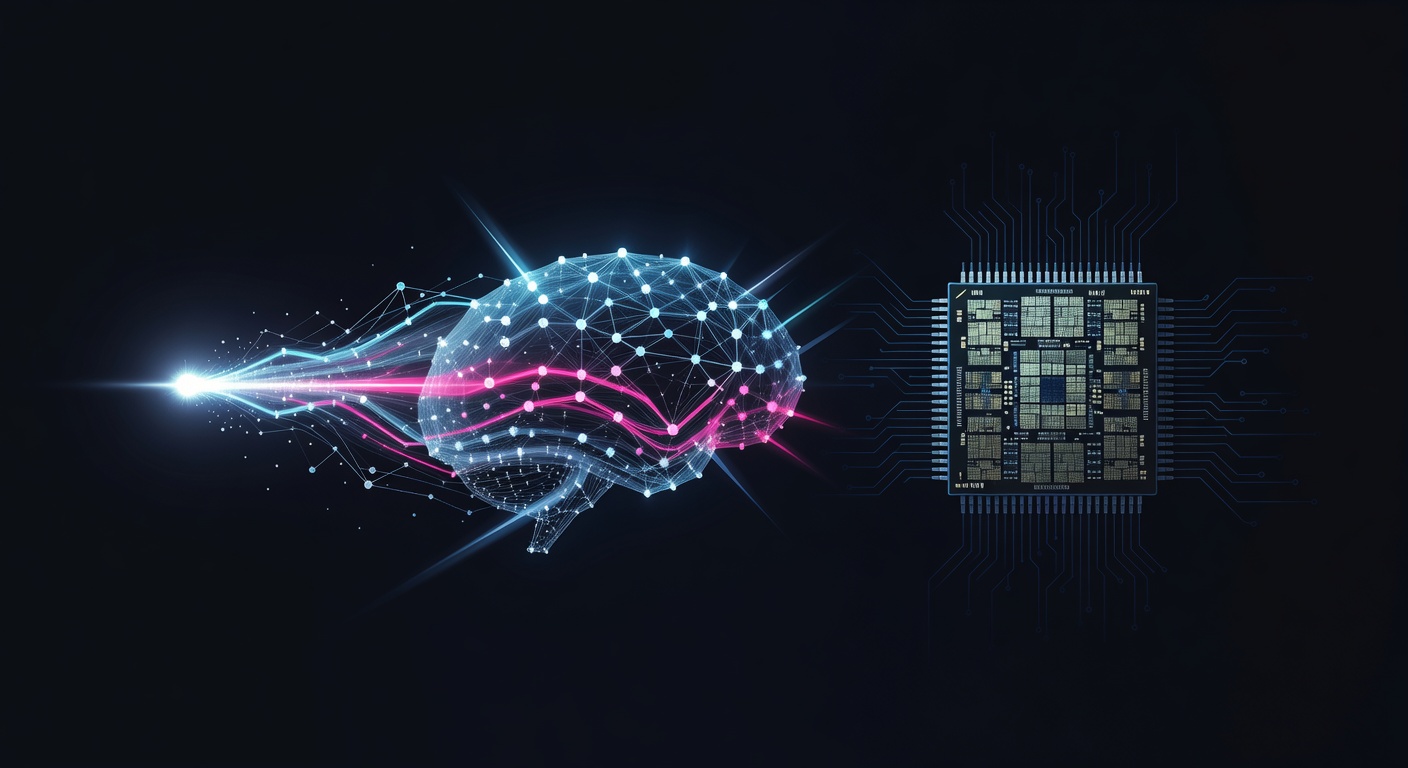
Racing Against Time: Can We Reach AI Singularity Before Moore's Law Dies?
The Magic of Moore's Law: From Prediction to Reality
Imagine predicting a tech trend that lasts decades beyond your wildest forecast. That's exactly what Gordon Moore did in 1965. As a co-founder of Intel, he observed that the number of transistors on a computer chip—the tiny switches that power all our gadgets—doubled roughly every two years. He graphed it as a 10-year trend, but "Moore's Law" became a self-fulfilling prophecy, fueling everything from smartphones to supercomputers for over 50 years.
This relentless shrinkage turned clunky room-sized computers into pocket powerhouses. But physics has limits. Transistors can't shrink forever; at atomic scales (we're talking nanometers now), quantum effects make them unreliable, hard to manufacture, and pricey. Intel's jump from 14nm to 10nm chips took five years instead of two, signaling the slowdown. Experts like MIT's Charles Leiserson declared Moore's Law "over" by 2016.
(Conceptual graph showing transistor density plateauing—source: adapted from industry data)
The Singularity Dream: AGI and the Godlike AI Horizon
Enter the futurists. They chase the "technological singularity"—the point where AI surpasses human intelligence, sparking runaway progress. Think AGI: an AI that thinks, creates, and innovates like a supercharged human brain backed by a billion computers. Boosters like OpenAI's Sam Altman promise it'll revolutionize work, cure diseases, and more.
But here's the catch: this needs insane computing power. The human brain runs at an exaflop (1 quintillion operations per second) on just 20 watts—like powering dozens of brains from one wall outlet. Today's top supercomputer, Frontier, guzzles a million times more energy for the same flops. Scale that to singularity levels? We're talking data centers the size of cities, drowning in heat and electricity demands.
Why No Quick Fix? Physics Bites Back
Companies are scaling up massive chips and optimizing efficiency, but it's a band-aid. Long-term? Zilch is ready:
- Nuclear Fusion: Hyped as unlimited clean energy, but it's decades away—no reactor has net-positive output yet.
- Quantum Computing: Exciting for specific problems, but it needs near-absolute-zero cooling and hand-assembly with "atomic tweezers." Consumer versions? Dream on.
- Dyson Spheres: Sam Altman's wild idea to enclose the Sun for stellar power. Pure sci-fi; we'd need to dismantle planets for materials. Meanwhile, 750 million people lack basic electricity.
| Paradigm | Promise | Reality Check | Timeline |
|---|---|---|---|
| Moore's Law | Double power every 2 years | Hitting atomic limits | Ended ~2016 |
| Nuclear Fusion | Infinite energy | No net gain yet | 10-30+ years |
| Quantum Computing | Exponential speedups | Lab-only, ultra-fragile | 10-20+ years |
| Dyson Spheres | Star-harvesting | Science fiction | Centuries? |
The Kardashev scale envisions planet-sized computers, but that's thought experiment, not engineering roadmap.
Brains vs. Bits: Why Raw Power Isn't Enough
Even if we built exaflop monsters, would they spark consciousness? Computers are predictable: slow it down, and you can trace every bit. Brains? A chaotic symphony of neurons weaving senses, emotions, memories, and context. Seeing a friend's face triggers instant facial recognition, emotional hits, and a wave—shaped by your life's unique wiring.
We don't fully get it. Antidepressants "work," but why? A poem or light slant can unlock buried memories unpredictably. AI mimics patterns from data but can't invent true unknowns, like chemist Mas Subramanian's YInMn Blue pigment. His AI spat molecule lists, but humans vetted them—machines excel at brute-force testing, not breakthroughs from "nothing."
(Brain efficiency dwarfs machines—NIST data)
Hype vs. Reality: Sorting AI Sales Pitches from Science
Venture capital pours billions into "singularity stocks," mandating AI at work. But experts like Murray Shanahan caution: LLMs aren't "thinking" like us—they're statistical parrots. Beware anthropomorphism. True AGI? Likely decades off, amid real crises like energy shortages and climate change.
Moore's Law's "end" is a wake-up call. It forces innovation beyond shrinkage—think specialized chips (GPUs for AI) or neuromorphic designs mimicking brains. But singularity salesmen promising god-AI tomorrow? That's The Music Man hawking trombones as symphony tickets.
The race is on, but physics doesn't rush. Let's invest wisely, not in sci-fi spheres, but in grounded tech that powers real progress.
Source: Popular Mechanics - The Race to Achieve the Singularity Before Moore’s Law Runs Out