
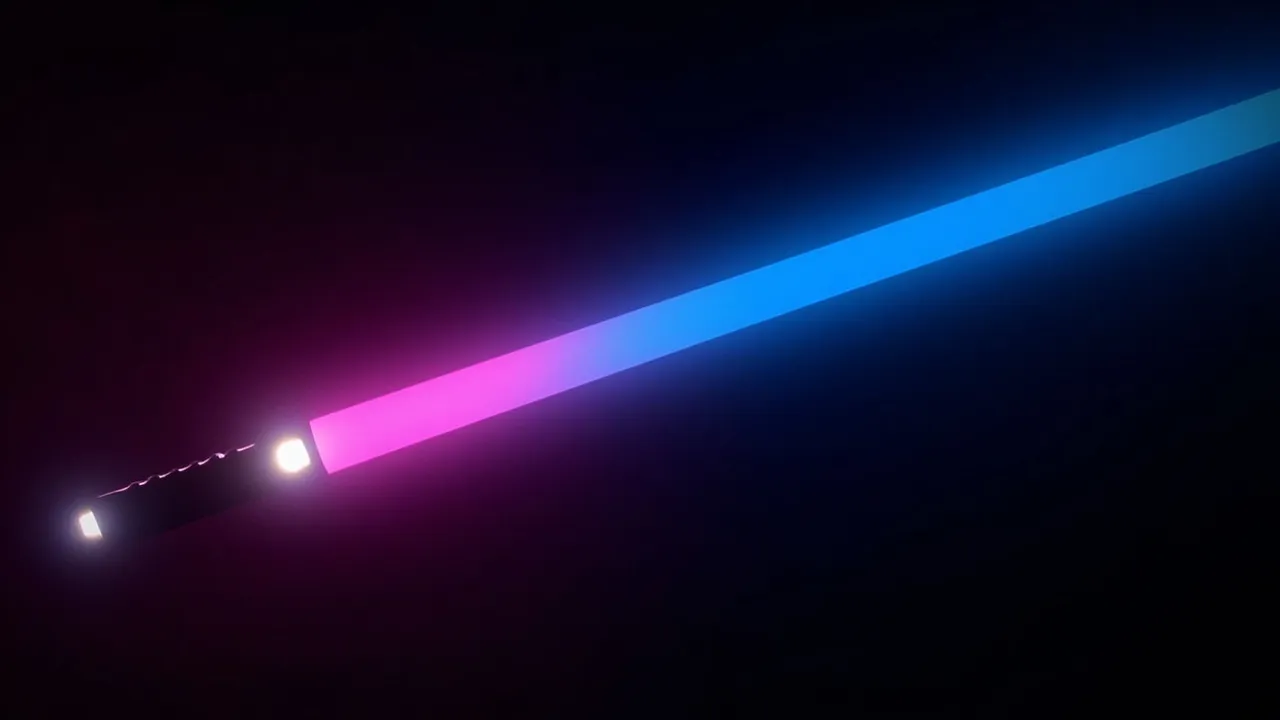
Okay, I know what you're thinking. "Lightsaber antenna" sounds like something a scientist came up with at 3 AM after watching too much sci-fi. But here's the thing — this is real, it's happening in a lab right now, and it could completely change how we think about wireless communication.
So What's the Big Deal About Antennas, Anyway?
Let me break this down. You've probably seen those old-school TV antennas on rooftops or those rabbit-ear things people used to struggle with. Those antennas work because their physical size determines what frequencies they can pick up. Want to tune to a different station? You'd need to physically change the antenna's length or structure. It's like trying to play different musical notes with a guitar that can only produce one sound unless you completely swap out the strings.
This becomes a massive headache in applications like space exploration. You can't exactly pull over on the side of the asteroid belt to adjust your equipment. Everything needs to be compact, lightweight, and — here's the tricky part — adaptable.
Enter the Plasma Antenna
The research team at NC State figured out something pretty ingenious. Instead of using metal structures that you have to physically manipulate, why not create the antenna out of thin air?
Here's how it works: They fire a laser through the air and carefully control its power and beam diameter. This ionizes the air — basically stripping electrons from atoms and molecules — which creates something called plasma. Plasma is often called the fourth state of matter (after solids, liquids, and gases), and it's got some pretty interesting properties, including the ability to interact with electromagnetic fields.
The result is a thin, concentrated channel of plasma that looks remarkably like a lightsaber blade. No, seriously — the photos from the lab look like someone pulled a prop from a movie set.
The Tricky Part: How Do You Feed It?
Creating a glowing plasma beam was only half the battle, though. To actually transmit radio waves, the team needed a way to deliver an electrical signal to the plasma — but without any physical connection. (That kind of defeats the purpose of having a wireless, flexible antenna, right?)
Their solution was pretty clever: a metal ring that acts as a capacitor. The laser passes through the center of this ring, creating a plasma filament that extends through the capacitor's electromagnetic field. When a radio frequency signal enters the capacitor, it transfers energy to the plasma, which then broadcasts radio waves at that frequency.
The researchers successfully demonstrated transmission at 30 megahertz — firmly in the VHF (very high frequency) radio band. Not bad for something made of air and light!
Why This Gets Me Excited
Here's where things get really interesting. Because this antenna is created by a laser rather than built from fixed metal parts, its dimensions can be adjusted on the fly. Want a longer antenna to pick up lower frequencies? Just adjust the laser settings. Need to point the antenna in a different direction? Steer the laser beam.
No moving parts. No mechanical complexity. Just light shaping the very fabric of your communication system.
One of the researchers, Ph.D. student Prya Darshni, put it this way: this could allow for "a customized antenna without complex mechanical deployment mechanisms." For applications like space exploration, where every gram matters and reliability is everything, that's a game-changer.
What This Means for the Future
Now, let's not get ahead of ourselves. This technology is still in the early experimental stages. The researchers haven't yet demonstrated that the plasma antenna can receive radio signals (though they see no reason why it wouldn't work). And there's plenty of engineering work ahead before we see lightsaber antennas on satellites or in your next smartphone.
But the concept is proven. For the first time, scientists have shown that you can create a functional radio antenna from laser-induced plasma — one that can be tuned, aimed, and reconfigured without touching a single mechanical component.
And honestly? Even if this specific application takes years to mature, I love that we're living in an era where scientists can legitimately say they built a lightsaber. The future is weird and wonderful, and I can't wait to see where this goes.
Source: ScienceDaily — https://www.sciencedaily.com/releases/2026/10/261008005239.htm