
Have you ever looked up at the night sky and wondered how any of this — us, the trees, your morning coffee — actually came to exist? I know I have. And honestly, it's the kind of question that can keep you up at night if you think about it too long.
Well, here's something that might blow your mind: a graduate student just recreated a piece of the universe inside a bottle. In a lab. In Sydney, Australia.
Linda Losurdo, a PhD candidate in physics, figured out how to make cosmic dust — the stuff that drifts through space and gets preserved in comets and meteorites — by zapping some gases with 10,000 volts of electricity. Yeah, you read that right. She basically recreated stellar chemistry on Earth, and it might be a game-changer for understanding where life comes from.
So What Exactly Is Cosmic Dust?
Before we get too deep, let's talk about what cosmic dust actually is. Imagine tiny particles floating around in space — they're made of carbon, hydrogen, oxygen, and nitrogen (scientists call these "CHON" molecules, because apparently scientists love acronyms).
These little particles aren't just random space junk. They're believed to be the building blocks for more complex organic molecules — the kind that eventually could become the stuff of life. And they're found everywhere: in comets, asteroids, meteorites, and the clouds of gas and dust where new stars are born.
The problem is, studying cosmic dust in space is incredibly hard. We can't exactly pop over to a supernova and collect samples. We have to wait for space rocks to fall to Earth, and even then, analyzing them is like trying to read a book that's been through a blender.
Building a Universe in a Bottle
Here's where Losurdo's research gets absolutely fascinating. Instead of waiting for cosmic dust to land on Earth, she created it herself.
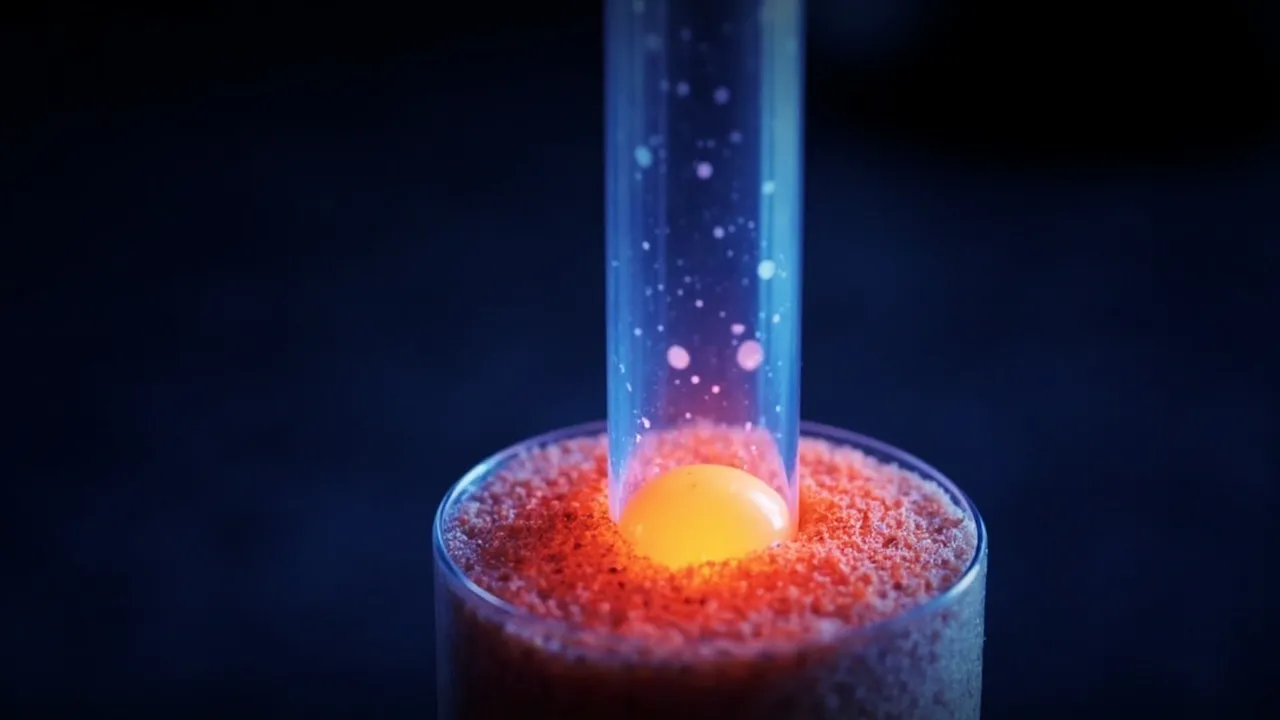
She put some nitrogen, carbon dioxide, and acetylene gas into a glass tube — the kind you'd probably see in a chemistry classroom. Then she used a vacuum pump to remove most of the air, creating conditions similar to the near-vacuum of space.
For about an hour, she hit that gas mixture with roughly 10,000 volts of electrical charge. The energy was so intense that it broke the original molecules apart, and their pieces recombined into bigger, more complex structures. Eventually, the newly formed dust settled onto silicon chips inside the tube.
The result? Carbon-rich dust with the same chemical signatures found in actual interstellar material. When Losurdo analyzed her creation using infrared light — the same technique astronomers use to study distant cosmic dust — the fingerprints matched.
"It's like we have recreated a little bit of the Universe in a bottle in our lab," she said. And honestly, I love that quote. There's something almost poetic about it.
Why This Matters for Understanding Life
Now, you might be thinking: "Cool science experiment, but why should I care?"
Here's why this is a big deal. One of science's biggest mysteries is how life got started on Earth. Did the first organic molecules form on our young planet? Were they delivered by comets and meteorites? Or some combination of both?
The answer matters because it tells us something fundamental about our place in the cosmos. Are we a lucky accident, or is the chemistry for life written into the universe itself?
Losurdo's research suggests it's probably the latter. If cosmic dust containing life's essential ingredients can form in the plasma expelled by dying stars and in the cosmic nurseries where new stars are born, then the raw materials for life aren't rare or special — they're everywhere.
Professor David McKenzie, who supervised the research, put it another way: by creating cosmic dust in the lab, scientists can explore conditions that are simply impossible to examine directly in space. They can test how dust forms, what happens when it's bombarded by radiation, and how it evolves over billions of years.
This is basically building a fingerprint library for cosmic materials. When astronomers spot something interesting in a distant galaxy, they'll have reference samples to compare against. When a meteorite lands on Earth, they'll better understand the journey it took to get here.
The Bigger Picture
What I find most remarkable about this story is what it reveals about the nature of scientific discovery. We're not just passively waiting for the universe to reveal its secrets anymore. We're actively recreating its processes, testing its chemistry, and building our own tiny universes to understand the big one we live in.
A PhD student with some glass tubes, a vacuum pump, and a lot of electrical charge just made something that mimics material formed near dying stars. That's not science fiction — that's happening right now, in a lab in Sydney.
And honestly? It makes me pretty optimistic about what we might figure out next.
Source: https://www.sciencedaily.com/releases/2026/07/260718010156.htm