
Okay, I need you to picture this with me.
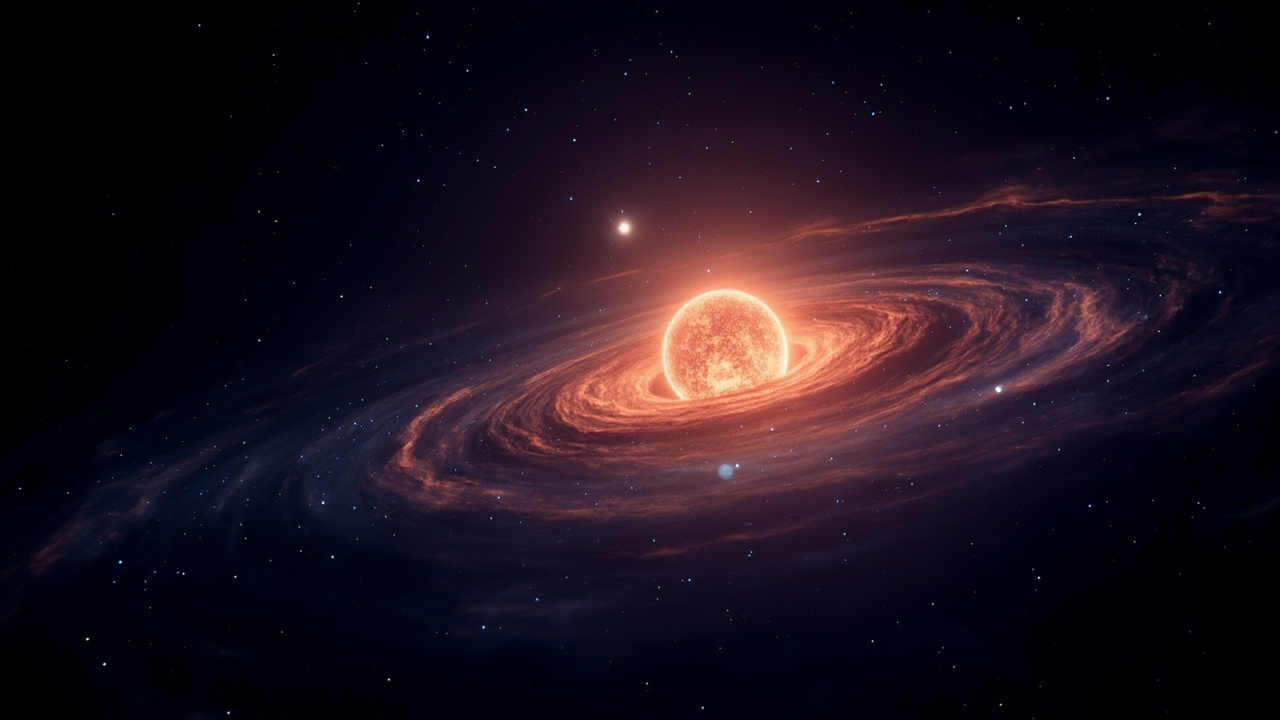
Somewhere out there, about a billion light-years from Earth, a massive star has just finished its life. Its iron core has collapsed, and it's now spinning wildly — over 1,000 times per second — while somehow not becoming a black hole. Instead, it's birthed something absolutely wild: a magnetar.
And for the first time ever, scientists watched it happen.
I don't know about you, but I find this absolutely bonkers. We've known magnetars existed for decades, but nobody had ever actually seen one being born. It was like knowing elephants exist but never witnessing an elephant being born. Well, our cosmic zoo just got a lot more interesting.
So What Exactly IS a Magnetar?
Let me break this down in friendly terms. A magnetar is essentially a neutron star — the collapsed core of a dead massive star — but on absolutely insane steroids. These things are only about 10 miles across, but they're so impossibly dense that a teaspoon of magnetar material would weigh about as much as a mountain.
The real party trick, though, is their magnetic field. We're talking 100 to 1,000 times stronger than a regular pulsar. If one of these things passed by Earth at about halfway to the Moon, it would completely scramble every piece of technology on our planet. Every. Single. One. No pressure!
And they spin fast. Really fast. Like, over a thousand rotations per second fast. When you combine that rapid rotation with an impossibly strong magnetic field, you get charged particles being flung outward at tremendous speeds.
The Mystery That Baffled Scientists
Here's where things get juicy. For about two decades, astronomers kept spotting something weird in space: super-bright supernovae called "superluminous supernovae" that were shining 10 times brighter than regular supernovae and staying bright way longer than they should.
Scientists were scratching their heads. How do these explosions stay so bright for so long after the initial blast? The standard physics just didn't add up.
Back in 2010, a physicist named Dan Kasen proposed something clever: what if there's a newborn magnetar hiding inside these explosions? Its spinning magnetic field would keep pumping energy into the debris, essentially keeping the explosion "lit" like a slow-burning fuse.
It was a beautiful theory. The only problem? Nobody could prove it actually happened. It was like having a recipe for the perfect cake but never actually seeing anyone bake it.
Enter SN 2024afiv
In December 2024, astronomers spotted something new: a supernova about a billion light-years away. The Las Cumbres Observatory — which is actually a network of 27 telescopes scattered around the globe — kept their eyes on it for more than 200 days.
Graduate student Joseph Farah was studying this explosion (he's about to become Dr. Farah, by the way, which is pretty good timing) and noticed something peculiar. After the supernova hit peak brightness around 50 days after the explosion, it didn't fade away smoothly. Instead, it kept flickering and pulsing in a very specific pattern.
Here's the cool part: the time between these fluctuations kept getting shorter and shorter, creating four distinct "bumps" in the light pattern. Farah compared it to the rising pitch of a bird's chirp — and that's literally what scientists started calling it: the "chirp."
Now, earlier super-bright supernovae had shown one or two of these bumps before, but four? That was unprecedented.
Einstein to the Rescue
Here's where things get genuinely exciting. When Farah and his team modeled what was happening, they realized Einstein's theory of general relativity had predicted something called "Lense-Thirring precession."
I know, I know — that sounds like something from a sci-fi movie. But stick with me.
Imagine you have a spinning top. As it spins, it wobbles slightly because of Earth's gravitational pull. Now imagine the top is a magnetar, and the wobble is happening in the fabric of space-time itself. Because the magnetar spins so incredibly fast, it literally drags space-time around with it like a dancer spinning on a turntable.
So when material from the explosion falls back toward the magnetar, it forms a tilted disk. Because of Einstein's relativity, that tilted disk wobbles like crazy. And that wobble is what we see as the "chirp" in the supernova's light.
It's not just evidence that a magnetar formed. It's proof that general relativity works in extreme environments we've never tested before.
Why This Matters
Look, I know this might seem like "just" scientists celebrating more science, but hear me out. This is actually a big deal for a few reasons:
First, it confirms that the universe's most powerful magnetic objects can form from stellar explosions. We've had the theory for nearly two decades, and now we have actual observational proof.
Second, it validates that Einstein's predictions about general relativity extend even to the most extreme environments in the universe. The man figured this out in 1915, and we're still finding new ways to confirm he was right.
Third — and this is the part that gets me — we're getting better at watching the universe change in real-time. A few decades ago, we could only photograph static snapshots of cosmic events. Now we're literally watching stellar explosions evolve over months and seeing details we never imagined.
UC Berkeley's Alex Filippenko, who's been studying supernovae for decades and is one of the researchers on this project, put it well: "What had not been demonstrated was that a magnetar did in fact form in the middle of the supernova, and that's what Joseph's paper shows."
Dan Kasen, the theoretical astrophysicist whose 2010 paper basically predicted this, had a poetic way of describing it too: "The chirp in this supernova signal is like that engine pulling back the curtain and revealing that it's really there."
The Bottom Line
We're living in an incredible time for astronomy. We're not just cataloging what's out there anymore — we're watching the universe's most dramatic events unfold and actually understanding the physics behind them.
So the next time someone tells you science is just boring number-crunching, tell them about the cosmic baby monitor that just caught a magnetar being born a billion light-years away. And tell them Einstein called it again.
Sometimes the universe is just cooler than we can make up.