
The Great Fusion Mystery
Imagine you're trying to build the most powerful energy machine on Earth, but something keeps not adding up. That's basically where fusion scientists have been for years.
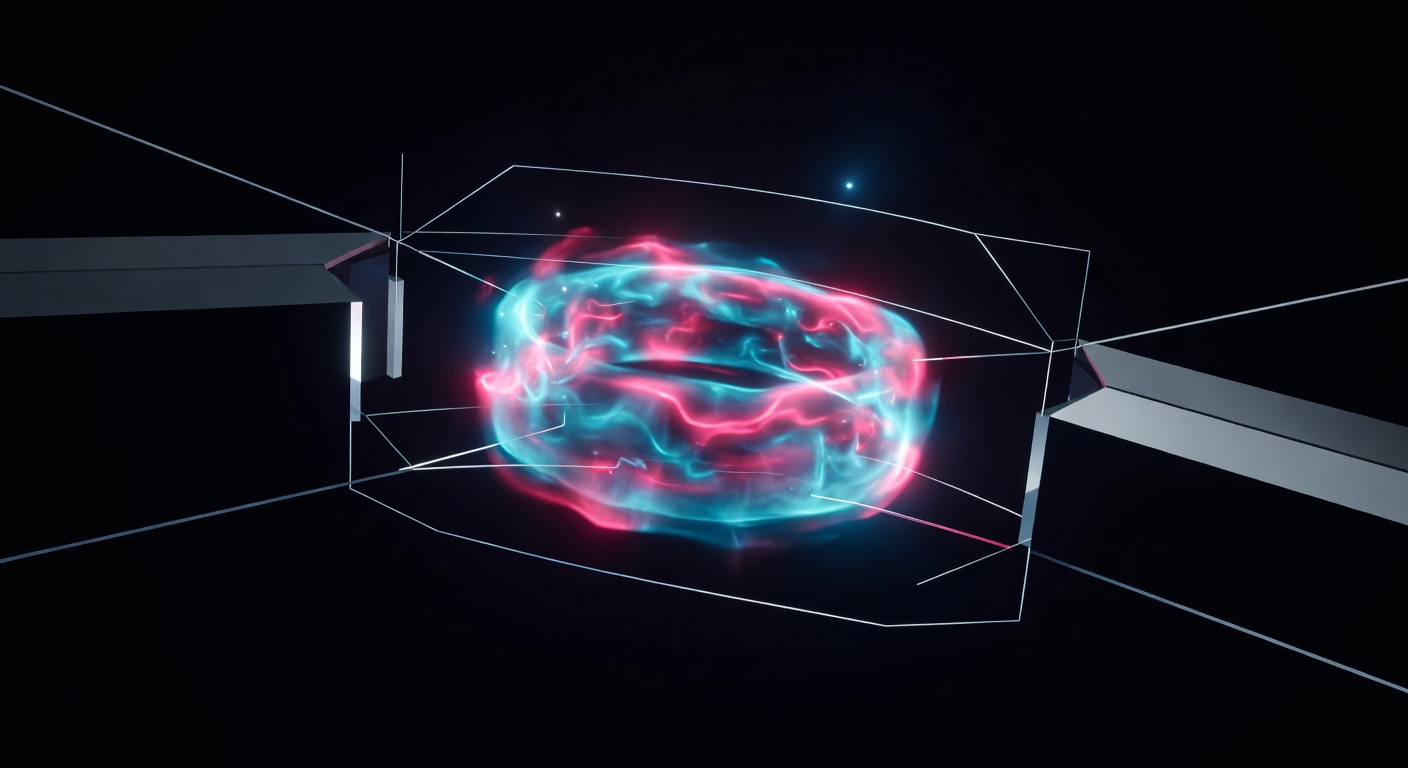
Inside tokamaks—those awesome doughnut-shaped devices designed to harness the power of atomic fusion—researchers heat plasma to insanely hot temperatures and use magnetic fields to keep it contained. Eventually, particles escape from the core and head toward the exhaust system (called the divertor). When they hit the metal plates there, they cool down and bounce back, which actually helps fuel the whole fusion process.
Sounds logical, right? But here's where it gets weird.
The Problem Nobody Could Solve
Experiments kept showing something strange: way more particles were smashing into the inner divertor target than the outer one. Like, significantly more. It was this consistent, stubborn imbalance that nobody could fully explain.
Now, you might think "so what?" But here's why this matters: if engineers don't know exactly where particles will land and concentrate their heat, they can't design divertors tough enough to handle it. And if your divertor falls apart, well, your fancy fusion reactor becomes a very expensive paperweight.
The leading theory at the time blamed something called "cross-field drifts"—basically, particles wandering sideways across magnetic field lines. Sounds reasonable. But when scientists ran simulations based solely on this explanation, the numbers didn't match what they were actually seeing in real experiments. The models kept failing to reproduce reality. That's... not great when you're trying to design something.
The Missing Piece
Enter Eric Emdee and his team at Princeton Plasma Physics Laboratory. They had a hunch: what if the researchers were only looking at half the picture?
It turns out, plasma rotation—the way the entire hot plasma core spins around the tokamak like a cosmic carousel—was the missing ingredient. Not replacing the cross-field drift explanation, but working alongside it.
Using advanced modeling software called SOLPS-ITER, the team tested different scenarios. They ran simulations with just cross-field drifts, just plasma rotation, and then both together. The results were pretty conclusive: only when they included the measured rotation speed of the plasma (about 88.4 kilometers per second, if you're wondering) did their simulations actually match what was happening in real tokamaks.
Think of it like this: you're trying to predict where a spinning coin will land. If you only consider how it tumbles through the air, you miss something important. You also need to account for the table's spin. Both matter.
Why This Actually Changes Everything
Okay, so scientists figured out another factor. Cool, but so what?
Here's the thing: this discovery isn't just academic. It fundamentally changes how engineers will design future fusion reactors. Now that physicists understand both the sideways drift and the rotational flow that determine where particles end up, they can design exhaust systems that are actually ready for real-world conditions.
This means building divertors that can better withstand the intense heat and stress of concentrated particle bombardment. It means more efficient, more reliable reactors. It means we're moving fusion from "interesting science experiment" to "viable energy source."
The Big Picture
Fusion energy has always felt like the distant dream—cheap, clean, virtually unlimited power. But making that dream real requires solving a thousand technical puzzles, and many of them are exactly like this one. Some factor is hidden in plain sight, quietly affecting everything, until someone brilliant connects the dots.
This research shows that even when we think we understand something, nature can surprise us. And that's exactly the kind of curiosity and careful experimentation that's going to eventually get us to practical fusion power.
Pretty cool to think that a few physicists just took a major step toward powering our future with the energy of the stars.