
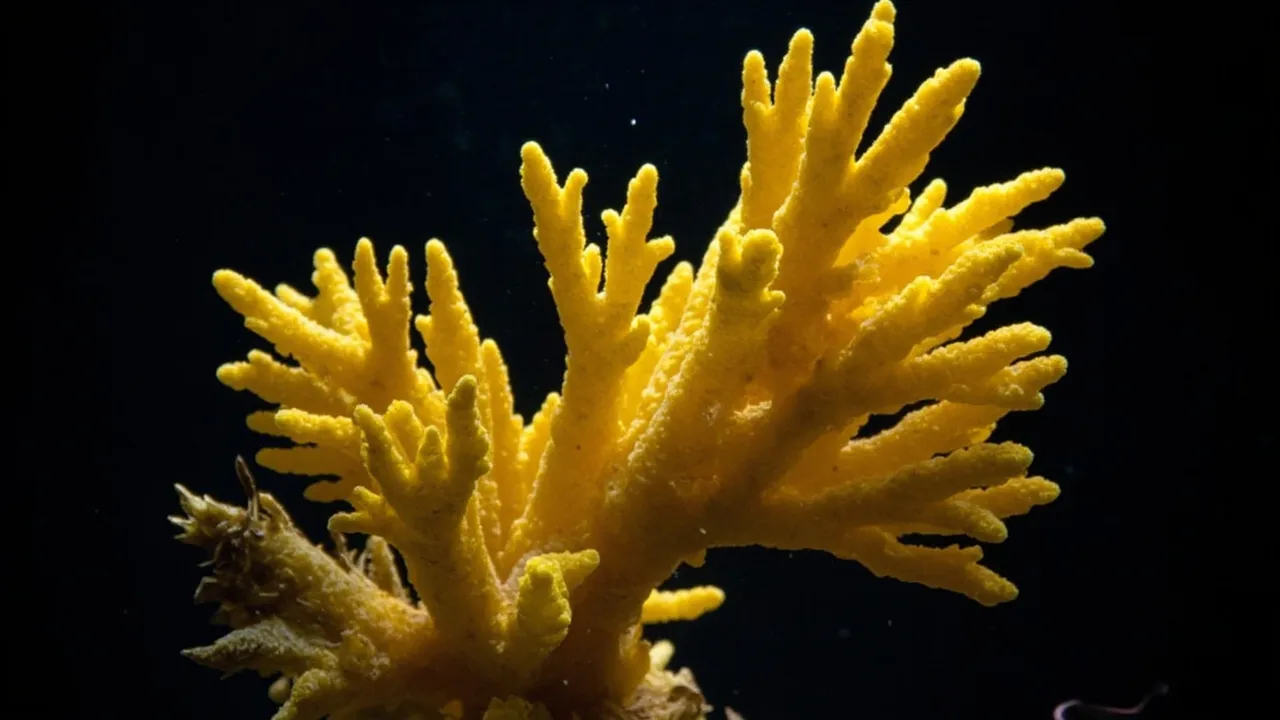
Picture this: You're diving deep underwater off the coast of Costa Rica, down around 360 to 530 meters below the surface. It's dark. Cold. You're surrounded by fields of brittle stars, those tiny starfish relatives that look like they're made of spun glass. Then, rising from the rocky seafloor like something from a dream, you see it — a brilliant golden, branching structure that looks exactly like a tiny glowing tree.
That's exactly what happened to researchers exploring underwater mountains near Isla del Coco. And honestly? I think they made the right call when they decided to name it after something from The Lord of the Rings.
Meet the Golden Tree Coral
The coral, now officially called Laurinque elenya, is a type of octocoral (corals with eight tentacles, if you're curious). Some colonies grow over a meter tall, which is pretty impressive when you consider they're sitting in the dark, cold depths of the Pacific with barely any light reaching them.
But here's what really got the scientists excited: when they tried to figure out where this coral fit in the coral family tree, things got weird.
They sequenced three genes that researchers typically use to identify and classify corals. You'd expect those genes to point toward the same family, right? Well, they didn't. Each gene suggested a completely different, unrelated family. That's like if you took a DNA test and got three different answers about your ancestry — each telling you your grandparents were from entirely different parts of the world.
The researchers had to bring out the big guns: phylogenomics, which compares hundreds of genes simultaneously. Finally, the data settled on an answer. This coral was so distinct that it needed not just a new genus (that's Laurinque) but an entirely new family — Laurinqueidae.
That's a pretty big deal, by the way. Creating a new family doesn't happen often. It means this coral is as different from other known corals as, say, cats are from dogs. In coral terms, that's enormous.
Why "Golden Tree" and "Stars"?
Now for my favorite part: the naming. The researchers could have gone with something boring like "New Yellow Coral Species #47." But no — they went full fantasy nerd, and I absolutely love them for it.
Laurinque comes from "Laurinquë," which means "golden tree" in Quenya, the Elvish language J.R.R. Tolkien created for Middle-earth. The species name elenya means "stellar" or "of the stars" — a reference to those dense fields of brittle stars surrounding the coral colonies.
So essentially, the official scientific name translates to something like "golden tree of the stars." And given how the coral literally looks like it's glowing in that star-covered underwater landscape, the name is honestly perfect.
Dr. Odalisca Breedy, who led the research, said she was "impressed by the beauty of the landscape" when she first saw it in 2019. She thought it might just be an unusual member of a known family, but after closer examination, she realized it was something entirely different — something she couldn't match with any known taxa.
I love that even experienced coral researchers can be genuinely surprised by what they find in the deep ocean.
The Deep Ocean Is Still Full of Mysteries
Here's something that really puts this discovery in perspective: we know more about the surface of Mars than we do about our own ocean floor. The deep sea covers roughly two-thirds of Earth, and we're still finding creatures and ecosystems that blow our minds.
This coral was found in coral gardens — vulnerable marine ecosystems with complex structures that provide homes for all sorts of other sea life. They're biodiversity hotspots in environments we rarely see. And Costa Rica's seamounts in particular seem to be treasure troves of undiscovered species.
The expeditions that found this coral were supported by the Schmidt Ocean Institute, using their remotely operated vehicle SuBastian. These research vessels — the Falkor and Falkor (too) — are doing the unglamorous but crucial work of exploring places humans can barely visit.
What This Means for Science (and Why You Should Care)
Beyond the cool name and the fantasy references, this discovery tells us something important: the deep ocean is still wild and unexplored. Every expedition seems to turn up something that rewrites our understanding of marine life.
These coral gardens matter too. They're not just pretty — they're ecosystems. They provide habitat, they support food chains, and they play roles in ocean health that we're only beginning to understand. When we protect places like these seamounts, we're protecting entire communities of creatures we haven't even named yet.
So the next time someone tells you we've discovered everything there is to discover about our planet, point them to Laurinque elenya — the golden tree of the stars, sitting quietly in the dark waters off Costa Rica, waiting for someone to finally notice it.
Sometimes the most magical things are right here on Earth, just hidden where we rarely look.
Source: ScienceDaily