
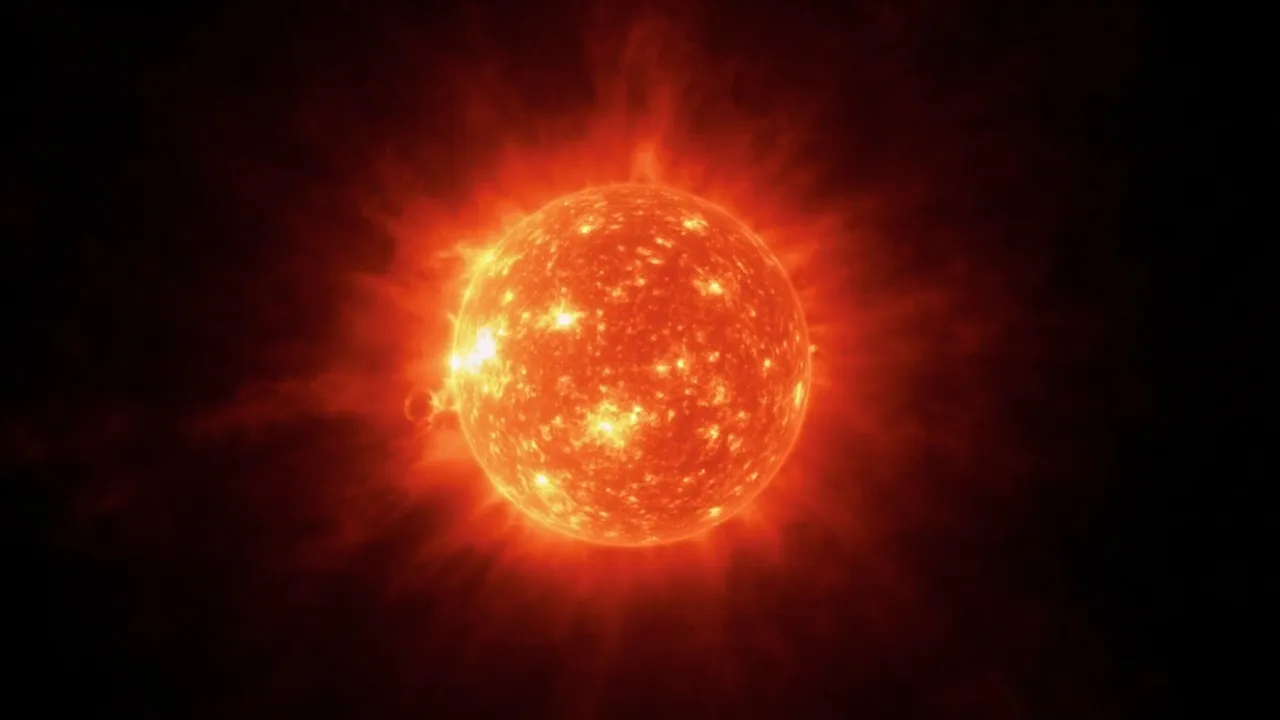
Okay, I need to tell you about something that genuinely excited me this week, and it's all about the Sun being a bit less unpredictable than we thought.
See, the Sun goes through these roughly 11-year cycles of activity — kind of like how some people have good days and bad days, except instead of skipping coffee, the Sun burps out massive explosions of radiation and charged particles that can mess with our satellites, GPS systems, and even power grids down here on Earth.
For a long time, scientists have been pretty bad at predicting how angry the Sun will get during any given cycle. Some cycles are mellow, producing maybe 100 sunspots at their peak. Others go absolutely wild with 200 or more. And honestly? We kind of just had to wait and see.
But here's the cool part.
A team led by Professor Sandra Chapman at the University of Warwick has found something unexpected. According to their research, the Sun doesn't slowly wind down from its most extreme behavior. Instead, it has what they're calling a "switch-off" point — a specific moment in each cycle where the most intense space weather abruptly ends.
Think of it like your chaotic uncle finally going to sleep at a party. There's no gradual fade-out. One moment he's telling the same story for the third time, and then... quiet.
So what's the big deal?
Well, the number of sunspots visible when the Sun hits this switch-off point actually tells scientists a lot about what's coming in the next cycle. It's like finding a weather vane hidden in the Sun's behavior that points toward future storms.
Using this technique, the team has already started making predictions about Solar Cycle 26 — the one that'll kick off after our current cycle finishes. Their early estimate? We're looking at something moderate, probably with a sunspot peak around 100 to 120. That would make it about as active as, or maybe even slightly weaker than, the cycle we're in right now (Cycle 25).
But here's what I find really fascinating: we won't know for certain until about two more years pass. That's when our current Cycle 25 should reach its own switch-off point, and scientists can base their Cycle 26 predictions on actual observations instead of estimates.
Why should you care?
Look, I know this sounds like something only astronomers lose sleep over. But space weather is increasingly important to our modern lives. Those solar storms can:
- Scramble satellite communications
- Throw off GPS navigation (imagine your Uber driver taking you to the wrong continent)
- Create voltage surges in power grids that could black out cities
Having a seven-year heads-up on how bad things might get? That's huge for anyone who needs to prepare infrastructure for potential disruptions.
And remember those amazing auroras from 2024?
You know those jaw-dropping northern lights sightings that happened across the UK and as far south as Devon and Cornwall? Those were partly because Cycle 25 turned out to be more active than many earlier predictions had suggested. Professor Chapman's earlier work using this same method actually called that stronger activity correctly.
The beautiful auroras we got to enjoy were, in a sense, a bonus from the Sun being a bit more feisty than expected.
The bigger picture
What's really exciting here isn't just the prediction aspect — it's what this tells us about how the Sun works. This switch-off point seems to coincide with when the magnetic field for the next cycle gets established. Understanding that timing could help scientists finally crack the code on the solar dynamo, the mysterious process that creates and maintains the Sun's magnetic field in the first place.
We're basically learning the Sun's rhythms, and that's pretty remarkable when you think about it.
So next time you check your phone's weather app or use GPS to find a restaurant, remember: somewhere out there, the Sun is going about its business, and we're getting better at knowing when it might decide to have a tantrum.
That's science doing what science does best — turning "we have no idea" into "we kind of see this coming."
Source: ScienceDaily