
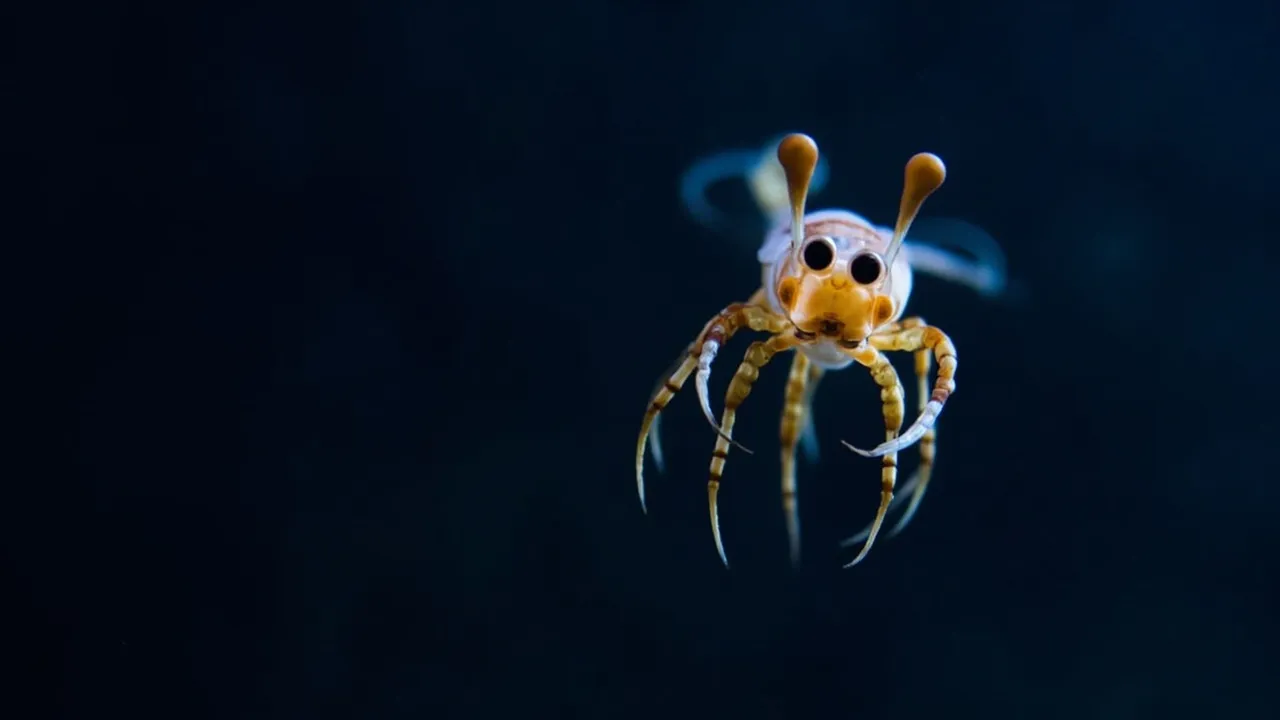
A Monster From the Abyss
Okay, I need to tell you about something that's been living rent-free in my brain since I read about it. Scientists have discovered a brand new species lurking in one of the most extreme environments on Earth — and this little guy looks like it was built in a horror movie.
I'm talking about Dulcibella camanchaca, a tiny predatory amphipod that was found chillin' (not chillin', actually — hunting, more like it) about 7,900 meters down in the Atacama Trench off the coast of South America. That's roughly 25,925 feet of water pressing down on this two-inch creature. The pressure there would crush most living things into paste, but D. camanchaca out here living its best life, molting and swimming like the abyss is no big deal.
What's So Special About This Little Guy?
Here's where it gets interesting. Most amphipods you might have heard of are scavengers — they kind of just float around waiting for dead stuff to drift down from above. Think of them as the cleanup crew of the deep sea. But D. camanchaca? This little predator has some equipment.
It has these oversized, grasping front limbs that work like spring-loaded claws. In most amphipods, those limbs are pretty unremarkable. In D. camanchaca, they dominate the animal's entire front end. The mouthparts are built for shredding, not filtering. This creature isn't waiting for a free meal to float by — it's actively hunting.
How cool (and slightly terrifying) is that?
The researchers who discovered it even named it "camanchaca" — a word from local indigenous languages meaning something like "the darkness of the deep." I love when scientists give creatures names that actually capture what they are instead of some unpronounceable Latin thing.
The Atacama Trench: Earth's Hidden World
Now, let me paint you a picture of where this creature lives. The Atacama Trench runs along the western edge of South America, stretching roughly 3,700 miles. It drops to depths of over 26,000 feet in some places. That's deep enough to be called the hadal zone — the name scientists give to the deepest, darkest parts of the ocean where sunlight literally cannot reach.
The water down there hovers just a few degrees above freezing. It's pitch black. The pressure would kill you instantly. And yet... life finds a way.
Scientists have been fascinated by these deep trenches for years. They're essentially isolated ecosystems — pockets of life cut off from other oceanic regions by thousands of miles of open ocean. And every time we look, we find something new.
The team that found D. camanchaca was from the Instituto Milenio de Oceanografía in Chile. They collected four specimens back in 2023 using a baited trap dropped to extreme depths. When they analyzed the DNA and physical characteristics of one of these tiny predators, they realized they'd found not just a new species, but potentially an entirely new genus. That's a pretty big deal.
Looking With New Eyes
Here's what really excites me about this story: in 2026, researchers went back with actual humans inside submersibles. The Joint China-Chile Atacama Trench Expedition sent a crewed submersible (named Fendouzhe, which means "Striver" in Chinese — I love that) down into the trench with scientists inside.
This is a game-changer. Previously, deep-sea research often meant dropping nets and traps and hoping for the best. But when you actually send people down there with cameras and robotic arms, you see things you never could before.
The expedition conducted more than 36 dives, surveying about 112 miles of seafloor. They brought back sediment cores, environmental DNA samples, and hours of video footage. According to the researchers, this represents the largest biological collection ever assembled from the Atacama Trench.
And here's what makes this even more significant: recent studies suggest that deep-sea creatures might not be as isolated as we thought. One study found the same species living in three widely separated trenches, and another catalogued similar communities across multiple hadal regions. So while the Atacama clearly has unique residents (like our friend D. camanchaca), these trenches might be more connected than we realized.
Why Should You Care?
I know what you're thinking — "Cool story, but why does this matter to me?"
Here's my take: we know more about the surface of Mars than we do about our own ocean floor. The deep sea is one of the last truly unexplored frontiers on Earth, and every expedition seems to reveal something completely unexpected.
These discoveries remind us that our planet is still full of surprises. D. camanchaca evolved to survive in one of the most extreme environments imaginable. Understanding how it does that could teach us things about biology, adaptation, and survival that we simply can't learn anywhere else.
Plus, honestly? I think there's something deeply humbling and wonderful about the fact that there are still creatures out there — right here on Earth — that we've never seen before. In a world that can sometimes feel completely mapped and catalogued, the deep ocean reminds us that mystery still exists.
So here's to the tiny predators of the abyss. May your spring-loaded claws serve you well in the eternal darkness.
Source: Popular Mechanics