
markdown formatted blog content
The Rocks That Are Actually Alive
Okay, I need you to picture this with me.
You're standing on the edge of Shark Bay in Western Australia — a place so remote that UNESCO had to step in and declare it a World Heritage site. The water is shallow and crystal clear. And right there at the shoreline, you see what look like lumpy, dark rocks poking up from the sand.
Boring, right?
Except these "rocks" aren't rocks at all. They're alive. They're breathing. They've been doing their thing for approximately three billion years.
These are stromatolites — and they're basically the oldest living communities on Earth.
For most of us, they'd be easy to walk right past. But for scientists, these unassuming blobs might just hold the secret to why you exist. Why anything complex exists, actually.
So What Exactly Are Stromatolites?
Think of stromatolites like apartment buildings — but instead of people, they're packed with billions of microbes all stacked in layers, cooperating to survive.
They showed up on Earth way before plants, animals, or anything with more than one cell. For the first couple billion years of life's existence, stromatolites were basically the only game in town. They churned out oxygen as a waste product, slowly transforming our planet's atmosphere into something that could eventually support more complex life.
Pretty impressive for something that looks like a lumpy rock at low tide, right?
The Plot Twist: They're Still Here
Here's what really gets me about stromatolites: they're not just fossils. They're not extinct. They still form today in places like Shark Bay.
That means scientists can actually go there, collect samples, and study living organisms that are remarkably similar to what existed billions of years ago. It's like having a direct window into Earth's distant past.
And recently, a team of researchers did exactly that — and what they found was remarkable.
A Match Made Billions of Years Ago
Associate Professor Brendan Burns and his team at UNSW Sydney, working with colleagues from the University of Technology Sydney and the University of Melbourne, were analyzing samples from Shark Bay when they stumbled onto something extraordinary.
They discovered a previously unknown microbe — specifically, a member of something called Asgard archaea — living in close association with another organism inside these ancient structures.
Now, Asgard archaea are kind of a big deal in the scientific world. These little creatures are believed to be extremely closely related to the ancestors of eukaryotes. Eukaryotes are the type of cells that make up every plant, every animal, every fungus on Earth — including us.
The mystery has always been: how did these relatively simple cells learn to cooperate and eventually become something as complex as a human being?
The Missing Piece
There's a popular theory in biology called endosymbiosis — the idea that the first complex cell came about when one organism essentially swallowed another, and they decided to stick together instead of one digesting the other. This partnership eventually produced mitochondria, the tiny power plants inside our cells that keep us running.
It's a beautiful theory. But here's the problem: scientists have never actually seen what that early partnership might have looked like.
Until now.
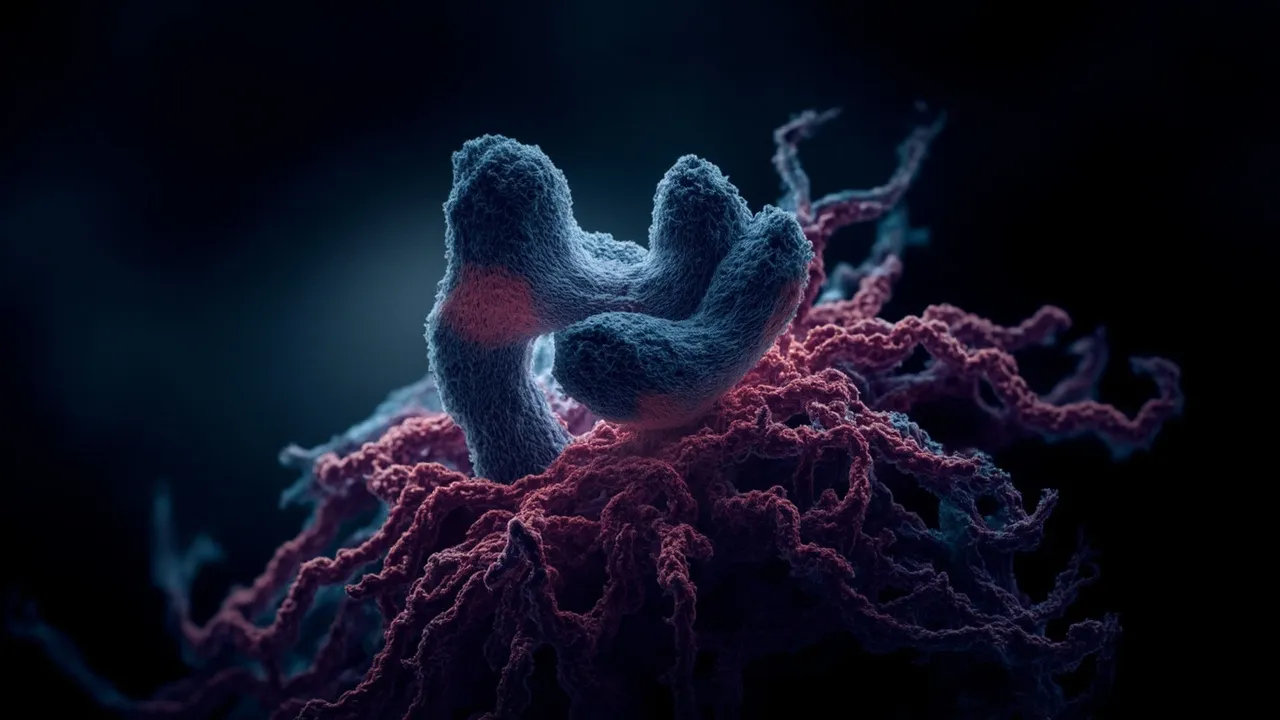
Using an incredibly powerful imaging technique called electron cryotomography (which can see things at the scale of a millionth of a millimeter — seriously), the researchers got the first-ever visual evidence of an Asgard archaeon physically connected to a bacterium through what look like tiny, tube-like bridges called nanotubes.
"It's if we have slowly, over billions of years, a conserved mechanism for how these partnerships form," said coauthor Associate Professor Iain Duggin.
They Help Each Other Survive
But the connection isn't just physical — it's chemical, too.
The images revealed that these two organisms appear to complement each other beautifully. The archaeon produces compounds that the bacterium can use. The bacterium produces compounds that the archaeon needs. They share vitamins, nutrients, even hydrogen. It's a microscopic teamwork dream.
This could be a little model for how these kinds of partnerships started and ultimately formed eukaryotes.
Let that sink in for a moment. What you're looking at might be a blueprint for the very thing that made complex life possible.
It Took Four Years Just to Find Them
Now here's something I find genuinely humbling: the researchers spent four to five years in the lab just trying to get these organisms to grow so they could study them directly.
Four years. Optimizing conditions. Chasing different approaches. As Professor Burns put it, "chasing different shadows."
Asgard archaea are notoriously finicky. They couldn't culture them on their own. And Professor Burns thinks that's actually meaningful — maybe these organisms never evolved to survive alone. Maybe partnership is baked into their very biology.
The Future of the Past
The team also used deep learning to predict the structures of proteins in these microbes. This allowed them to start seeing ancient versions of the cellular machinery that later became central to complex life.
In other words, they're not just studying these organisms — they're tracing the evolutionary roots of everything.
"This discovery brings us a few steps closer towards understanding how complex cells evolved from relatively simpler microbial life forms." — Associate Professor Debnath Ghosal
Why This Matters
Look, I know this might sound like the kind of science that only matters to people in lab coats. But here's why I find this genuinely thrilling:
We are eukaryotes. Every cell in your body — your brain cells, your heart cells, your skin cells — contains the legacy of an ancient partnership between two organisms that decided to work together billions of years ago.
And now, for the first time, scientists have caught a glimpse of what that partnership might have actually looked like.
It's happening right now, in shallow waters off the coast of Australia, inside structures that have been doing this for longer than multicellular life has existed.
The next time you look in the mirror, remember: you're looking at the descendants of a microbial match made three billion years ago. And thanks to research like this, we're finally starting to understand how that match was made.
Pretty incredible, right?
Source: ScienceDaily — https://www.sciencedaily.com/releases/2026/09/260902234514.htm