
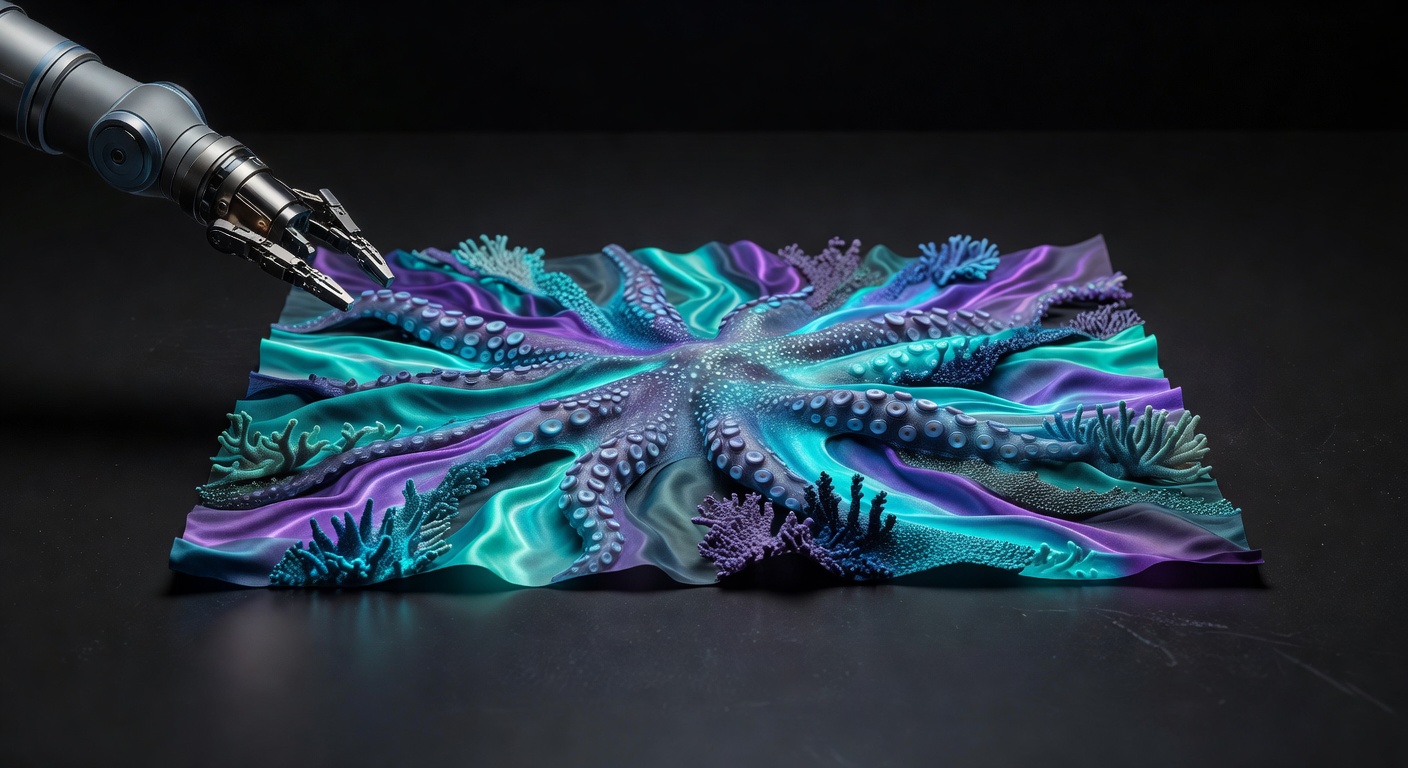
When Nature Inspires Science: The Octopus Problem That Stanford Just Solved
You know that moment when you're watching a nature documentary and an octopus transforms from bright red to sandy beige in like half a second? Yeah, scientists have been absolutely obsessed with figuring out how to pull that off artificially for ages. And honestly, I get it. The ability to change your appearance on demand? That's basically superpowers.
Well, the team at Stanford just cracked a major piece of the puzzle, and their solution is genuinely clever.
The Secret Ingredient: Water and Electrons
Here's where it gets interesting. The researchers didn't invent some crazy new material from scratch. Instead, they combined two existing technologies in a way that, frankly, seems obvious once you hear about it — but took real scientific creativity to figure out.
They took a flexible polymer film and blasted it with electron beams (the same technology used in computer chip manufacturing). Then they added water. Sounds simple, right? But here's the magic: the areas hit by the electron beam absorb water differently than the rest of the material. When water seeps in, those regions swell up at different rates, creating tiny surface features that pop up from the film.
The best part? It was basically accidental. One of the researchers, Siddharth Doshi, reused some old samples he'd examined under a scanning electron microscope, and noticed they were displaying new colors and textures. That "whoops, that's actually amazing" moment led to this entire breakthrough. Science is wild sometimes.
From Flat to 3D in Seconds
The precision here is genuinely mind-blowing. We're talking about controlling structures at scales smaller than a human hair. To show off just how precise they could get, the team created a microscopic replica of Yosemite's El Capitan. When dry? Completely flat. Add water? It pops up into a full 3D shape.
This isn't just a party trick, though. Because they can control how much the material swells, they can also control how it reflects light. Want a glossy finish? Done. Want matte? Easy. Want something that shimmers between colors as it expands and contracts? That's possible too.
And when you want it to go back to normal? Just hit it with a solvent and it flattens right back down. It's like a reset button.
The Real Game-Changer: Smart Camouflage
Here's where this gets genuinely exciting. The researchers can stack multiple layers of these films on top of each other, allowing them to independently control both color and texture. In theory, this material could blend into any background — kind of like octopus skin, but even cooler because you can fine-tune it.
Right now, they have to manually adjust the water and solvent levels to match a background. But the team is working on something way more ambitious: they want to add AI and computer vision systems that would let the material adjust itself in real time.
Picture this: you're wearing a jacket made of this stuff, and it's constantly analyzing the environment around you through a built-in camera, then automatically shifting its appearance to match. No manual tweaking needed. Self-camouflaging clothing. That's genuinely sci-fi-feeling, and it's not far away.
Beyond Camouflage: The Real Goldmine
Honestly, while the camouflage angle is the flashy headline, I think some of the other applications might be even more interesting.
Small robots could use this material to grip surfaces when they need traction, then switch to a slippery finish when they need to glide. Flexible displays for phones and wearables could actually change color and texture instead of just showing different images on a screen. At the nanoscale, these texture changes could even influence how cells behave, which opens up medical applications we're probably not even thinking of yet.
The researchers call this "an entirely new toolbox in the world of optics," and honestly, that's underselling it. We're talking about fundamentally new ways to control how light interacts with materials.
The Not-So-Secret Secret
What I really love about this story is that it demonstrates how often major breakthroughs come from combining existing technologies in new ways. Nobody invented a magical new material. They just figured out how to use electron beams and water in a clever way. It's elegant, and it's the kind of thing that, once explained, makes you think "wait, why didn't we think of that before?"
The octopus has been doing this for millions of years, and now we're finally catching up. The real question is: what else have we been missing while nature had the answers all along?