
Water Is Basically a Rebel Among Liquids
Let's be honest—water is weird. And I don't mean that in a casual way. I mean that if water were a student, it would be the one sitting alone at lunch, refusing to follow any of the rules that every other liquid follows.
Here's the thing: most liquids are predictable. Cool them down, and they shrink and get denser. That's just how physics works, right? But water? Water said "nah" to that plan.
When you freeze water, it expands. Ice floats. This shouldn't happen, but it does. And before water even gets cold enough to freeze, it's already doing weird stuff—like being densest at 4°C instead of 0°C. It's like water is deliberately trying to confuse everyone.
For over 100 years, scientists have been scratching their heads wondering: why is water like this? And now, they finally have an answer.
The Breakthrough That Took Ultra-Fast X-Rays to Discover
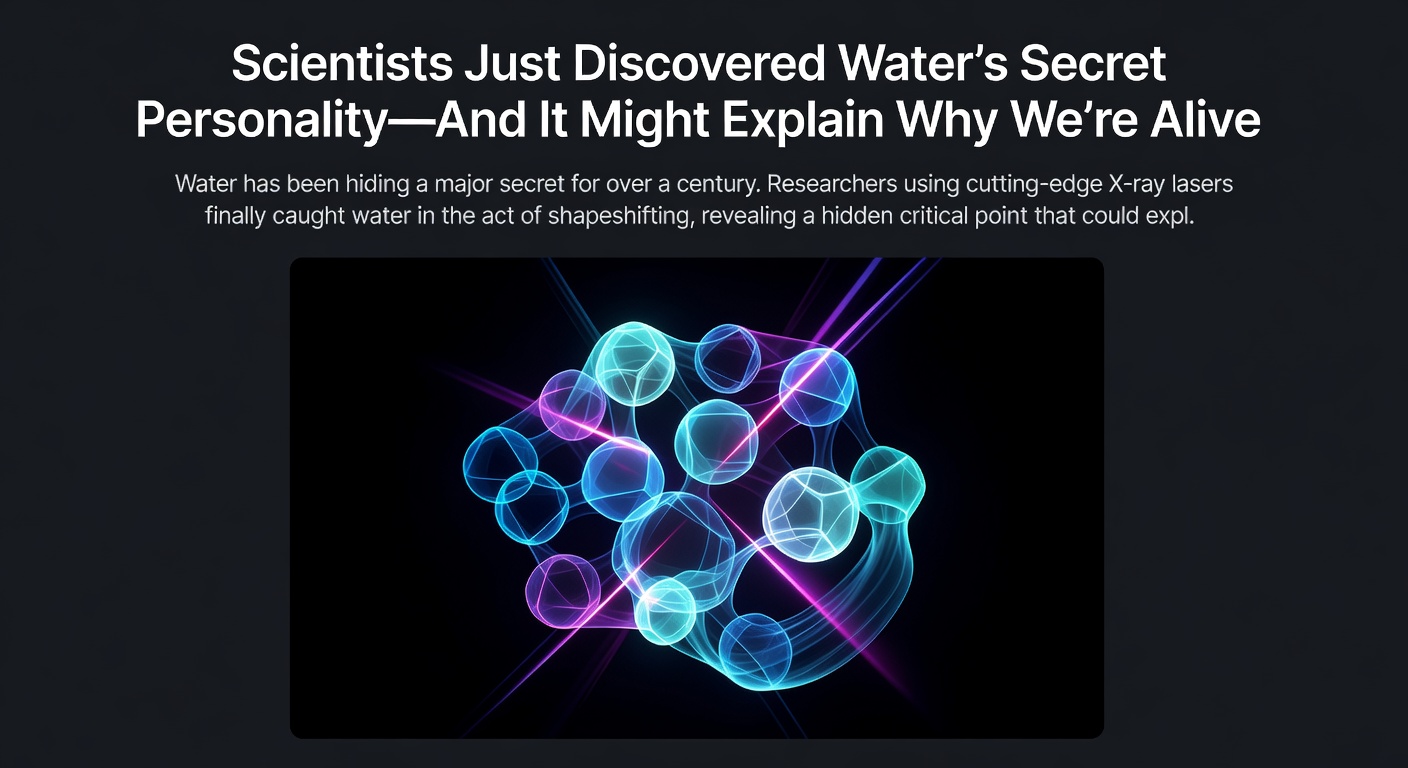
A team of researchers at Stockholm University just did something wild: they caught water in its supercooled state (we're talking about -63°C here—that's ridiculously cold) using incredibly fast X-ray pulses from lasers in South Korea. Think of it like using a super-high-speed camera to capture something happening in microseconds.
What they found was mind-blowing. Water has a hidden critical point—a moment where it essentially has two personality types that can coexist, and scientists have theorized about it for decades but could never actually see it.
One of the researchers, Robin Tyburski, described it in a way that's genuinely poetic: approaching this critical point is like trying to escape a black hole. Once the water gets near it, the molecular motion slows down dramatically, and you can't easily escape that gravitational pull.
Two Different Types of Liquid Water (Yes, Really)
Here's where it gets genuinely fascinating. At extremely low temperatures and high pressure, water can exist as two different liquid forms with different molecular structures. These aren't ice and liquid water—they're both liquid, just different versions.
Think of it like water has a Jekyll and Hyde situation going on. As conditions change, these two forms dance around each other, and at the critical point, they sort of merge together into one confused, chaotic state.
The wild part? These fluctuations between the two states don't just happen in extreme conditions. They're happening all around us, even at normal room temperature. Scientists believe these constant micro-shifts are what give water all its unusual properties.
So What Does This Actually Mean for Life?
Here's where it gets philosophical, and honestly, kind of beautiful.
One of the researchers, Fivos Perakis, asked a question that stuck with me: "Water is the only supercritical liquid that exists under normal conditions where life can actually thrive. And we know life can't exist without water. Is that a coincidence?"
Think about that for a second. Water's weirdness—the very properties that confused scientists for a century—might be the reason life exists at all. Maybe water's strange behavior at the molecular level is essential for biology to work.
This discovery suggests that water's odd properties aren't bugs in the system; they might be exactly the features that make chemistry and biology possible.
Why This Matters Going Forward
This isn't just a neat theoretical discovery that gets filed away in a physics journal. Understanding water at this fundamental level could help us understand:
- How life actually originated
- How biological processes work at the molecular level
- How climate systems behave
- How to predict and understand geological processes
- Maybe even the conditions necessary for life elsewhere in the universe
Scientists have basically been looking at water's behavior through a foggy lens for over 100 years. Now they've finally cleaned that lens, and the picture is much clearer.
The Real Takeaway
What I love about this story is that it reminds us that even the most common, everyday things around us still have secrets to tell. Water is literally everywhere. We drink it, bathe in it, and our bodies are mostly made of it. Yet scientists just discovered something fundamental about its behavior that we didn't know before.
And the cool part? This discovery required international collaboration, cutting-edge technology, and decades of theoretical work finally converging into one "aha!" moment.
Water has been quietly running the show this whole time, being weird in just the right way to make life possible. Now we finally understand why.