
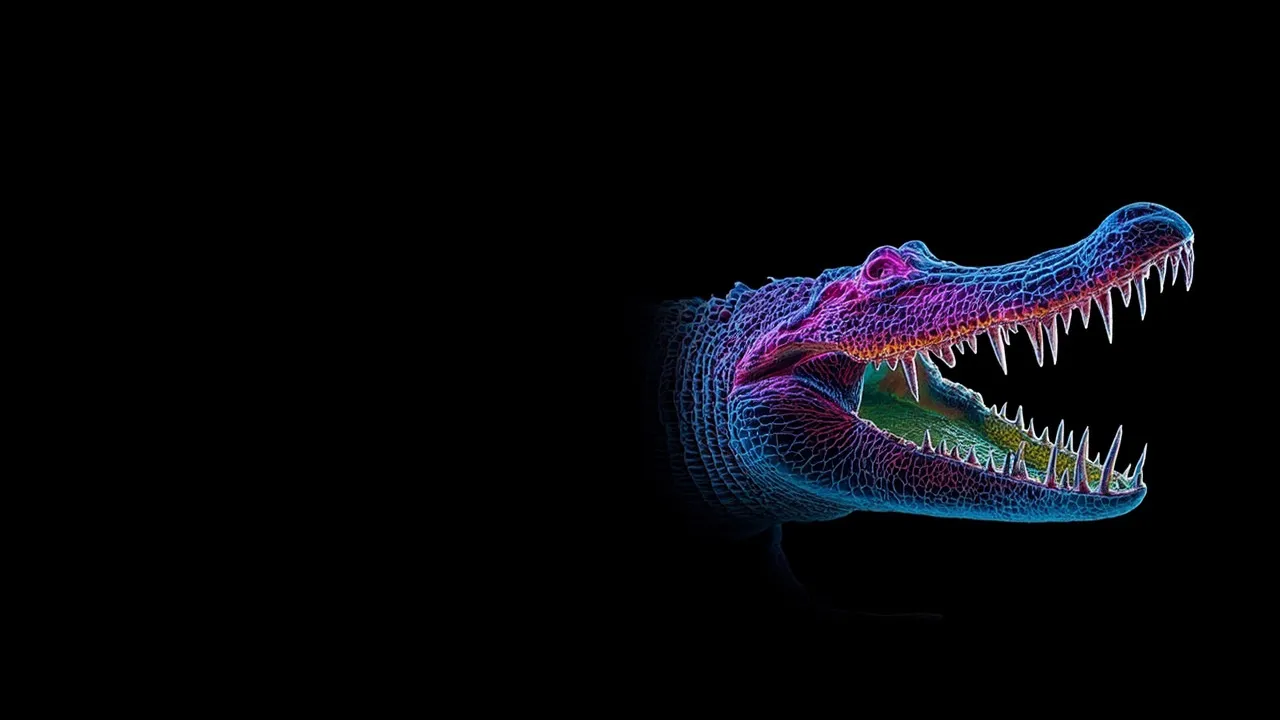
Wait, There's an Ancient Crocodile in That Rock?
Okay, I've got to share this with you because it's one of those science stories that genuinely made me gasp out loud.
So here's the deal: scientists in Spain were recently examining an old fossil — like, really old — when they shined some ultraviolet light on it and discovered something incredible. Hidden inside this rock for 125 million years was the preserved skin, soft tissues, and possibly even the color pattern of an ancient crocodile relative.
How cool is that?
Meet Montsecosuchus depereti
This little guy lived during the Cretaceous period, about 125 million years ago. That's roughly 60 million years before the famous T. rex ever walked the Earth. The fossil was found in northeastern Spain, in an area called Catalonia, and it's been sitting in a museum in Barcelona for over a century.
But here's the thing — nobody had really looked at it properly until now. The fossil is only about 50 centimeters long (roughly the length of a newborn human), which is tiny compared to today's crocodiles. This little croc died near a coastal lake and was preserved in super fine sediments that eventually turned into limestone.
You know those incredible fossil sites where everything preserves in crazy detail? This was one of those. The limestone at Pedrera de Meià is actually part of a UNESCO Geopark now — a place so special for paleontology that it's protected.
The Magic of Ultraviolet Light
So what changed? Why are we only now learning about this crocodile's skin after the fossil has been sitting in a museum for so long?
The answer is UV light.
When researchers Oscar Castillo and Jesús Serrano were cataloging fossils from these famous limestone deposits, they decided to examine this little crocodile under ultraviolet light. And that's when the magic happened.
UV light makes different materials glow in different ways. The fossilized tissues respond differently than the surrounding rock, kind of like how some posters only reveal hidden images under blacklight. Suddenly, details that were completely invisible became crystal clear.
"UV light allows us to see details that would otherwise remain completely hidden in the rock," Castillo explained. And honestly, isn't that just the coolest thing? All those years that fossil sat there, holding onto its secrets, just waiting for the right kind of light to reveal them.
What They Found
Where do I even start? The team documented all sorts of soft tissue details that had never been seen before in this species.
First, the skin: They mapped out the entire pattern of epidermal scales across the body. And get this — the scales varied in shape and size depending on where they were on the body. That's similar to modern crocodiles, which have different scale patterns in different regions. They also discovered that unlike modern crocodiles, this ancient relative didn't have a tall fin running along its tail.
Then, the sensory structures: This is where it gets really interesting. The researchers found tiny structures within some of the scales, especially around the neck, limbs, and along the sides of the body. In living crocodiles, similar organs can detect touch, water pressure, temperature changes, and even chemical signals. Pretty sophisticated stuff for a 125-million-year-old animal.
But here's what's fascinating: in Montsecosuchus, these possible sensory organs only appeared in small scales around the edges of the body. Modern crocodiles have them distributed much more broadly across their skin. This suggests that these sensory structures might have first evolved in localized areas before spreading across the entire body in later species.
The respiratory system: They also found cartilage structures in the chest area, indicating this little crocodile already had a pretty advanced breathing system — one that shared features with today's crocodiles.
"These traits indicate that, despite being a primitive animal, it was already very well adapted to a semi-aquatic lifestyle," the researchers noted. Makes sense, right? If you're going to be lurking in lakes and rivers, you need to be able to breathe efficiently.
The Stripes on Its Tail
But without question, the most striking discovery involves something on the tail.
Under that ultraviolet light, researchers noticed alternating light and dark bands running across some scales on the tail. These bands looked almost like zebra stripes. The team thinks these might be the preserved remains of the animal's original coloration — essentially, the actual pigment patterns from 125 million years ago.
If they're right, this would be the oldest known evidence of coloration in the entire crocodile family tree. That's kind of a big deal.
As for what color it actually was? Nobody knows for sure. But one researcher suggested it probably wasn't too different from modern species, which also show varied coloration patterns.
So what was the point of these stripes? The researchers think they might have served as disruptive camouflage — a pattern that breaks up the animal's outline and helps it blend into its surroundings. Think of how a zebra's stripes can make it harder to pick out individual animals in tall grass. Same idea.
It would have been a useful feature for a small crocodile trying to sneak up on prey or avoid becoming someone else's lunch in those ancient lakes.
Why This Matters
Here's the thing that really gets me excited about this story: we're talking about soft tissue preservation.
Soft tissues — skin, organs, cartilage — they're incredibly fragile. They decay almost immediately after an animal dies. For them to survive 125 million years in the fossil record, conditions need to be absolutely perfect. This is rare. Really, really rare.
Most of the time, fossils only preserve the hard stuff — bones and teeth. Soft tissue discoveries are the paleontological equivalent of winning the lottery. Each one is a tiny window into what these animals were actually like as living, breathing creatures.
This little fossil from Spain is now one of those rare windows. And what it's showing us is that ancient crocodile relatives were already more complex and sophisticated than we might have assumed.
Pretty wild to think about, right? A tiny crocodile, preserved by chance in lake sediments, overlooked in a museum collection for a century, and then finally revealed — scale by scale, stripe by stripe — under the right kind of light.
Science is so cool.
Source: ScienceDaily