
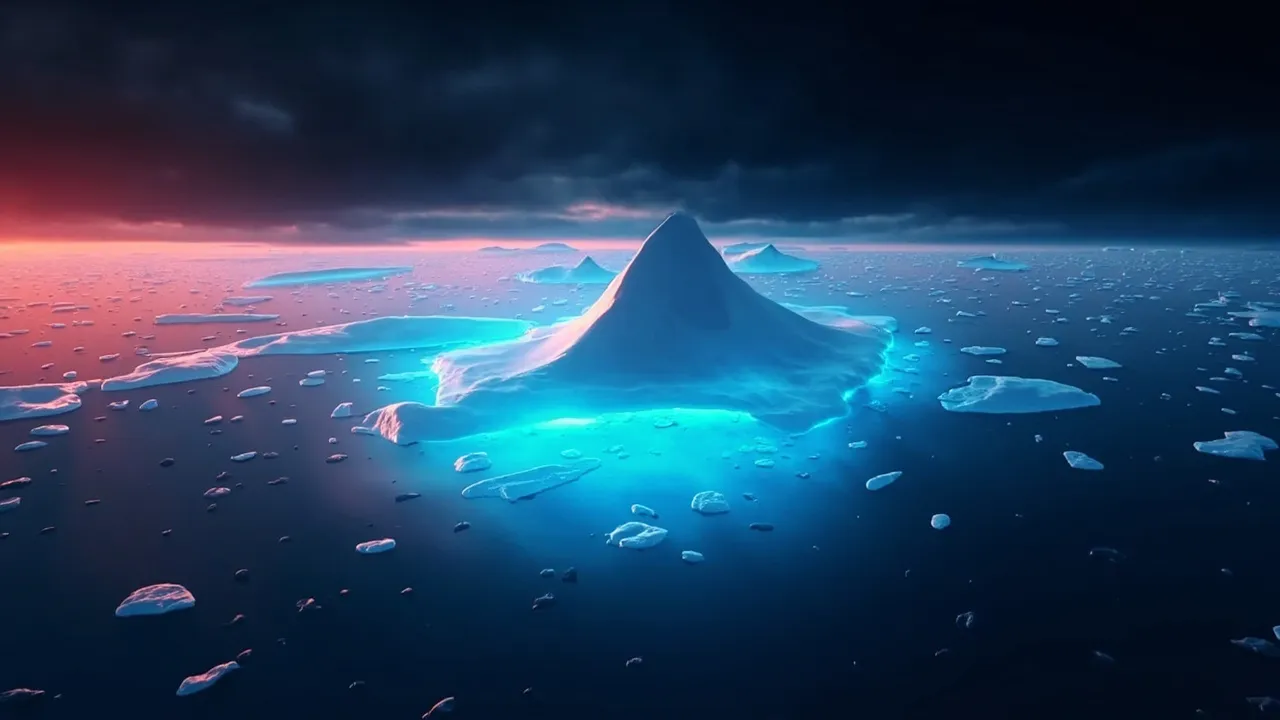
Okay, confession time: I never really thought much about how sea ice actually moves around the Arctic. I pictured big frozen sheets sliding around like hockey pucks, pushed by wind and currents. Simple, right?
Well, scientists just pulled the rug out from under that assumption, and honestly, what they found is way more interesting than I ever imagined.
The Ice Doesn't Behave
Here's the puzzle: Arctic sea ice doesn't always move the way wind models predict. Sometimes it travels faster than expected. Sometimes slower. And it spreads across the ocean much more gradually than those simple wind-based calculations suggest.
Researchers have scratched their heads over this for years. They've proposed explanations involving unusual wind patterns, ocean swirls, and cracks in the ice. But a new study from UC Riverside suggests the answer might be something much more fundamental — and honestly, kind of adorable when you picture it.
The ice pieces are just bumping into each other.
Imagine Kids on a Playground
Lead researcher Bhargav Rallabandi explained it in a way that made me laugh: "If you get a lot of ice floes together in the same place with some wind, they bump into each other and transfer energy to neighbors. We showed that that's the only ingredient you need to explain these observations."
That's it! No complicated ocean eddies or mysterious forces. Just a bunch of floating ice slabs bumping shoulders like kids at a crowded playground.
Think about it — the Arctic isn't covered by one giant frozen blanket. It's actually broken into thousands of pieces called "floes," ranging from a few meters across to several kilometers wide. When wind pushes them, they drift around and slowly spread apart. But here's the thing: they're floating in water and can get pretty densely packed together.
When you cram all those floes into the same neighborhood, they start colliding constantly — way more often than the wind direction even changes. And every single collision steals a tiny bit of energy from the system. It's like each bump is a tiny brake, preventing the ice from just accelerating endlessly whenever the wind picks up.
Building a Better Model
To test this idea, the team created a computer simulation that treats floating ice kind of like grains of sand flowing through an hourglass — except these grains are bobbing in water and getting shoved around by gusty winds. The simulation included ocean drag plus all those repeated collisions between neighboring floes.
Then they put their model to the real-world test using data from the Fram Strait, that dramatic passage between Greenland and Svalbard where massive amounts of Arctic ice make their journey toward the Atlantic Ocean.
The results? The model nailed three observations that had previously been head-scratchers: how quickly sea ice spreads, the range of speeds at which individual floes move, and how ice motion shifts over hours and days. All from just adding collision physics to the mix.
Why Should Any of Us Care?
Here's where things get genuinely exciting — and a little sobering.
As our climate continues to warm, understanding how sea ice moves becomes increasingly important. Both the amount of ice covering the ocean and the size of individual floes affect how often collisions happen. Those collisions, in turn, influence how rapidly ice fields can spread and, ultimately, where they'll end up.
Rallabandi pointed out that this model could help scientists investigate whether changing ice conditions might allow floes to spread apart more easily and drift into warmer waters — where they melt faster. It's a feedback loop we desperately need to understand better.
There's also a practical benefit for climate science itself. Global climate models simply can't track every individual floe across the entire Arctic — there are too many, and they're too small. But now, researchers have a physics-based framework that captures these interactions without needing to simulate each piece separately. That's huge for making our climate predictions more accurate.
The Elegant Simplicity
For me, though, the most beautiful part of this research isn't necessarily the practical applications — it's the reminder that sometimes the most complicated real-world behavior emerges from surprisingly simple rules.
The same principles might apply to avalanches rumbling down mountainsides, landslides shifting through debris, or even those special particle-filled inks used in 3D printing. Anytime you have lots of objects colliding while being pushed by some unpredictable force, you might see similar dynamics.
Rallabandi put it perfectly: "The model is not restricted to ice. It just needs a noisy source of force and the things that are moving to experience collisions."
The Bottom Line
So next time you hear about Arctic sea ice movements or climate modeling, remember this story. Somewhere out on that frozen ocean, thousands of ice chunks are bumping into each other like friends at a crowded party, and in doing so, they're shaping the behavior of the entire system.
Science can be pretty cool like that. The big picture often emerges from the smallest, most ordinary interactions.
Source: https://www.sciencedaily.com/releases/2026/09/260917003708.htm