
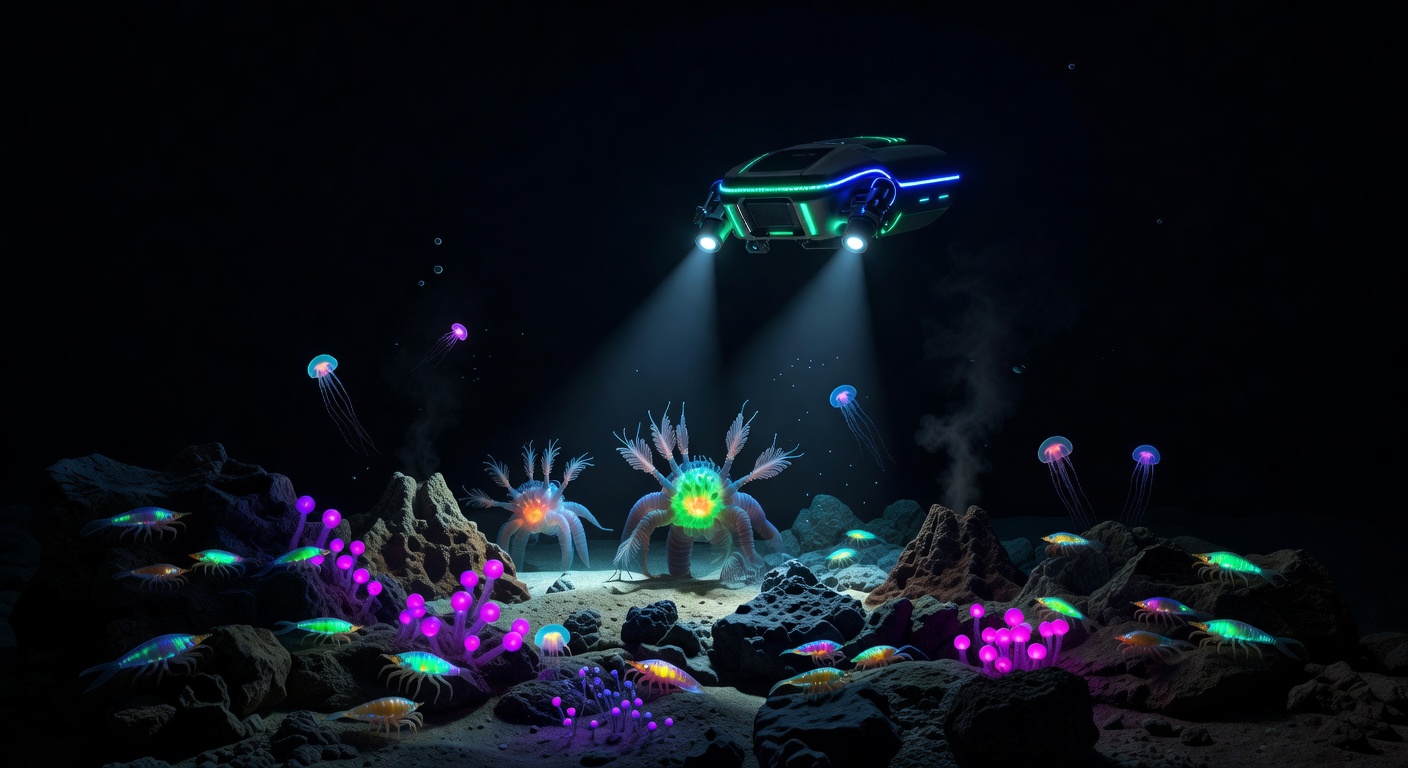
Welcome to the Least-Explored Part of Our Planet
Imagine if I told you that there's a massive region of Earth—about the size of Australia—that sits 4,000 meters below the ocean surface and remains almost completely unmapped. Welcome to the Clarion-Clipperton Zone, a stretch of deep-sea floor between Hawaii and Mexico that scientists are only now starting to explore seriously.
What they're finding? It's kind of mind-blowing. Just this year, an international team of researchers announced they've identified 24 species that have never been documented before. But here's the kicker: one of these discoveries is so significant that it represents an entirely new branch on the evolutionary tree of life itself.
What Makes This Discovery Actually Special
Finding a new species in the ocean isn't exactly unheard of—scientists discover thousands every year. But what happened here is genuinely rare. The team didn't just find new species; they found evidence of a completely new family of creatures called Mirabestiidae, and an even larger grouping called a superfamily (Mirabestioidea).
Dr. Tammy Horton from the National Oceanography Centre put it perfectly when she said discovering a new superfamily is "incredibly exciting, and very rarely happens." Think of it like this: if living creatures were organized like a family tree, scientists just found a completely new branch that previous scientists didn't even know existed.
All of these creatures are amphipods—small crustaceans that live on the seafloor. Some are scavengers munching on dead organic matter that drifts down from above, while others are active predators hunting their neighbors. They're all weird, fascinating, and totally adapted to an environment where it's pitch black and the pressure could crush you instantly.
How Scientists Actually Made This Happen
Here's what I find really cool about this story: it wasn't just one researcher working alone in a lab. Instead, scientists from eight different countries and institutions gathered for a week-long taxonomy workshop at the University of Lodz in Poland. Sixteen specialists and early-career researchers collaborated to describe and classify these creatures together.
This kind of coordinated effort is apparently way more effective than everyone working separately. One of the lead researchers, Anna Jaźdżewska, noted that describing more than 20 new species in a year would be "not possible if each of us worked independently." When you bring together experts from different countries and institutions, they can work through identifications faster and catch things they might have missed alone.
This project is part of something called the "One Thousand Reasons" initiative, which aims to formally describe 1,000 new species from the Clarion-Clipperton Zone by the end of the decade. At their current pace of about 25 new amphipods per year, they estimate they could nearly complete the catalog for the region within ten years.
The Deep Sea Still Has Secrets to Tell
Here's the sobering part: scientists estimate that over 90% of the species living in the Clarion-Clipperton Zone still don't have names. We haven't even formally identified them yet. That means we're living in an era where there's an entire ecosystem as big as Australia that remains essentially unexplored.
This matters for more than just scientific curiosity. Understanding what lives in these regions is crucial for making good decisions about how we use them. There's mining interest in these deep-sea zones, and we can't make informed choices about whether that's sustainable if we don't even know what we'd be disturbing.
The Fun Part: Naming New Species
Now here's something I absolutely love about the scientific process—when you discover a new species, you get to name it. And scientists, despite their reputation for formality, can be surprisingly creative and personal about this.
Several species were named to honor the team members. Dr. Horton got three species named after her—including one her daughter had been waiting for! Meanwhile, Horton named a new species "Mirabestia maisie" after her daughter, ending a long family drought of scientific naming honors.
But it gets weirder (in the best way). One researcher named a species after a video game character, noting that both the creature and the character are "just little arthropods trying to survive in total darkness." Another species got its name from the concept of "apricity"—that warm feeling of sunshine in winter—as a tribute to the friendship that developed during the workshop.
Even institutions got honored. The team named one species after the World Register of Marine Species (WoRMS), a database that all marine taxonomists rely on constantly.
What This Really Means
Finding 24 new species in a single research project sounds impressive, but here's the bigger picture: it's a reminder of just how little we actually know about our own planet. The vast majority of Earth's oceans remain unexplored. We're discovering new species every single day, and most of them live in places we can barely reach.
The fact that scientists can find an entirely new evolutionary family just by looking harder at one underwater region tells you something important: there's probably a lot more life out there that we haven't discovered yet. It's humbling and exciting at the same time.
The next time someone tells you that we've explored everything on Earth, you can tell them about the Clarion-Clipperton Zone and the hundreds of thousands of species down there just waiting to be found.