
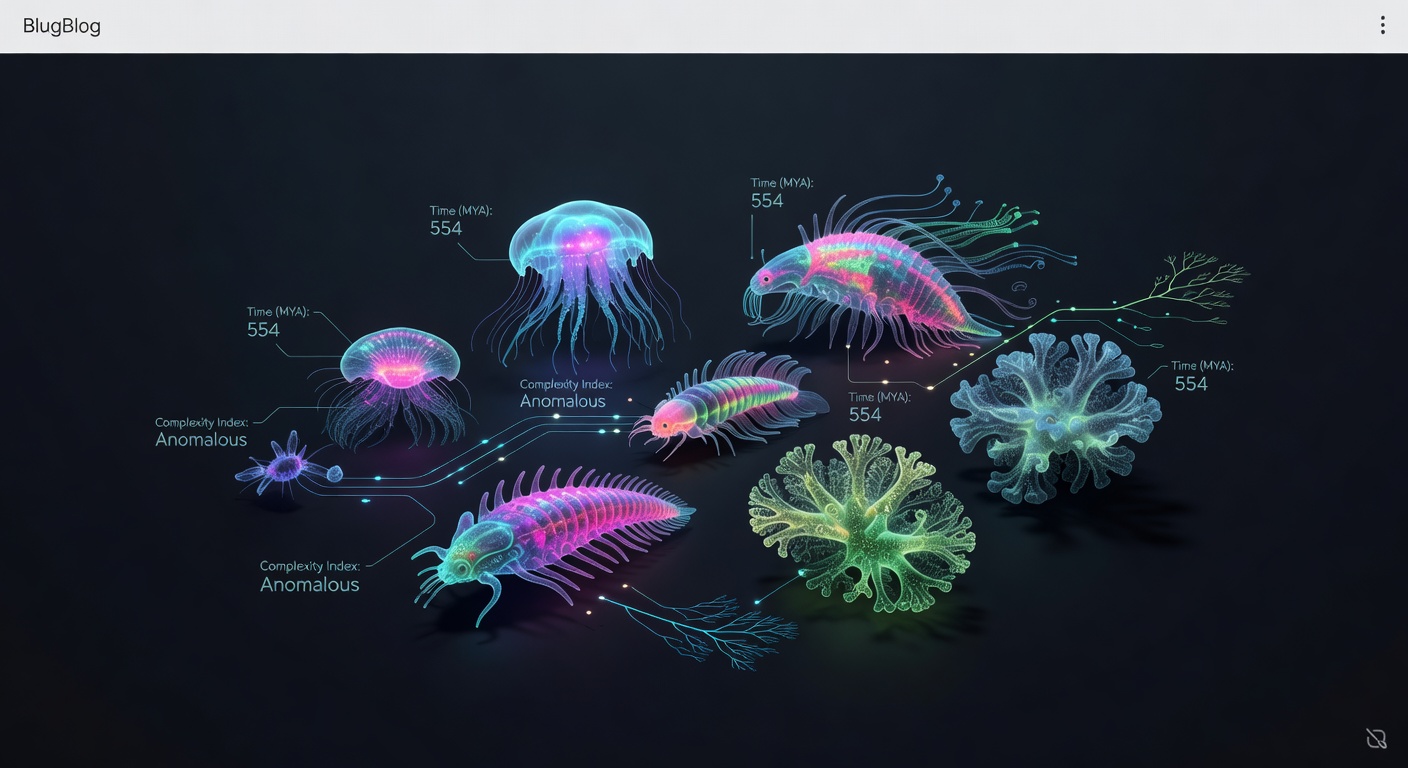
The Timeline Just Got Way More Complicated
Here's something wild: for decades, scientists had a pretty solid story about how life on Earth became diverse and complex. There was this pivotal moment called the Cambrian explosion, roughly 535 million years ago, when animals suddenly became way more varied and complicated than their predecessors. It was like life flipped a switch from "simple" to "oh wow, that's intricate."
Except now we know that switch was flipped way earlier than anyone realized.
A team of researchers from Oxford University and Yunnan University in China just published a study that's basically saying, "Hey, remember that neat timeline we had? Yeah, scratch that." They've found fossil evidence that many of the complex animals we thought appeared during the Cambrian explosion were actually already thriving millions of years before—during the late Ediacaran period.
Meet the Jiangchuan Biota: Earth's Ancient Lost World
The discovery happened at a fossil site in southwest China called the Jiangchuan Biota, tucked away in Yunnan Province. When researchers dug through this site, they found over 700 specimens dating back between 554 and 539 million years ago. That might sound like ancient history (because it absolutely is), but it's surprisingly recent in geological terms.
What makes this site so special? Unlike most ancient fossil sites that just show you rough impressions in rock, the fossils here are preserved as something called "carbonaceous films." Think of it like finding a detailed photocopy of ancient life instead of just a blurry shadow. This level of detail lets scientists see feeding structures, digestive systems, and organs—basically, the stuff that tells you what an animal actually was and how it lived.
The Animals That Shouldn't Exist Yet (But Totally Do)
Some of the most exciting finds are the ancestors of animals you'd recognize today. The team found what they believe are the oldest known relatives of deuterostomes—which is a fancy way of saying "the animal group that eventually led to us humans, fish, and everything with a spine." These creatures were already around during the Ediacaran, which pushes back our understanding of when this whole lineage got started.
They also found early relatives of starfish and their neighbors, the acorn worms. These creatures had this weird setup: a U-shaped body that anchored to the seafloor with a stalk, and tentacles near their heads (probably for grabbing food). Honestly, they sound kind of adorable in a bizarre way.
But here's the kicker—and I love this detail from the research—some of these creatures had combinations of features that don't fit neatly into any known animal from either time period. One researcher literally compared a specimen to the sandworms from Dune. I mean, how cool is that? Ancient ocean aliens from our actual planet's history.
Why This Actually Matters
You might be wondering: "Okay, so some animals existed earlier. Does that really change anything?" Actually, yes—a lot.
For years, geneticists and evolutionary biologists had been saying, "Our models suggest all these animal groups should have existed before the Cambrian explosion." But they didn't have the fossil evidence to back it up. It was frustrating—like having a theoretical prediction but no proof. Now they have proof.
This discovery essentially says that the evolution of complex animals wasn't some dramatic overnight transformation. It was a longer, slower process that started earlier than we could see in the fossil record. The apparent "explosion" of the Cambrian might actually just be the point where we finally have enough fossil evidence to see what was already happening.
The Preservation Problem We Just Solved
Here's something fascinating about why we didn't know about these animals earlier: most Ediacaran fossil sites preserve organisms as simple, flat impressions in sandstone. It's hard to see details when you're looking at basically a fossil photocopy of a photocopy.
But the Jiangchuan Biota? It's like someone preserved these animals in high definition. The carbonaceous film preservation is usually something you see in famous Cambrian sites like Canada's Burgess Shale—not in the earlier Ediacaran rocks. This suggests that similar ancient communities probably existed at other sites too, but we just haven't been able to see them clearly because they weren't preserved as well.
What This Means Going Forward
The real takeaway here is that evolution is messier and more interesting than our textbooks suggested. Life didn't suddenly become complex during the Cambrian explosion; the explosion was just when we finally got good enough at preserving and finding fossils to really see what was going on.
This also means paleontologists are going to be looking at other Ediacaran sites with fresh eyes, wondering what they might have missed. There could be other "lost worlds" out there, waiting to be discovered in rocks that we thought we'd already understood.
And honestly? I think that's the best part of science—when you think you've figured something out, and then nature says, "Actually, it's way cooler than that."
Source: https://www.sciencedaily.com/releases/2026/04/260406234153.htm