
The Space Rock That Tells a Ancient Story
Okay, I've got to share this with you because it's one of those space stories that genuinely made me stop and think about how wild our solar system's history really is.
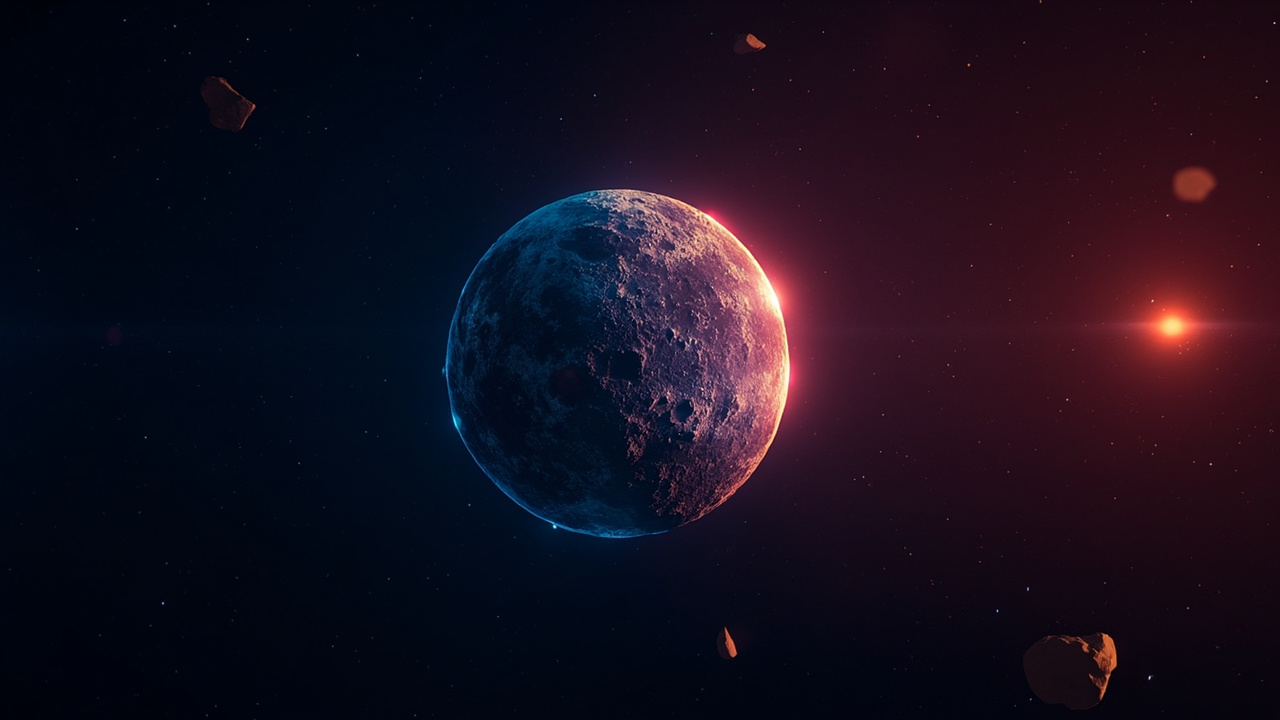
Picture this: 4.5 billion years ago, when the Sun was still a youngster and the planets were just starting to take shape, there was another world out there. Not a small asteroid or a chunk of space debris, but a full-blown protoplanet—potentially as big as our Moon, maybe even approaching the size of Mars.
And then it got destroyed. Completely shattered into pieces.
We never knew it existed. Until now.
A team of researchers from the University of Colorado Boulder has just published findings about a meteorite called Northwest Africa 12774 (affectionately known as NWA 12774 among space nerds), and what they've found inside is pretty extraordinary. This little rock, picked up from the Sahara Desert, is holding onto secrets from a world that no longer exists.
What's So Special About This Meteorite?
The meteorite belongs to a rare group called angrites. These aren't your everyday space rocks. Of the more than 80,000 meteorites discovered on Earth, only 68 are angrites. They're volcanic rocks that formed just a few million years after our solar system was born—making them incredibly old and incredibly valuable to scientists trying to understand planetary origins.
Here's what puzzled researchers for years: angrites have a very unusual chemical makeup. Compared to Earth, Mars, and other rocky planets, they contain surprisingly little silica, one of the most common ingredients in terrestrial planets. Because of this weird chemistry, scientists assumed these meteorites came from small, puny asteroids—nothing more than 200 kilometers across.
But NWA 12774 told a different story.
The Clue Hidden in the Crystals
When the research team took a close look at this meteorite, they found clinopyroxene, a mineral we commonly see in Earth's crust and mantle. Nothing unusual there. But here's where it gets interesting: the clinopyroxene in this meteorite contained unusually high levels of aluminum.
That might sound like a minor detail, but it's actually a huge clue.
This particular form of clinopyroxene can only form under extreme pressure—specifically, at least 17.5 kilobars of pressure. To put that in perspective, the pressure at the bottom of the Mariana Trench (the deepest point in Earth's oceans) reaches only about 1 kilobar. We're talking about pressures that exist deep within substantial planetary bodies, not inside some tiny asteroid floating through space.
The researchers did the math, and their results were clear: the parent body of this meteorite couldn't have been small. It had to have a radius of at least 1,000 kilometers.
That's bigger than Mercury.
A World Comparable to Our Moon
But the story gets even more fascinating.
The crystals inside NWA 12774 still retain their sharp edges and delicate chemical features. If these crystals had formed deep inside a massive planetary body and stayed there, all those delicate details would have been smoothed out over time by heat and pressure. The fact that they're so well-preserved suggests they formed relatively close to the surface of their parent world.
If that's true, then the original world must have been much larger than the minimum estimate. The team calculates the parent body likely exceeded 1,800 kilometers in radius—putting it right in the same size class as Earth's Moon, and getting close to Mars territory.
Can you imagine? A moon-sized world, one of many protoplanets circling our infant Sun, completely destroyed in the chaos of the early solar system. Its fragments scattered across space, eventually becoming part of other rocky worlds—including possibly our own Earth.
This Changes Everything We Thought We Knew
Here's what really gets me about this discovery: it points to a completely different pathway for planet formation than what scientists previously recognized.
According to researcher Aaron Bell, "The materials that formed the angrite parent body are fundamentally different from the ingredients of Earth and Mars. It points to a distinct and separate evolutionary path in planetary formation."
In other words, there were worlds forming in our solar system that took a completely different path than the planets we see today. They had different compositions, different structures, and ultimately, different fates. Many were destroyed in catastrophic collisions. Their materials got recycled into newer worlds.
And here's the thing—scientists think there were probably more of these protoplanets than we ever realized. Bell noted that "there are many meteorites sitting in drawers that haven't been thoroughly studied." So this might just be the beginning. There could be more lost worlds waiting to be discovered in museum collections around the world.
Why This Matters
I love this story because it reminds us that the solar system we see today is just the survivor. The Earth beneath our feet, the Moon overhead, Mars spinning in its orbit—all of these are the winners of a cosmic lottery that took place billions of years ago. Countless other worlds formed alongside them, only to be destroyed in the violent chaos of the early solar system.
The materials that made up those destroyed worlds weren't wasted, though. They got incorporated into new planets, new moons, new asteroids. We're literally made of remnants of these lost worlds.
So the next time you look up at the Moon on a clear night, remember: it might be the only remaining sibling of a whole family of worlds that are now part of us. How's that for a cosmic connection?