
Okay, I need to share something that just happened in the world of Alzheimer's research, and honestly? It's got me pretty excited.
Scientists at ETH Zurich have been working on this for almost twenty years. Twenty years! That's longer than some of you have been driving. And what did they find? A protein that, when it goes bad, might be a major driver of dementia. And better yet — they think they've found a way to stop it.
What's Going On in Alzheimer's Brains?
Let me break this down so it actually makes sense.
There's a protein called GRK2 that exists in all of us. It helps our cells respond to signals and handle stress — pretty important stuff. But here's the wild part: researchers discovered that in people with Alzheimer's, this protein has a "broken" version that just... accumulates.
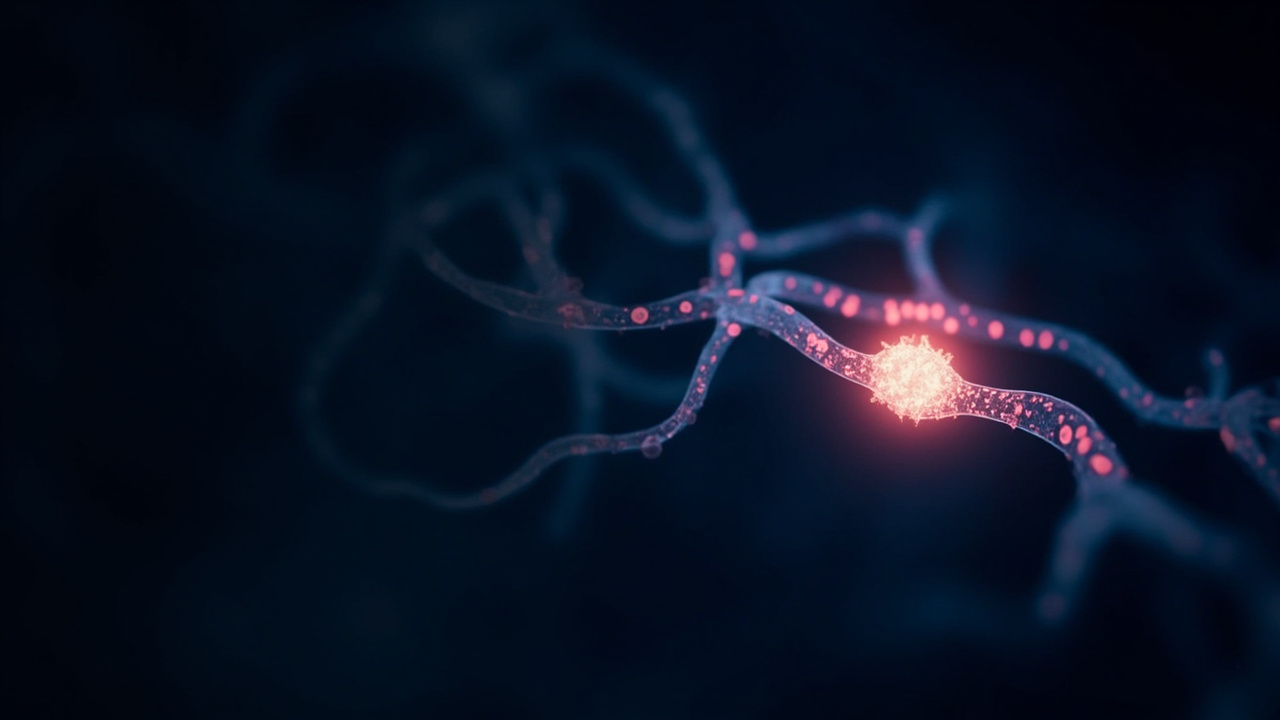
These broken GRK2 molecules clump together inside nerve cells and basically stick themselves to the mitochondria — you know, the parts of cells that act like tiny power plants. When these clumps attach, they block the mitochondria's pores, reducing the energy the cells can produce. It's like putting a kink in a garden hose. Nothing flows right anymore.
And it gets worse. This broken GRK2 also seems to ramp up production of amyloid beta — that's the stuff that forms those notorious plaques in Alzheimer's brains. So you've got this vicious cycle: amyloid causes stress, stress creates more broken GRK2, broken GRK2 damages the power supply, and everything gets worse.
The Compound That Breaks the Cycle
Here's where it gets interesting. The researchers, led by Professor Ursula Quitterer, developed a compound they creatively call... wait for it... "Compound 10."
(Boy, scientists really need to work on their naming game, but I digress.)
When they tested this compound in mice with Alzheimer's-like symptoms, the results were genuinely promising. Compound 10 prevented those GRK2 clumps from forming in the first place. Mitochondria could do their jobs again. Amyloid deposits decreased. Nerve cells stayed healthier, and cell death slowed down.
But here's a detail that made me do a double-take: the treated mice also showed fewer gray hairs as they aged. Their hearts seemed healthier too. That's because GRK2 is active throughout the body, so fixing this problem doesn't just help the brain — it helps everywhere.
Why Did This Take So Long?
If you're wondering why it took two decades, here's the honest answer: Alzheimer's is slow. Really slow.
Since it's an age-related disease, the researchers had to use older mice — we're talking 1.5 to 2 years old, which is ancient in mouse years. Each experiment took just as long as the disease progression itself. Professor Quitterer put it simply: "It's all a great deal slower than in cancer research, for example."
Yeah, no kidding.
What Does This Mean for Humans?
Let's be real here — we're still in the early stages. The team has filed a patent and is looking for a company to help move Compound 10 toward human testing. That's a big leap from mouse studies to actual patients.
But here's why this matters: current Alzheimer's drugs don't target GRK2 at all. They work through different mechanisms, and at best, they only delay progression by a few months. Identifying a completely new target protein — one that operates through a different biological pathway — could be game-changing.
The researchers think Compound 10 might eventually be combined with existing medications to provide better results. It's not a cure. Not even close. But it's a new door opening in a field that desperately needs new ideas.
My Take
I've been following Alzheimer's research for years, and one thing I've learned is that progress comes in waves — big breakthroughs followed by lots of careful validation. This research fits that pattern. It's not a miracle cure, but it's a genuinely novel approach that addresses something current drugs don't touch.
The fact that they identified a completely new mechanism — GRK2 aggregates damaging cellular power supplies — that itself is significant. Understanding the enemy better is half the battle.
Will Compound 10 work in humans? I have no idea. But after twenty years of work, these researchers have given us something we didn't have before: a new target and a compound that actually hits it. For the millions of families affected by this disease, that's worth paying attention to.
We'll keep watching this one.
Source: ScienceDaily