
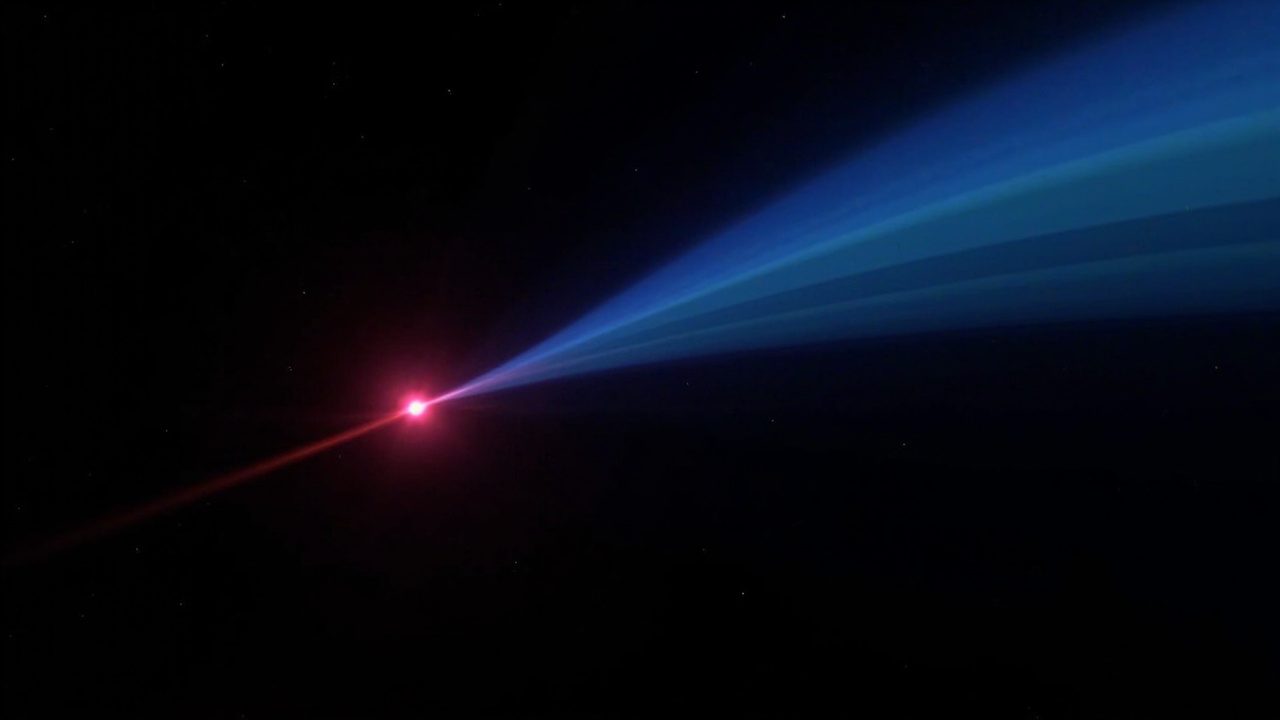
Have you ever noticed how sunrise and sunset can feel totally different, even though they're basically the same phenomenon? Well, it turns out the same idea applies to planets hundreds of light-years away — and scientists just caught our distant neighbors being weird about it.
Using the incredible James Webb Space Telescope (JWST), researchers have been studying a planet called WASP-121 b, which is what we call an "ultra-hot Jupiter." It's a gas giant that orbits extremely close to its star, completing one trip around in just about 1.3 days. Because of this tight orbit, one side of the planet permanently faces its star (imagine always having noon on one hemisphere), while the other side sits in eternal darkness.
A World of Two Extremes
The day side of WASP-121 b reaches temperatures around 2,500 degrees Celsius — hot enough to melt many metals. Meanwhile, the night side chills out at a comparatively mild 725 degrees Celsius. That's still incredibly hot by Earth standards, but quite the temperature difference!
What's really cool (or should I say cool-ish?) is what happens at the boundary between these two extremes. Scientists call these transition zones "terminators" — basically the planetary equivalent of twilight here on Earth. You might expect both twilight regions to be pretty similar, but JWST has revealed something surprising: they're actually quite different from each other!
Why Would Morning and Evening Look Different?
Here's where things get interesting. The JWST data shows that the evening terminator (the boundary between day and night on the side trailing behind as the planet rotates) absorbs more light than the morning terminator (the leading edge). This tells scientists that the evening side is hotter and has a more expanded atmosphere.
The explanation comes down to atmospheric winds. On WASP-121 b, powerful winds sweep from the day side toward the night side, moving in the same direction as the planet's rotation. These winds carry heat eastward, which means the evening terminator gets pre-heated before it ever transitions into darkness. The morning terminator, on the other hand, just came from the cold night side and hasn't been buffeted by those warm winds as long.
Think of it like this: if you're walking from a warm room into a cold hallway, the part of you that's been in the warm room longer will feel warmer for longer. Same idea, just with planetary atmospheres!
Water Gets Destroyed in the Heat
The observations also revealed something fascinating about water molecules. On the hotter parts of the planet, water appears to break down — literally getting torn apart by the extreme heat. This is pretty wild because water is actually quite stable under normal conditions. It just goes to show how bizarre conditions can get on these ultra-hot worlds.
The scientists also spotted variations in carbon monoxide signals, though these seem to be more about temperature effects than actual changes in abundance.
What Makes This Discovery Special?
Previous telescopes just couldn't see these kinds of details. The JWST's unprecedented sensitivity in the infrared range allows astronomers to essentially map how different parts of an exoplanet's atmosphere behave, even though we can't directly photograph the planet's surface.
The team accomplished this by watching how starlight filtered through the planet's atmosphere during transits — when the planet passed in front of its star. As different parts of the atmosphere rotated into view, they could see subtle differences in how light was absorbed.
This isn't just a cool curiosity, either. Understanding how atmospheres behave on extreme planets helps scientists build better models for all kinds of worlds, from scorching hot gas giants to potentially habitable exoplanets. Every new data point brings us closer to understanding the incredible diversity of planets out there in our galaxy.
Who knows what other strange and wonderful things JWST will reveal about distant worlds? One thing's for sure: space keeps finding ways to surprise us.