
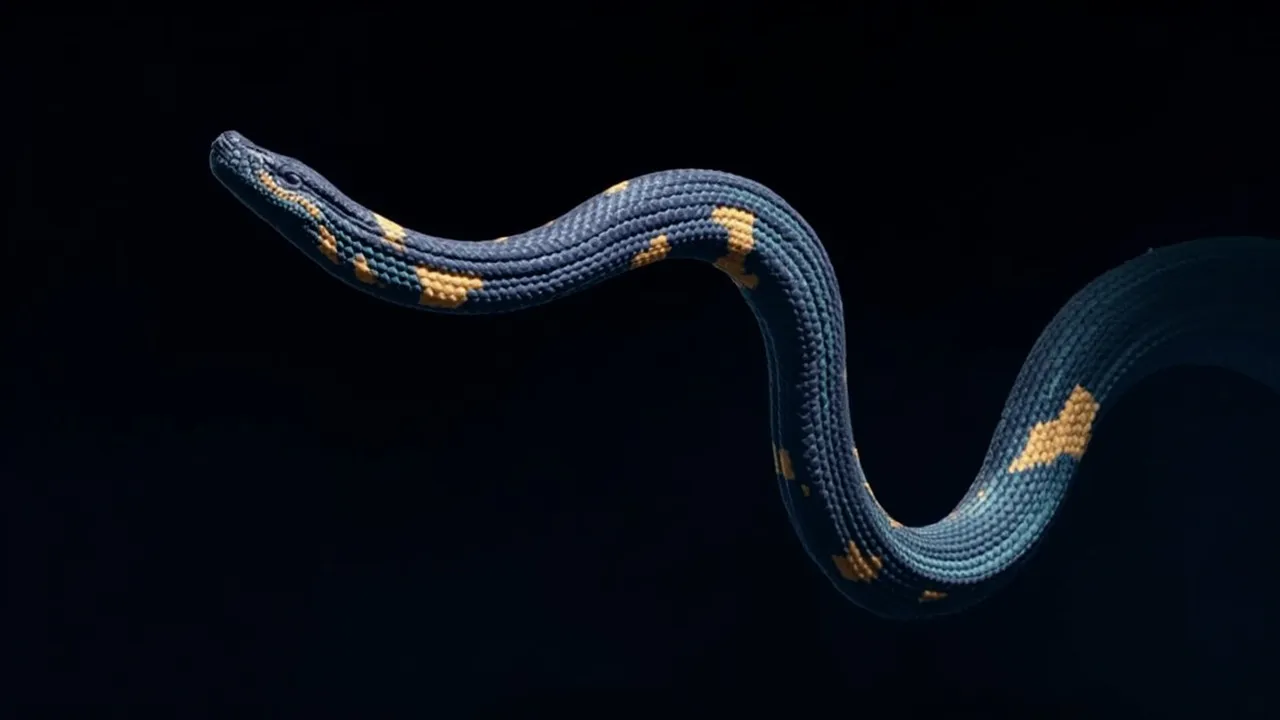
Okay, I need you to picture this with me.
You're walking through the wetlands of western India, roughly 47 million years ago. The air is thick and steamy — about 82°F on a good day. And then you see it: a snake the length of a telephone pole, just... lounging in the marsh.
Cue the nightmares, right?
Well, according to some fascinating new research, this wasn't just a fever dream. Something very much like this actually existed. A team of paleontologists from the Indian Institute of Technology Roorkee recently described a massive ancient snake they call Vasuki indicus, and honestly, the name is perfect. In Hindu mythology, Vasuki is the mythical serpent wrapped around Lord Shiva's neck — a fitting tribute to a creature of this scale.
So Just How Big Are We Talking?
The researchers found 27 fossilized vertebrae (that's backbone bones, for those of us who aren't paleontologists) from the Panandhro Lignite Mine in Gujarat. These weren't just any bones — many were beautifully preserved, with some still connected in their original arrangement. That tells us we're looking at a fully grown animal here.
When scientists measured these vertebrae, they found individual bones between 1.5 and 2.5 inches long and up to 4.4 inches wide. If you're thinking "wow, those are big bones for a snake backbone," you'd be absolutely right. The unusually broad shape suggests Vasuki had a thick, cylindrical body — the kind of body that could support some serious weight.
Using these vertebrae and comparing them to modern snakes of known size, the team estimated Vasuki's total length at somewhere between 36 and 50 feet. Yes, you read that right. Fifty. Feet.
That's basically the length of a standard city bus, people.
But How Does It Stack Up Against Titanoboa?
Ah, great question! For years, Titanoboa cerrejonensis held the crown as the largest known snake ever discovered. Titanoboa lived about 60 million years ago in what is now Colombia, and scientists estimate it reached around 43 feet.
Based on the best available estimates, Vasuki could potentially match or even slightly exceed that length. But — and this is an important but — the researchers are quick to point out that there's real uncertainty here. Different estimation methods gave slightly different results, and when you're reconstructing an extinct animal from incomplete remains, things get fuzzy.
So will Vasuki dethrone Titanoboa? Maybe. Maybe not. The honest answer is we need more fossils to know for sure. But either way, we're talking about two absolutely colossal predators that would make today's anacondas look like garden hoses.
How Did Such a Massive Snake Even Exist?
Here's where things get really interesting from a scientific standpoint. Vasuki lived during the Middle Eocene, a period when Earth's climate was significantly warmer than it is today. Average temperatures in its habitat hovered around that 82°F mark — essentially tropical conditions year-round.
Why does this matter? Remember, snakes are ectothermic, which is a fancy way of saying they can't generate their own body heat. They need warmth from their environment to function. In modern ecosystems, we see the biggest snakes in the warmest places — think reticulated pythons in Southeast Asia or anacondas in the Amazon.
During those ancient hot periods, it seems the stage was set for snakes to grow to extraordinary sizes. Warmer temperatures support higher metabolic rates, better digestion, and ultimately, bigger bodies.
But temperature isn't the whole story. You also need abundant food, suitable habitat, and the right evolutionary circumstances coming together. In Vasuki's case, those ancient Gujarat wetlands were apparently the perfect recipe — lots of prey in those marshes and swamps, plenty of room to grow, and millions of years of evolution doing its thing.
The Ambush Predator Lifestyle
Now, I know what you're thinking. A 50-foot snake sounds like it would've been terrifyingly fast, right? Like something that could outrun anything in its path?
Actually... probably not. The researchers suggest that Vasuki's enormous body would've made it more of a slowpoke. Its size and vertebral structure would've favored relatively slow movement.
Instead, like modern anacondas and large pythons, Vasuki was almost certainly an ambush predator. Picture it lurking in shallow water or concealed among marsh vegetation, waiting for something unfortunate to wander within striking distance. Then — squeeze. The snake would wrap its powerful coils around prey and constrict, cutting off blood flow until the animal succumbed.
Brutal? Absolutely. Effective? Obviously, since this strategy has worked for tens of millions of years.
Why This Discovery Matters
Beyond the sheer wow-factor of "giant ancient snake," Vasuki actually tells us something important about snake evolution. The researchers determined it belonged to an ancient snake lineage called Madtsoiidae — a family that existed for over 100 million years and spread across multiple continents.
Vasuki represents one of the largest known members of this group and provides crucial evidence about how these ancient snakes evolved and diversified. It also adds to our understanding of prehistoric ecosystems in India, which was its own subcontinent floating around (geologically speaking) during the Eocene.
Every new fossil is like another piece of an enormous puzzle, and this one happens to be particularly exciting because of its size. It's not every day you discover an animal that rivals the record holders of the prehistoric world.
The Bottom Line
So the next time you see a snake — even a big one at the zoo — take a moment to appreciate that you're not dealing with something 50 feet long. Vasuki indicus might be extinct, but it reminds us that nature has always found ways to push the limits of what's possible.
And honestly? I'm kind of glad we don't have to encounter these giants in the wild. Some things are better left as fossils.