
markdown formatted blog content
Okay, I have to admit—this story made me feel like we just discovered something completely new about one of the most studied objects in our sky. Scientists using the world's largest solar telescope have spotted tiny, swirling vortices on the Sun's surface that no one has ever seen before. And honestly? They're absolutely beautiful.
Meet the World's Largest Solar Telescope
The Daniel K. Inouye Solar Telescope sits in Hawaii, and it's seriously impressive. This thing is the size of a small building and can see details on the Sun's surface that would make most other telescopes jealous. What makes this discovery possible isn't just the telescope itself—it's the combination of that powerful instrument with some seriously advanced computer simulations.
To give you an idea of what we're talking about: the vortices they found are about 20 kilometers across. On the Sun, that's practically microscopic. The researchers compared it to spotting a single euro coin from 180 kilometers away. I don't know about you, but I can't even see my neighbor's house from that distance.
The Sun's Surface Is Basically a Giant, Violent Pot of Boiling Water
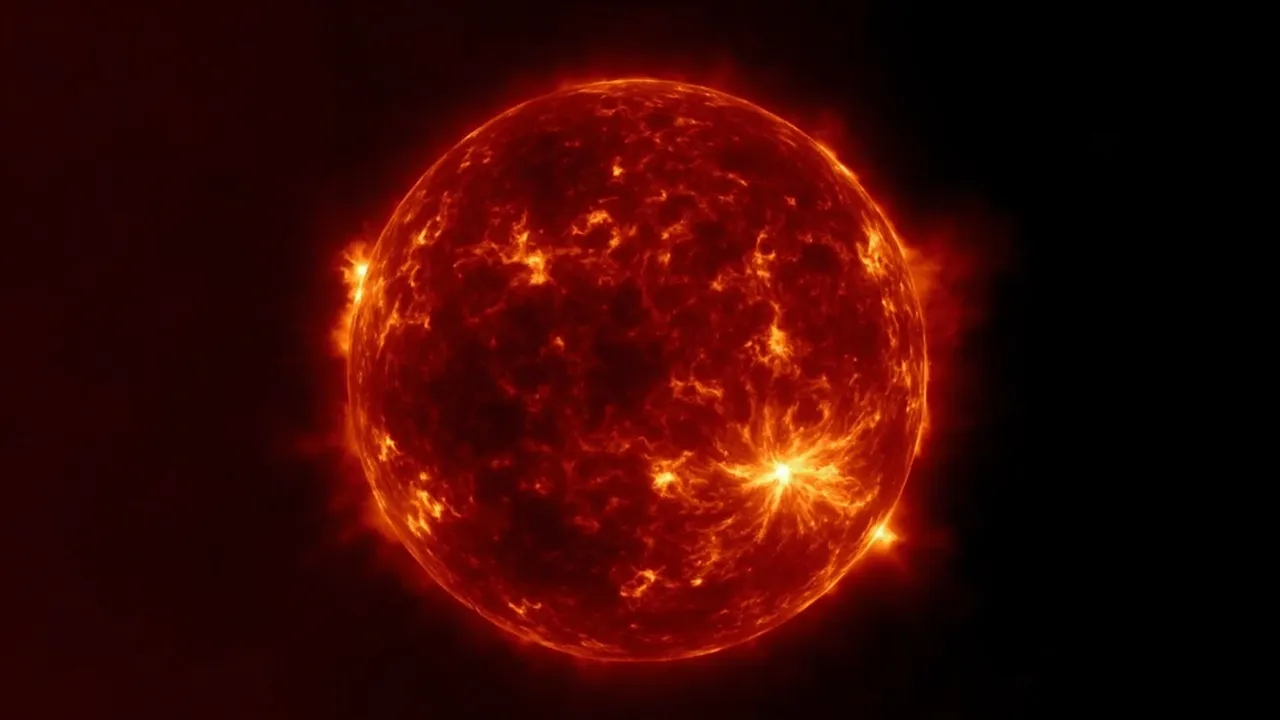
Here's where things get fun. The Sun's visible surface isn't smooth—it's covered in something called granules. These are enormous structures (by human standards, anyway) that range from 500 to 2,000 kilometers across. Imagine looking at the Sun and seeing what looks like thousands of bubbles constantly forming, popping, and reforming. That's granulation.
The reason these granules exist is because of convection—hot plasma rises from deep inside the Sun, cools down at the surface, and then sinks back down. It's literally like watching a pot of water boil, except the "water" is plasma at millions of degrees and the "pot" is our entire star.
And now, thanks to these new observations, we can see what happens at the edges of those granules. The researchers spotted these fringe-like structures that develop swirling motions. The best comparison I can think of? Ocean waves starting to break. There's something almost hypnotic about it.
These Little Swirls Might Explain How the Sun Stores Energy
Now here's where it gets really interesting. The scientists think these tiny whirlpools are examples of something called Kelvin-Helmholtz instabilities. You might have seen this phenomenon before without realizing it—it's what happens when two fluids moving at different speeds create those beautiful wave patterns or swirling vortices at their boundary.
Think about wind blowing across water. The difference in speed between the air and the water creates those little ripples and swirls. The same thing is happening on the Sun, except instead of air and water, it's plasma moving at different velocities along the edges of granules.
But here's the really exciting part: these instabilities might be a key piece of the puzzle in understanding how the Sun twists and stores magnetic energy. See, the Sun's magnetic field is what drives solar flares, coronal mass ejections, and all those beautiful auroras we see on Earth. But we still don't fully understand how that magnetic energy builds up in the first place.
Could These Vortices Be the Missing Piece?
The Sun's magnetic field lines get twisted and coiled like someone slowly winding up a spring. All that twisting stores energy. Eventually, something gives, and the energy releases through a process called magnetic reconnection—basically, the field lines snap and rearrange themselves, releasing a burst of energy.
But what starts that twisting in the first place? That's been a major unanswered question. And here's where our new friend, the plasma vortex, might help. The researchers noticed that these little whirlpools appear constantly wherever the magnetic field is strong enough. If they're constantly churning and swirling at the boundaries of granules, they could be continuously twisting those magnetic field lines like someone spinning a top.
It's like finding out that tiny, constant ripples in a pond are actually slowly turning a underwater propeller you never knew was there.
Why This Matters for Us Down Here on Earth
You might be wondering—why should I care about tiny swirls on the Sun? Fair question! Here's why it matters: the Sun's magnetic activity follows an approximately 11-year cycle, and those cycles affect us in real ways. Solar storms can disrupt satellites, power grids, and even GPS systems. Understanding how the Sun's magnetic framework changes so rapidly could help us predict space weather more accurately.
The current models have trouble explaining how magnetic fields move from the Sun's surface up into its atmosphere quickly enough to drive these rapid cycles. These newly discovered vortices might be the missing mechanism—constantly mixing magnetized plasma and helping it travel upward.
The Bottom Line
We've been studying the Sun for centuries, and we just found something completely new happening right there on its surface. In my opinion, that's pretty humbling—and pretty exciting. The Sun is literally our closest star, and apparently it still has secrets to share.
What I find most remarkable is that these vortices have probably always been there, swirling away on the solar surface. We just didn't have the right tools to see them until now. It makes you wonder what else might be hiding in plain sight, just waiting for better technology to reveal them.
The next time you look up at the Sun (please don't do this directly!), remember that beneath that blinding light, there's a violent, churning, constantly changing landscape—and now we know there are tiny whirlpools dancing along its surface, possibly playing a crucial role in shaping the space weather that affects our technological world.