
Markdown formatted blog content with:
- Introduction that hooks the reader
- Explanation of the discovery
- Personal commentary and excitement
- Conclusion
🎯 Wait, There Are TWO Black Holes Here?
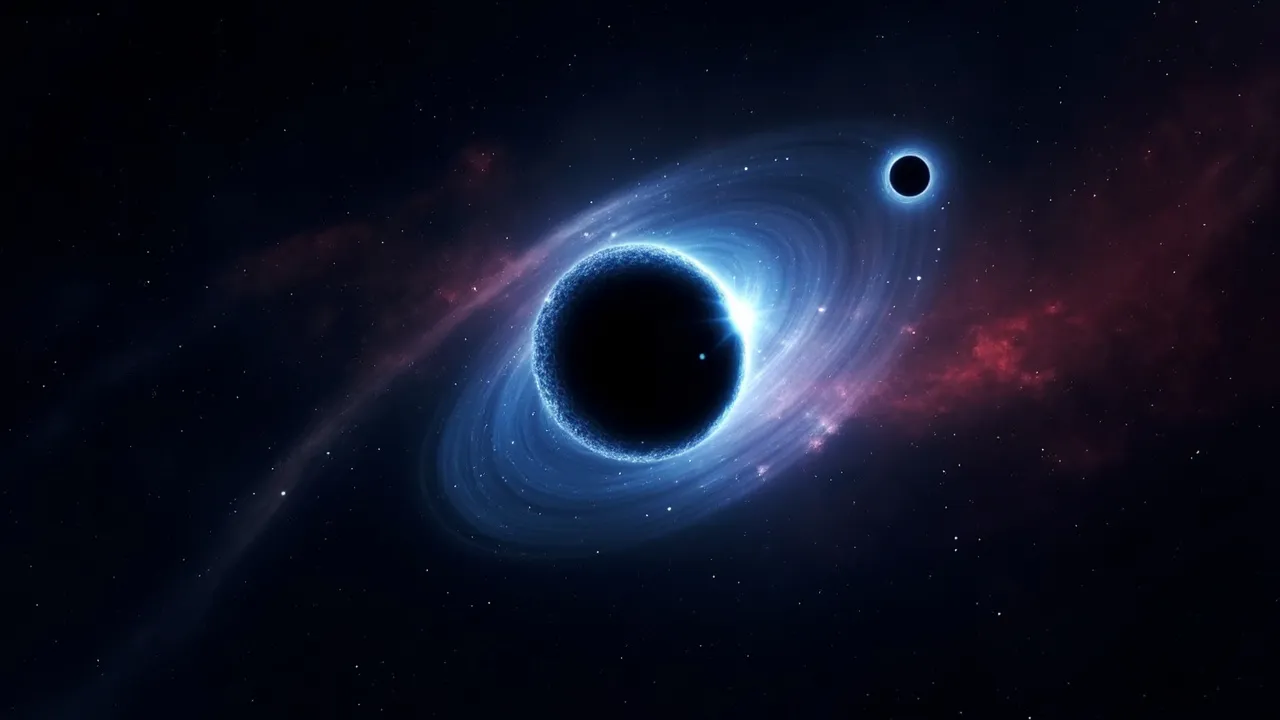
Okay, let me share something that genuinely excited me this week. Scientists have discovered what looks like a pair of supermassive black holes twirling around each other in a galaxy called Mrk 501 — and they might actually crash together in roughly 100 years.
Yeah, you read that right. One hundred years.
I know, I know — 100 years sounds like forever to us. But in the grand cosmic timeline? That's basically the blink of an eye. We're talking about objects each weighing hundreds of millions to a billion times more than our Sun, and they're locked in an orbit so tight that it takes them only about four months to go around each other once.
The Hunt for Hidden Companions
Here's why this discovery matters: supermassive black holes sit at the centers of most large galaxies. When galaxies collide (which happens fairly often throughout the universe), their central black holes eventually get pulled together too. At least, that's the theory.
The problem? Scientists hadn't actually found many pairs of these black holes circling each other. We've seen plenty of colliding galaxies, but spotting the black holes themselves in their final approach? That turned out to be tricky.
Until now, apparently.
A Jet That Gave Itself Away
The team, led by researchers at the Max Planck Institute for Radio Astronomy, was studying the galaxy Mrk 501 because it has a well-known jet shooting out from its center — one of those incredible streams of particles accelerated to nearly light-speed by the insane forces around a black hole.
But when they looked at radio observations spanning over two decades, they noticed something odd. There was a second jet. It had been hiding in plain sight, pointing in a different direction than the first one.
"We searched for it for so long, and then it came as a complete surprise," said researcher Silke Britzen. I love that quote because it captures that wonderful moment in science when you're looking for one thing and the universe shows you something else entirely.
Watching Them Dance
The really cool part came when they tracked that second jet over just a few weeks. It wasn't sitting still — it was moving. The jet appeared to sweep around the main black hole like someone tracing a circle with a flashlight. Over and over again.
Britzen described the feeling: "Evaluating the data felt like being on a ship. The entire jet system is in motion."
Can you imagine? We're watching a system with two black holes, each potentially hundreds of millions of times heavier than our Sun, slowly waltzing through space — and we can actually track their motion by following the jets they produce. That's pretty remarkable if you ask me.
The Einstein Ring Mystery
Oh, and there was a bonus observation from June 2022. The radiation from the system suddenly formed what looked like a ring — one of those beautiful Einstein rings that appear when gravity bends light in just the right way.
The researchers think the two black holes and Earth might have briefly aligned, letting the gravity of the one in front bend light from the one behind. It's like cosmic sleight of hand, and it adds another piece to the puzzle.
The Countdown Is On
So what's the timeline for this merger? Based on how the jets behave and the orbital patterns they observed, the team calculated the two black holes orbit each other every 121 days. Their separation? Between 250 and 540 times the distance from Earth to the Sun.
That might sound like a lot — and it is in absolute terms — but these are incredibly massive objects. The fact that they're this close while still maintaining their orbit suggests the final spiral inward could happen fast.
"Depending on the black holes' actual masses, their separation may shrink rapidly enough for them to merge in as little as 100 years," the researchers note.
One hundred years. An astronomical instant.
Why Should You Care?
I know what you might be thinking: "Cool, but these things are millions of light-years away. Why does it matter to me?"
Fair question. Here's my take: we're watching a process that sculpts the universe itself. When supermassive black holes merge, they send ripples through spacetime called gravitational waves. We're only just beginning to detect these waves with instruments like LIGO, and every pair we find helps us understand how galaxies evolve and grow.
Plus, let's be honest — two black holes, each billions of times more massive than our Sun, locked in a gravitational embrace and spiraling toward an inevitable collision? That's just objectively amazing. It reminds me that the universe is full of events so dramatic they sound like science fiction.
Fingers Crossed
Unfortunately, Mrk 501 is so far away that even our best telescopes can't separate the two black holes visually. We're inferring their presence from the jets and their movements. But that doesn't make the discovery any less exciting.
In fact, it makes me wonder: if we found this pair almost by accident, how many more are out there waiting to be discovered?
The universe keeps surprising us. And honestly? I wouldn't have it any other way.