
When Two Theories Don't Want to Play Nice
Here's one of the biggest headaches in science: we have two incredibly successful theories that explain how the universe works, but they absolutely refuse to cooperate with each other.
Einstein gave us the theory of relativity, which is basically the rulebook for everything massive—planets, stars, black holes, that kind of thing. It says gravity isn't really a force pulling you down; it's more like heavy objects bend space and time itself, like a bowling ball sitting on a trampoline.
Then we have quantum mechanics, which rules the teeny tiny world of atoms and particles. It's a completely different set of rules, and honestly? They're kind of weird. Particles can be in two places at once. Things can be "spooky action at a distance" (Einstein's actual phrase, by the way—he hated this idea).
The problem? Nobody can figure out how to make these two systems work together. It's been bugging physicists for almost a century.
Enter: Entangled Atoms
Now here's where this new research gets exciting. An international team of scientists from Australia and the US just pulled off an experiment that's never been done before: they've shown that atoms can have their momentum "entangled."
You might be wondering what that means. Think of entanglement like this—imagine you have two magic coins that are mysteriously linked. You flip one and get heads, and instantly, the other coin (even if it's on the other side of the galaxy) becomes tails. They're connected in a way that defies normal logic.
Scientists have known about entanglement for decades, but they've mostly tested it with light particles called photons. Here's the thing: photons don't have mass, so they're kind of boring for this particular mystery we're trying to solve. We need something heavier.
Why Atoms Are the Game Changer
That's why this atom momentum entanglement is huge. Atoms actually have mass. This opens up a completely new playground for physicists.
Picture this: if atoms can be entangled while moving through different paths in space, those paths might experience different gravitational effects. Normally, quantum mechanics says atoms can somehow take multiple paths at the same time (which is already mind-bending). But if we can prove these atoms are entangled while doing that, we might finally have a way to study quantum effects and gravity together in the same experiment.
That could be the bridge we've been searching for to connect those two feuding theories.
How They Actually Did It
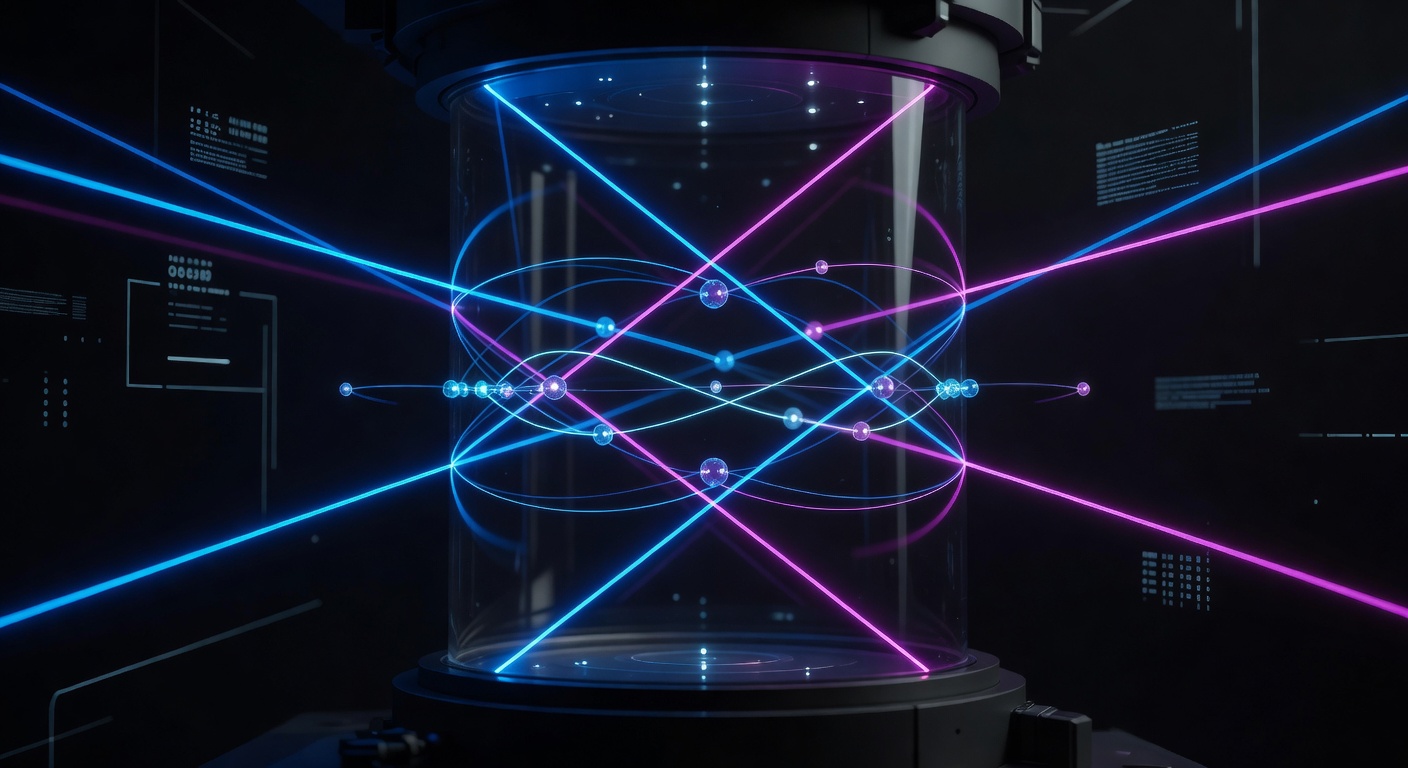
The experiment sounds like something from a sci-fi movie. The team used super-cold helium atoms (we're talking near absolute zero) suspended in a magnetic trap. Once they turned off the magnets, gravity took over and the atoms fell while passing through a series of laser pulses that created multiple possible paths.
This setup is called a Rarity-Tapster Interferometer, and it's specifically designed to measure entanglement. The results? The atoms showed signs of being entangled in their momentum—a first-ever confirmation of this phenomenon.
The Weird Part? They're Actually Serious
One of the researchers, Sean Hodgman, made it sound appropriately bizarre: "For two separated atoms that are entangled, if you change one of them, it will instantly affect the other."
Yeah. That's genuinely how quantum mechanics says reality works. And now we have experimental proof that it works this way for something with actual mass moving through actual space.
Why This Matters (Beyond Just Being Cool)
This isn't just a check in the "cool science achievements" box. This is potentially a crucial step toward finally understanding whether quantum mechanics and general relativity can be unified into a single, coherent theory of how everything works.
Scientists have been theorizing about this stuff for years, but the technical challenge of measuring individual atoms has been a serious roadblock. As technology improves and we get better at controlling and measuring atoms, experiments like this become possible.
And if this works with atoms, what happens when we use bigger objects? The researchers are already thinking about testing this with increasingly larger things. That could eventually lead to testing quantum effects on objects we can actually see—which would be absolutely revolutionary.
The Bottom Line
What we're looking at here is another tiny piece of a massive puzzle that humans have been trying to solve for nearly a hundred years. Scientists just showed that a weird quantum phenomenon that everyone suspected was possible actually is possible when you're dealing with something that has mass.
It's not the complete answer yet. It's not going to revolutionize your daily life next Tuesday. But it's a genuine breakthrough that brings us closer to understanding the deepest nature of reality itself.
And honestly? That's pretty cool.