
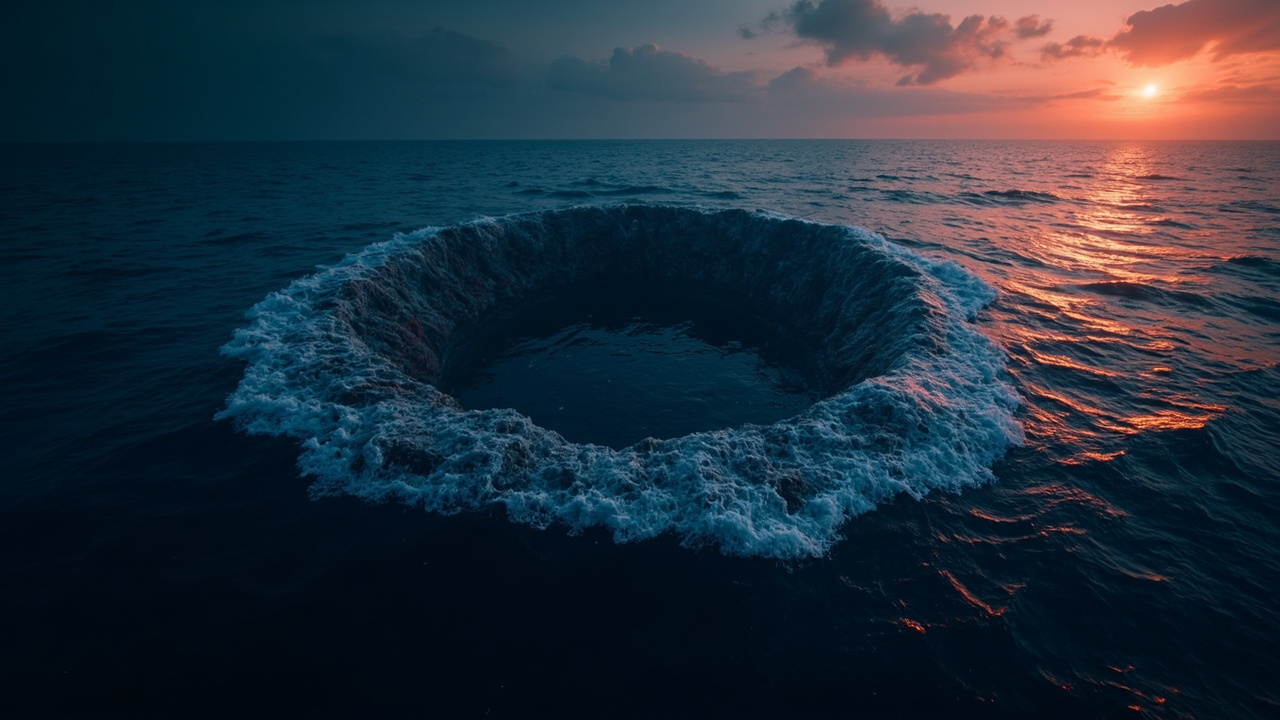
Okay, I have to be honest with you — when I first came across this story, I couldn't believe it took scientists twenty years to figure out what created a crater in the North Sea. I mean, we're talking about a hole in the ground (well, under the seafloor). Shouldn't that be pretty straightforward to figure out?
Turns out, no. And the answer they finally uncovered? Absolutely jaw-dropping.
The Mystery That Wouldn't Go Away
Picture this: It's 2002, and geologists are doing their thing, mapping the ocean floor when they stumble across something strange. About 80 miles off the Yorkshire coast, hiding roughly 2,300 feet beneath the waves, sits a crater about two miles wide. No big deal, right? Craters are everywhere on Earth.
But here's the kicker — this one didn't make sense. Its shape, the way the surrounding rock was fractured, even the way the whole structure looked on scans... it screamed asteroid impact. But not everyone was convinced.
Some scientists argued it was just salt deposits shifting around underground. Others said volcanic activity caused the seabed to collapse. The debate got so heated that in 2009, geologists literally voted on it. And here's the embarrassing part — most of them voted against the asteroid explanation.
Can you imagine being the poor researcher who was like, "No, trust me, it's space rocks," while everyone else is like, "Lol, no."
The "Silver Bullet" Everyone Was Looking For
Well, fast forward to now, and that researcher has been absolutely vindicated.
A team led by Dr. Uisdean Nicholson from Heriot-Watt University in Edinburgh recently published findings that put the debate to rest forever. And they did it by finding something that basically acts as a smoking gun for asteroid impacts: shocked minerals.
Now, I'm going to get a little sciencey here, but stick with me — it's actually cool. When an asteroid slams into Earth at thousands of miles per hour, the pressures involved are so extreme that they actually change the molecular structure of certain crystals in the rock. We're talking about quartz and feldspar crystals that get rearranged in ways that only happen under these ridiculous impact conditions.
Dr. Nicholson called finding these minerals "a real needle-in-a-haystack effort." They had to examine samples from an oil exploration well near the site, looking at tiny fragments under microscopes, hoping to spot these signature patterns.
And boom — there they were. Proof positive that something from space absolutely walloped this spot roughly 45 million years ago.
So What Exactly Hit There?
Based on all the new data — including super detailed seismic imaging (think of it like an ultrasound for the Earth) and computer simulations — the team pieced together what happened.
The culprit was an asteroid or comet about 525 feet wide. That's roughly the length of one and a half football fields, or if you prefer, about as tall as the Eiffel Tower's first observation deck. It came screaming in from the west at a shallow angle.
Here's where things get really wild.
Within minutes of impact, it created a curtain of rock and seawater over a mile high — that's taller than Mount Rushmore. All that material came crashing down and generated a tsunami over 330 feet tall.
Let me say that again. A 330-foot tsunami.
To put that in perspective, that's taller than many skyscrapers. If something like that hit today, we're not just talking about coastal damage — we're talking about entire cities being wiped off the map. The good news? This happened about 12 million years before the first humans even showed up, so our ancestors didn't have to deal with this particular disaster.
Why Does This Even Matter?
You might be wondering — okay, cool story, but who actually cares what happened millions of years ago in a spot most of us will never see?
Here's the thing: Earth gets hit by space rocks way more often than most people realize. Most are small and burn up in the atmosphere (those are your "shooting stars"). But occasionally, something big enough to cause serious damage comes along.
By studying craters like Silverpit, scientists can better understand how often these events happen, what happens when they do, and — hopefully — how we might protect ourselves in the future. NASA's already tracking objects that could potentially threaten Earth, but every impact crater we study adds to our understanding of what we're dealing with.
Plus, let's be real — this is just a genuinely amazing story. An ancient cosmic visitor, a hidden crater, decades of scientific debate, and finally, proof that yes, asteroids really do hit Earth and leave behind geological scars that persist for millions of years.
It's the kind of thing that makes you look up at the night sky a little differently, right?
Source: ScienceDaily