
Okay, I need to tell you about something that just happened in the world of particle physics, and I promise it's way cooler than it sounds. Seriously, grab a coffee and stick with me here.
The Universe's Wild Beginning
Picture this: 13.8 billion years ago, the universe pops into existence. In those first microseconds — we're talking millionths of a second, people — everything was impossibly hot. I'm talking trillions of degrees. At those temperatures, the rules get weird. Instead of the protons, neutrons, and atoms we're familiar with today, there was this bizarre substance called quark-gluon plasma (or QGP for short).
Think of quarks and gluons as the most fundamental ingredients you could possibly have. They're the building blocks that combine to make literally everything you see around you — your coffee cup, your phone, your cat, you. But in those earliest moments, they weren't locked together. They were zipping around freely in a superheated soup of particles, all racing around at nearly the speed of light.
Then, almost as quickly as it formed, everything cooled down, and those quarks and gluons got locked together into the particles we still have today. For the longest time, scientists couldn't really study what that primordial soup actually behaved like. We had theories, sure, but direct evidence? That was missing.
Recreating the Beginning in a Tunnel Beneath Switzerland
Here's where it gets fun. For years, physicists at CERN's Large Hadron Collider have been doing something absolutely wild: they're recreating the early universe's conditions by smashing heavy atoms (like lead) together at nearly the speed of light. When these collisions happen, they briefly — we're talking fractions of a quadrillionth of a second — create tiny droplets of that same quark-gluon plasma that existed all those billions of years ago.
It's like having a time machine, except instead of sending anything back, you're creating microscopic snapshots of what the cosmos looked like when it was basically still a baby.
The Breakthrough: Watching Quarks Make Ripples
Now, here's the new part that's got physicists pretty excited. A team led by MIT's Yen-Jie Lee just announced they've seen something remarkable: quarks creating wakes as they move through the plasma.
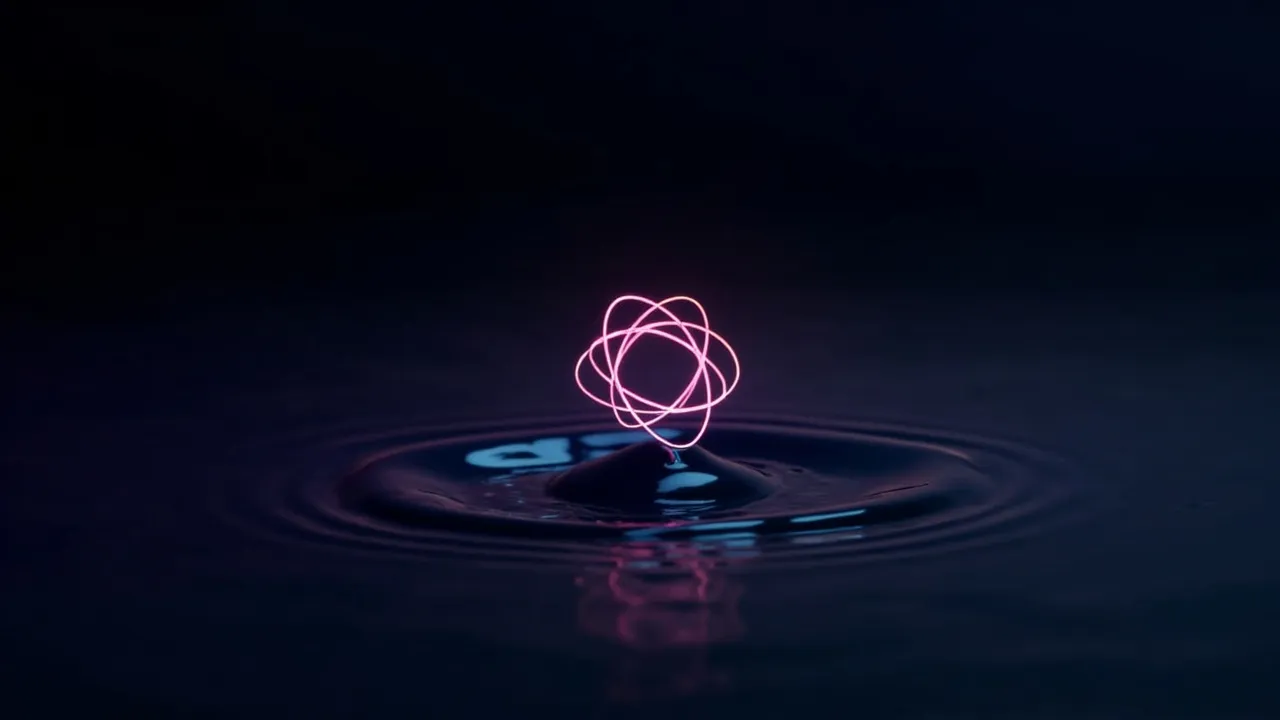
Let me break that down with a picture you can relate to. Imagine you're at a pond, and you toss a stone in. Ripples spread out from where it landed, right? Now imagine a duck swimming across the surface — it creates a little wake behind it, a trail of ripples.
That's basically what these physicists saw happening at the subatomic level.
When a quark rockets through the quark-gluon plasma, it doesn't just pass through unaffected. The plasma is so dense and interconnected that it responds to the quark's presence. The quark pushes against this primordial material, creating waves, splashes, and even swirling motions.
Lee put it beautifully: "The plasma is incredibly dense, such that it is able to slow down a quark, and produces splashes and swirls like a liquid."
This is a big deal because it confirms something theorists have suspected for years — the quark-gluon plasma doesn't behave like a bunch of independent particles bouncing off each other. Instead, it acts as a unified, flowing substance. A liquid, if you will. The hottest liquid in the universe's history, at that.
Why Didn't We See This Before?
You might be wondering — if this is such a fundamental behavior, why is this the first time we've observed it?
The honest answer is that it's incredibly hard to detect. When scientists have looked for this effect before, they typically searched for pairs of quarks and their counterparts (antiquarks), expecting both to create detectable wakes. But here's the problem: when two particles are produced going in opposite directions, one quark's wake tends to overshadow the other's. It's like trying to hear two whispers in a noisy room.
Lee and his team developed a clever new detection method that let them finally pick out these quark wakes from all the chaos of particle collisions. They essentially found a way to isolate and identify the signature of a single quark disturbing the plasma around it.
What Does This Mean for Us?
Beyond the "that's pretty neat" factor, why should you care?
Understanding how quark-gluon plasma behaves gives us crucial clues about the universe's earliest moments. By measuring the size of these wakes, how fast they travel, how far they extend, and how quickly they fade away, scientists can start to pin down the properties of this primordial substance.
As Lee explained, "Studying how quark wakes bounce back and forth will give us new insights on the quark-gluon plasma's properties. With this experiment, we are taking a snapshot of this primordial quark soup."
We're essentially looking at a cosmic photograph from 13.8 billion years ago, and every new technique like this one adds more pixels to the picture.
The Bottom Line
So here's the takeaway: the universe's first moments involved a kind of matter that flowed like liquid, responded to particles moving through it, and existed for just the briefest instant before cooling into the building blocks of everything we know today.
And now, thanks to some clever physics and a massive particle accelerator, we've just gotten a clearer glimpse of what that looked like.
Not bad for a species that figured out fire only a few hundred thousand years ago.