
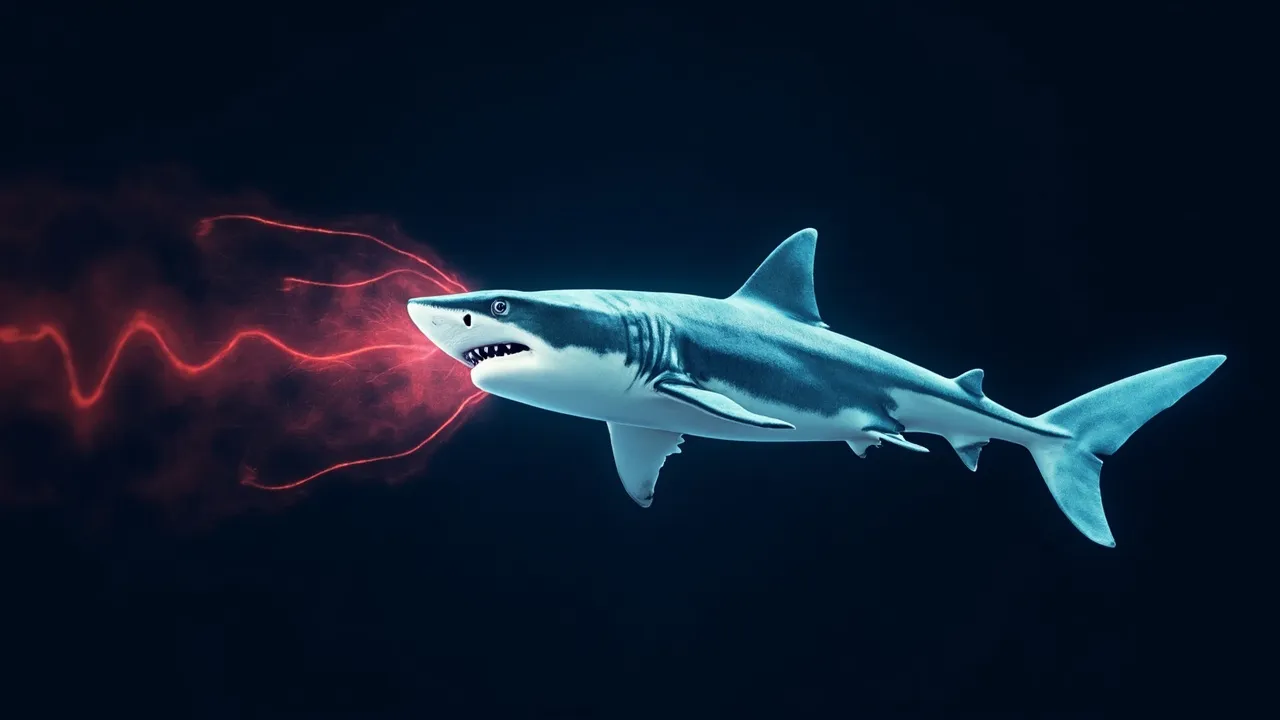
Okay, I have to admit something. When I first heard about this new study on shark hearing, my initial thought was "wait, sharks can hear?" Like, I knew they had impressive senses — those famous ability to detect electrical fields, the incredible sense of smell — but hearing? That one hadn't really been on my radar.
Well, buckle up, because it turns out sharks have been quietly flexing some serious auditory superpowers all along.
The Sound of Silence (Which Sharks Definitely Don't Have)
Picture this: You're swimming in the ocean. Visibility might be limited, but sound? Sound travels beautifully through water. And for sharks, that means the ocean is basically a giant information highway of clicks, splashes, and rustling movements.
Scientists have always known sharks could hear something. But here's the thing — nobody had actually measured how far away they could detect sounds while swimming around freely in the ocean. Previous experiments were mostly done in tanks, which, as it turns out, create all sorts of acoustic weirdness when sound bounces off the walls.
That's what makes this new research from Florida Atlantic University so exciting. They went straight to the source: blacktip sharks hanging out in the wild waters off Palm Beach County, Florida.
The Experiment That Made Me Say "Whoa"
So what did these researchers actually do? They dragged an underwater speaker out into the ocean, played some low-frequency sounds, and watched what happened with drones flying overhead.
The setup was pretty clever. They anchored a boat, dropped in a speaker that drifted with the current, and played three different ranges of low-frequency sounds. The key detail? They played sounds loud enough to trigger a "startle response" — basically, they wanted to see if sharks would suddenly change direction and bolt away.
And you know what? The sharks totally did.
The researchers recorded sharks reacting to sounds from up to 74 meters away. For those of you keeping track at home, that's about 243 feet. That's roughly the length of two and a half school buses lined up. Or, in shark terms, an incredibly impressive distance to detect a sound you can't even see.
Here's What Really Blew My Mind
But here's the part that really got me: not only could these sharks hear sounds from that far away — they also knew which direction the sounds were coming from.
Think about what that means. When you hear a weird noise in your house at night, you might freeze and try to figure out where it's coming from, right? Sharks can do the same thing, but underwater, from nearly 250 feet away, while swimming.
The sharks would detect the sound and then abruptly turn away from it. That wasn't just a reaction to noise — that was active processing of spatial information. They heard something, figured out where it was, and decided whether to investigate or bail.
More than 70% of these responses happened in what's called the "acoustic far field" — the zone where sound behaves differently than it does close to the source. Previously, scientists weren't even sure sharks could do this in the real world.
How Do They Even Do That?
Now here's where things get really interesting from a biological standpoint. Most fish have something called a swim bladder — a gas-filled organ that helps them float. That organ also happens to be useful for detecting sound pressure.
Sharks? No swim bladder. They've evolved completely differently.
Instead, scientists believe sharks rely heavily on their inner ears, which contain a specialized structure called the macula neglecta. This little guy helps detect the particle motion generated as sound waves travel through water.
It's a completely different hearing mechanism than what most fish use, and honestly, it's kind of amazing that it works so well from such distances.
Why This Matters
Beyond just being cool (and it is cool), this research tells us something important about shark behavior and ecology. If sharks can detect sounds from hundreds of feet away, that means they're getting constant information about their environment — potential prey splashing around, predators approaching, other sharks in the area.
It also explains why studying sharks in captivity can only tell us so much. In a tank, sound bounces everywhere. You can't replicate those real-world distances and acoustic conditions. To truly understand how sharks experience their world, you need to get out there and watch them in action.
The Bottom Line
So next time you think about shark superpowers, don't just focus on the teeth and the terrifying speed. Add hearing to that list. These creatures can detect and localize sounds from nearly a quarter of a football field away using a completely different mechanism than most other fish.
Honestly, I find that both fascinating and slightly humbling. We've been studying sharks for decades, and we're still discovering basic things about how their senses work. There's always something new to learn about these ancient, incredibly adapted predators.
Maybe that's what makes the ocean so endlessly fascinating. Every time we think we understand it, we realize we've barely scratched the surface.
SOURCE: ScienceDaily