
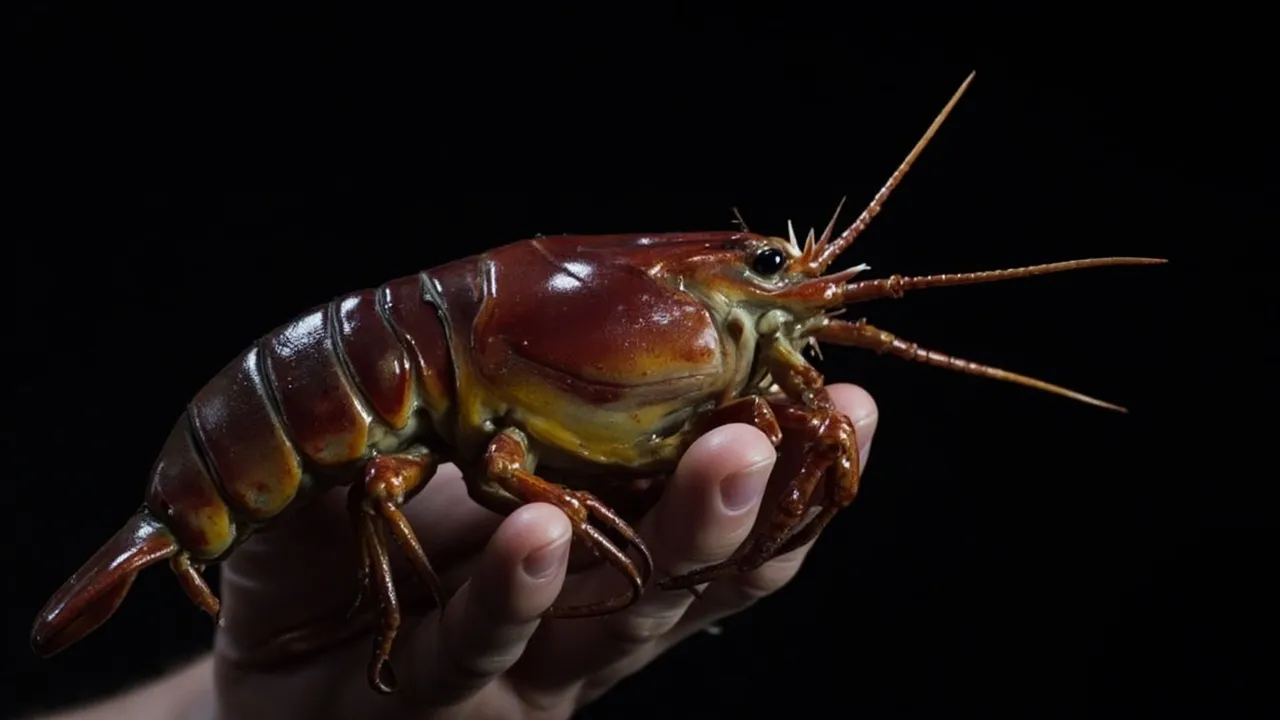
The Crayfish That Started It All
Look, I love a good "world's biggest" story. You know the ones — the giant pumpkin, the massive goldfish, the lobsters that look like they should be applying for life insurance. Well, scientists just found themselves in a similar situation, except instead of a backyard garden or a fishing trip, it all started with a muddy catch during a routine biological survey in Kentucky.
The researcher, Caitlin Bloomer, pulled this absolute unit of a crayfish from the mud. We're talking about a creature so impressive that she gave it the legendary nickname "Crawzilla." I love that she did that, by the way. You know someone is confident about their specimen when they immediately give it a superhero name.
So picture this: Bloomer comes back to campus, absolutely beaming, ready to show off her once-in-a-lifetime discovery. "Look at this thing! LOOK AT IT!" Probably something along those lines.
And her colleague just... looked at it. And said, "No way. I've caught bigger."
Mic drop.
A Scientific Feud (Affectionately Called)
Now, I'm sure there are many ways this story could have gone. Maybe there was awkward silence. Maybe there was some professional backpedaling. But what actually happened is way cooler — Bloomer turned this friendly doubt into a full-blown nationwide investigation.
She started reaching out to biologists and museum curators across the country. She asked them to dig through their collections, break out the calipers (those fancy measuring tools scientists use when they want to be precise), and hunt for any unusually massive crayfish specimens.
What started as a little friendly rivalry became something genuinely scientific. The team ended up comparing specimens from all over, building a list of the 20 largest crayfish ever documented in North America. And get this — 18 different species made that list. It's not like one species dominates the giant rankings. Crayfish of all kinds have their champions.
Here's the thing that made me laugh: Bloomer's beloved Crawzilla didn't even win. It came in somewhere in that top 20, which honestly is still incredibly impressive. But not the top spot.
"Mine was not the biggest, but it did make the top 20, so I'm super proud of it," Bloomer said. "And it was also the only burrowing crayfish to make the list, so I'll take the win."
That's the spirit. You didn't win, but you won something. I'm here for this energy.
Meet the Actual Record Holder
The reigning champion turned out to be a Tennessee bottlebrush crayfish sitting pretty in the collection at West Liberty University in West Virginia. This beast measured a whopping 86.6 millimeters — about 3.4 inches — and that's just its body. We're not even counting the tail, claws, and antennae.
Here's the wild part: this crayfish wasn't even a fresh catch. It had been collected way back in 2011 by Dr. Zac Loughman and some students. It was just sitting in a museum collection, being its enormous self, waiting for someone to measure it and realize its true potential.
Dr. Zackary Graham, who's now the proud custodian of these giants, put it in terms we can all understand: the carapace alone is about the length of a credit card. And if you stretched out the whole thing — tail and claws included — it would stretch nearly the width of a sheet of notebook paper.
Both of these massive specimens are now displayed in his office. He shows them to everyone who walks in. I'd absolutely want to be that guy at parties. "Oh, you like my office? Check out my crayfish."
But Here's Where It Gets REALLY Interesting
Okay, so we found the biggest crayfish in North America. Case closed, right? Well, not exactly. Because when the researchers started analyzing all their data, they noticed something genuinely puzzling.
Almost all the giants clustered around the same size — roughly 80 millimeters. Doesn't matter what species, doesn't matter where they came from, doesn't matter what environment they lived in. The biggest crayfish just... stop growing at around that point.
And that raised a genuinely cool question: why?
I mean, think about it. Crayfish elsewhere in the world get MUCH bigger. The Tasmanian giant freshwater crayfish can be absolutely massive, with some specimens weighing over 10 pounds. That's not a typo — pounds. So what's keeping North American crayfish stuck at what is, comparatively speaking, a modest size?
The team started investigating. Latitude? Oxygen availability? Habitat type? They checked everything that seemed like a reasonable explanation.
And nothing matched.
"We started looking at things like latitude, oxygen availability, and habitat type as possible correlates to explain why certain species and individuals were larger than others, but we weren't seeing any patterns," Bloomer explained.
That's the part that really fascinates me. Sometimes science is about answering questions. But sometimes science is about realizing the answer is way more complicated — or unknown — than you expected.
What Does This Mean?
Honestly? We're looking at one of the first real attempts to understand the upper size limits of North American crayfish. And it turns out that limit might be surprisingly consistent across the continent, even though we can't fully explain why yet.
Maybe there's something in the water — literally or figuratively. Maybe there's a biological constraint we haven't identified. Maybe North American crayfish evolved in a context that capped their growth potential in ways that crayfish in Australia and Tasmania never faced.
The honest answer is that scientists don't know for sure. And I think that's kind of beautiful. We found the biggest crayfish, and in doing so, we discovered there's a lot more to learn about why things are the size they are.
So next time you see a crayfish — probably at a crawfish boil or something equally delicious — take a moment to appreciate its dimensions. Because apparently, there are forces at work determining exactly how big these little guys can get, and we're only just starting to understand them.
And if you happen to find one approaching that 80-millimeter mark? Name it something cool. Give it a shot at scientific immortality.
The original research was published in the journal Ecology.
Source: ScienceDaily