
Okay, I have to be honest with you — when I first heard about this story, I got a little bit giddy. Picture it: a rock floating through our Solar System that came from somewhere entirely different, somewhere around another star. And what did scientists do? They pointed a bunch of radio antennas at it and went, "Hello? Anyone home?"
That's basically what happened with 3I/ATLAS, the third interstellar object we've ever spotted cruising through our cosmic neighborhood. It showed up in July 2025, and the team at the SETI Institute (that's the Search for Extraterrestrial Intelligence, for those playing at home) got right to work listening for any signals that might suggest this wasn't just a really ambitious space snowball.
Now, before we get into the details, let's talk about why this even matters. Interstellar objects are incredibly rare guests. We've only confirmed three of them ever: first there was 'Oumuamua back in 2017, then Borisov in 2019, and now good old 3I/ATLAS. These objects formed around other stars billions of years ago and somehow got kicked out of their home systems, wandering through the galaxy until they happened to drift through our little corner of space.
That's pretty remarkable when you think about it. These things have traveled farther than anything human-made except for our Voyager probes. As Dr. Sofia Sheikh, the lead author of the study, pointed out: eventually our own Voyager spacecraft will be artifacts in other stellar systems. So in a way, we're practicing for the day when we're the interstellar visitors someone else might detect.
So what did they actually do?
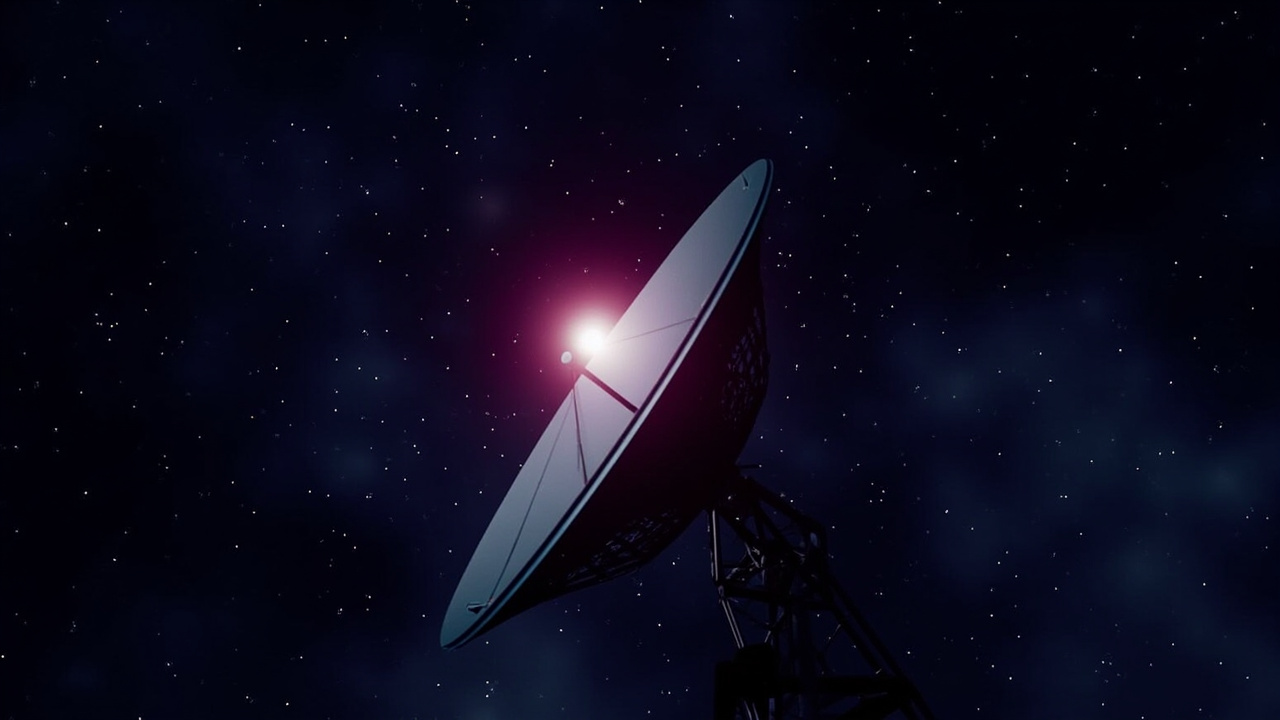
The team used the Allen Telescope Array up in Northern California's Hat Creek Radio Observatory. Think of it like a bunch of satellite dishes working together as one giant ear. They pointed it at 3I/ATLAS for more than seven hours, listening across frequencies from 1 to 9 gigahertz — a range specifically chosen because narrowband radio signals (the kind we'd expect from technology) don't occur naturally.
Here's where it gets interesting. During the search, they picked up nearly 74 million narrowband signals. Seventy-four million! That's a lot of data to sort through.
But here's the thing — most of those signals weren't coming from the interstellar object at all. They were good old Earth-based interference. You know, our cell phones, satellites, WiFi networks, and all the other electromagnetic chatter we pump into the atmosphere every single second. The team had to carefully filter through all that noise, looking only for signals that matched the object's actual motion through space.
After whittling things down, they were left with about 200 candidates. And after even more careful analysis? Every single one of those signals turned out to be from human technology — either ground-based or orbiting Earth.
No alien transmissions. No mysterious signals from beyond. Just us, once again, talking to ourselves.
But wait — this isn't a failure
I know what you're thinking: "They found nothing. Big whoop." But hear me out, because the story here is actually pretty cool.
First, they established new limits on what any potential transmitter on 3I/ATLAS could be putting out. They essentially ruled out radio signals stronger than about 10 to 110 watts across the frequencies they searched. That's roughly the power of a household appliance. So if there were aliens with a radio transmitter hanging out on this thing, it wasn't putting out more power than your toaster. (Though honestly, if aliens are out there, I'd hope they'd have better communication systems than a 110-watt setup, but I digress.)
More importantly, as co-author Valeria Garcia Lopez said, this demonstrates just how realistic it is to detect a technosignature with current technology. We're not guessing anymore — we know what works, what to look for, and how to filter out all the messy interference we create ourselves.
And perhaps most impressively, the whole observation started less than 24 hours after 3I/ATLAS was announced. That kind of rapid response is exactly what we need when dealing with interstellar visitors, since they're not sticking around. These objects zip through our Solar System and then they're gone, possibly forever.
The bigger picture
Look, I won't pretend this search found evidence of alien life. It didn't. But here's what I love about this kind of research: it's methodical, it's thorough, and it's preparing us for the future. Every interstellar object we examine teaches us something — not just about what these cosmic tourists are made of, but about how to search for technosignatures in general.
As Dr. Sheikh noted, we need to understand the natural distribution of these objects so that someday, if something genuinely strange shows up, we'll know the difference between a weird comet and an actual artifact.
The universe is vast. We're only just beginning to understand what might be out there. And studies like this one? They're building the foundation for whatever discoveries come next.
So next time you hear about an interstellar visitor swinging through our Solar System, remember: somewhere, some scientist might just be listening.
Just in case.
Source: ScienceDaily