
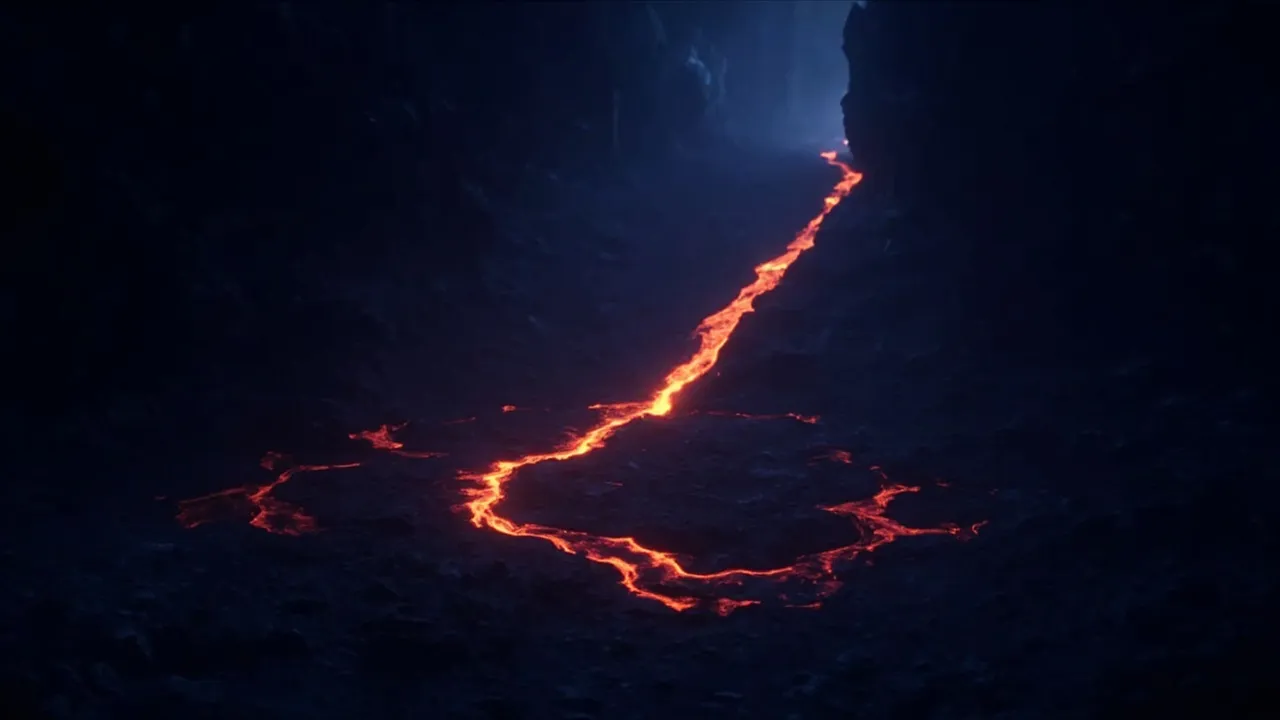
What's Going On Deep Down There?
Okay, let me paint you a picture. Imagine Earth as a hard-boiled egg (stick with me here). The thin shell? That's the crust we live on. The white? That's the mantle, made of solid rock that slowly churns. But the yolk? That's where things get really interesting.
The yolk is actually two parts: a solid inner core (about the size of the Moon!) and a liquid outer core surrounding it. This outer core is made of molten iron and nickel, and it's absolutely massive — about 2,200 kilometers thick. That's roughly the distance from London to New York, buried deep inside our planet.
Now here's the cool part: as this liquid iron sloshes around, it creates electrical currents. And those currents generate Earth's magnetic field — the invisible force that makes compass needles point north and protects us from harmful solar radiation. Scientists call this process the "geodynamo," and it's essentially what keeps our planet habitable.
The Great Reversal of 2010
For decades, researchers tracking tiny variations in Earth's magnetic field believed they understood how this deep molten layer behaved. They concluded that most of the outer core was flowing westward — a slow, steady drift that seemed pretty stable.
Then came 2010.
Something changed dramatically beneath the Pacific Ocean. A vast region of molten iron-rich fluid that had been lazily drifting westward suddenly shifted gears and started moving strongly eastward instead. The researchers described it as a "large-scale flow reversal" — and here's the thing that really got everyone excited: nobody has a clue what triggered it.
That's right. We still don't know why this happened.
The Satellite Heroes
Here's where things get high-tech. Scientists have been using satellites to peer into Earth's interior in ways that would have seemed like science fiction just a few decades ago. The European Space Agency's Swarm mission — three satellites launched in 2013 — has been absolutely crucial in tracking these changes.
Each satellite carries incredibly sensitive magnetometers that can measure Earth's magnetic field with remarkable precision. Because they orbit in carefully coordinated patterns, they can separate the magnetic signals coming from deep in the core (the good stuff!) from signals produced by the crust, oceans, ionosphere, and magnetosphere. It's like having three detectives working together to isolate one specific voice in a massive crowd.
Combined with data from other missions like Germany's CHAMP and Denmark's Ørsted satellite, researchers have now reconstructed flow patterns near the core-mantle boundary with unprecedented detail. Their findings were published in the Journal of Studies of Earth's Deep Interior.
This Changes Everything (Or Does It?)
Here's what's really striking about this discovery: scientists had assumed that large-scale circulation in the outer core was relatively stable. The idea was that while small turbulence exists, the big picture remains consistent over decades.
The 2010 reversal throws that assumption out the window.
"It suggests that the system can vary much more quickly than previously believed," the research team noted. We're not talking about millions of years of gradual change here — this was a dramatic shift that happened almost suddenly (geologically speaking).
The lead author, Frederik Dahl Madsen from the University of Edinburgh, put it well: "The large-scale flow reversal beneath the Pacific raises new questions about the behavior of Earth's deep interior."
Wait — It Might Be Connected to the Inner Core?
Now here's where things get even more intriguing. The research team has noticed something fascinating: the rise of this eastward flow beneath the Pacific coincides with changes in behavior in the inner core — the solid metal ball at Earth's center.
Using data from geodesy and seismology, scientists have inferred that the inner core may be doing its own thing right now. And the team hypothesizes that these changes might be connected — like two dancers responding to the same music, even if we can't hear the tune.
Could there be a relationship between what's happening in the solid inner core and the liquid outer core surrounding it? That's a question researchers are now eager to explore.
Is It Over Already?
Here's a plot twist: the strong eastward flow beneath the Pacific has actually been weakening since 2020.
This raises some exciting possibilities. Maybe the reversal was just a temporary blip — a brief anomaly in an otherwise stable system. Or maybe it's part of a longer natural cycle, like a slow-motion pendulum swinging back and forth over centuries.
The honest answer? We don't know yet. But continued monitoring will be essential to figure out what's happening.
Why Should You Care?
I know what you're thinking: "Cool science, but why does this matter to me?"
First, Earth's magnetic field is literally keeping us alive. It deflects harmful radiation from the Sun and solar winds that would otherwise strip away our atmosphere. Understanding how the geodynamo works helps us understand how this protection might change over time.
Second, this discovery reminds us how much we still don't know about our own planet. We can see galaxies billions of light-years away, but there are fundamental mysteries happening just a few thousand kilometers beneath our feet. That's humbling and exciting at the same time.
Third, understanding Earth's interior helps us understand other planets too. The same physics that drives our geodynamo might be at work elsewhere in the solar system — and knowing more about our own backyard gives us clues about planetary behavior everywhere.
The Bottom Line
What we have here is a genuine scientific mystery. Something deep inside Earth changed direction dramatically in 2010, and we don't fully understand why. New satellite technology is finally giving us the tools to observe these distant processes, and the findings are challenging long-held assumptions.
As Anja Stromme, ESA's Swarm Mission Manager, noted: "Long-duration satellite magnetic measurements allow researchers to follow changes in the geodynamo in near-real-time."
So the next time you use a compass, or watch the Northern Lights dance across the sky, or simply feel grateful that our atmosphere is still intact — remember that somewhere far below your feet, a river of molten metal is sloshing around in ways we're only beginning to understand.
And honestly? That's pretty amazing.