
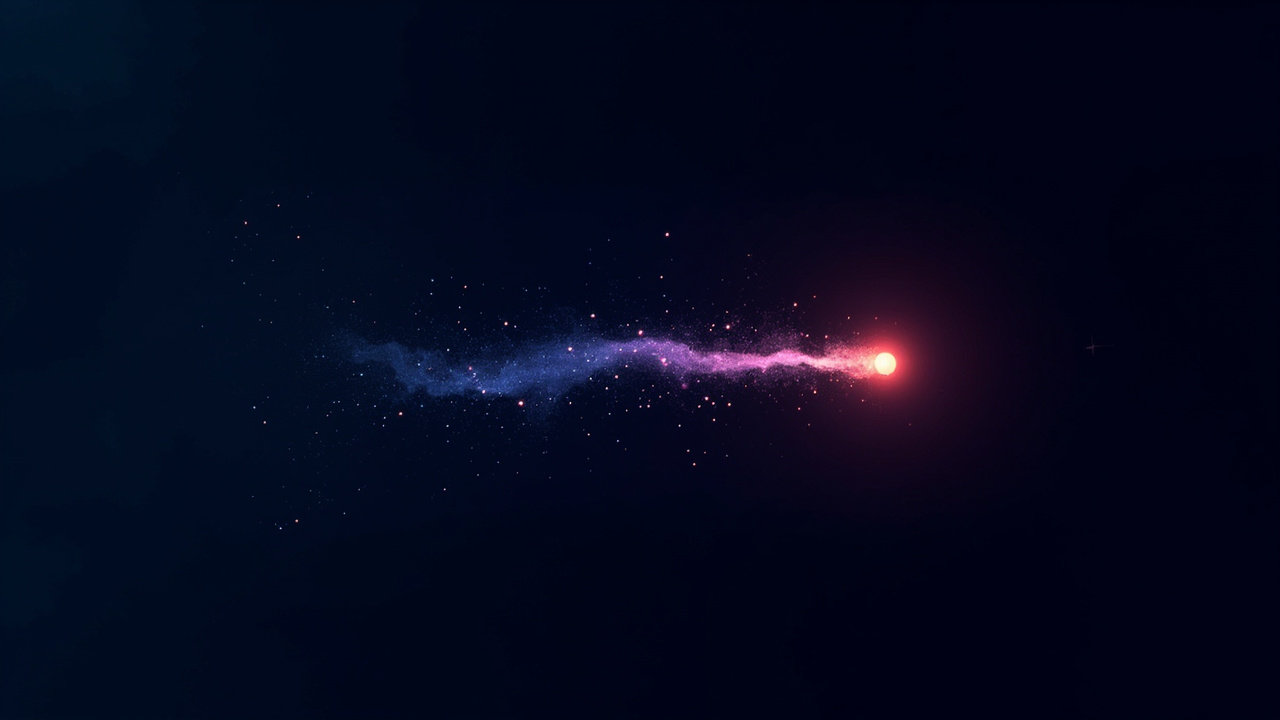
- Hook about the mysterious particle
- Explain what cosmic rays are in simple terms
- Introduce the Amaterasu particle
- The mystery (cosmic void)
- The new research findings
- What this means for understanding the universe
- Personal commentary/thoughts
Okay, I need you to imagine something wild for a second.
You're standing on a beach, minding your own business, when—wham—a grain of sand hits you in the face. No big deal, right? Except this particular grain of sand isn't just annoying. It's moving so fast that it carries the same energy as if you threw a tennis ball at your own face at full speed.
That's basically what happened back in 2021, except instead of a beach, it was Earth, and instead of sand, it was a cosmic particle so powerful that scientists named it after the Japanese sun goddess. They called it the Amaterasu particle.
So What Exactly Is This Thing?
Let me break it down in terms that won't make your brain hurt. Cosmic rays are basically particles—usually protons or atomic nuclei—that zoom through space at ridiculous speeds. Most of them come from our sun or distant stars, and they're constantly bombarding our planet. Usually, you don't notice because the atmosphere blocks most of them.
But every now and then, one of these particles is so incredibly energetic that it punches right through everything and slams into Earth with force that frankly seems impossible. We're talking about energies way beyond what our biggest particle accelerators like the Large Hadron Collider can produce. The Amaterasu particle? It was about 240 exa-electron volts. That's roughly 10 million times more energetic than particles inside the LHC. One tiny atomic nucleus carrying the kick of a tennis ball.
The previous record holder was the "Oh-My-God particle" from 1991, and scientists have been trying to explain these monsters ever since.
The Problem That Baffles Everyone
Here's where things get weird—really weird.
When researchers traced back where the Amaterasu particle came from, they found something completely unexpected: it appeared to originate from a cosmic void. A nothing zone. A region of space so empty that there are no known stars, galaxies, or anything else powerful enough to launch such a monster particle.
And that's the puzzle. These ultra-energetic cosmic rays must come from the most violent events in the universe—things like neutron star collisions, massive stars collapsing into black holes, or gamma-ray bursts. But the Amaterasu particle pointed to a cosmic dead zone.
It's like finding a perfectly cooked gourmet meal in the middle of the Sahara Desert with no kitchen in sight.
The New Discovery That Changes Everything
Here's where it gets exciting. A team of researchers at Penn State just published findings that might explain this cosmic head-scratcher, and honestly, their idea is pretty clever.
They suggest that some of these ultra-powerful cosmic rays might not be protons or lighter particles at all. Instead, they might be ultraheavy nuclei—heavy atoms, possibly even heavier than iron.
Now, you might think heavier particles would have a harder time surviving the journey through space, and normally you'd be right. But here's the interesting part: according to their computer simulations, these heavy nuclei actually lose energy more slowly as they travel across vast cosmic distances. It's like they have better stamina for the long haul.
This means they can make the trip to Earth while still carrying their extreme energy, unlike lighter particles that would burn through their energy reserves along the way.
Why Should You Care?
I know what you're thinking: "Cool science fact, but why does this matter?"
Here's why I find this stuff genuinely fascinating. We're talking about using tiny particles to understand some of the most violent, extreme events in the entire universe. When massive stars collapse or neutron stars collide, they're events so powerful that they reshape galaxies. Understanding cosmic rays helps us understand these cosmic engines.
And honestly? There's something almost poetic about it. These particles have traveled millions or even billions of light-years, crossed intergalactic space, and slammed into our little planet. They're messengers from the most violent corners of the universe, and we're just now getting smart enough to catch and study them.
The researchers aren't claiming they've solved everything yet. But if some of these ultra-energetic cosmic events are indeed caused by heavy nuclei, it completely changes how we search for their sources. We need to look for different kinds of cosmic events, different mechanisms, different explanations.
The Bigger Picture
We've been studying cosmic rays for over 60 years, and honestly, we still don't fully understand where the most powerful ones come from. That might seem frustrating, but I think it's actually pretty exciting. It means there's still so much to discover out there.
Every time we think we have physics figured out, the universe throws us a curveball like the Amaterasu particle. And you know what? That's the best part of science. It's the universe reminding us that we're still learning, still questioning, still amazed by what's out there.
So the next time you feel the sun on your face or look up at the stars, remember: the cosmos is constantly sending us messages. We're just getting better at understanding the language.