
So here's a fun head-scratcher for you: what happens when the very thing pushing your spacecraft forward starts working against you at extremely high speeds?
That's exactly what researchers at the Harbin Institute of Technology recently uncovered, and honestly, it's one of those findings that makes you appreciate just how weird the universe is when you start moving really, really fast.
The Basic Idea Behind Solar Sails
Let me explain how solar sails work in the first place, because it's genuinely cool. You know how you can feel the sun's warmth on your skin? Well, that sunlight carries actual momentum. When those photons hit a surface, they push on it—just very, very gently.
A solar sail is basically a giant reflective sheet, kind of like an enormous mirror made of incredibly thin material. When sunlight bounces off it, the change in direction of all those photons creates a tiny bit of push. It's not much, but in the frictionless void of space, it adds up. Over time, a spacecraft with a large enough sail can build up serious speed without needing to carry any fuel.
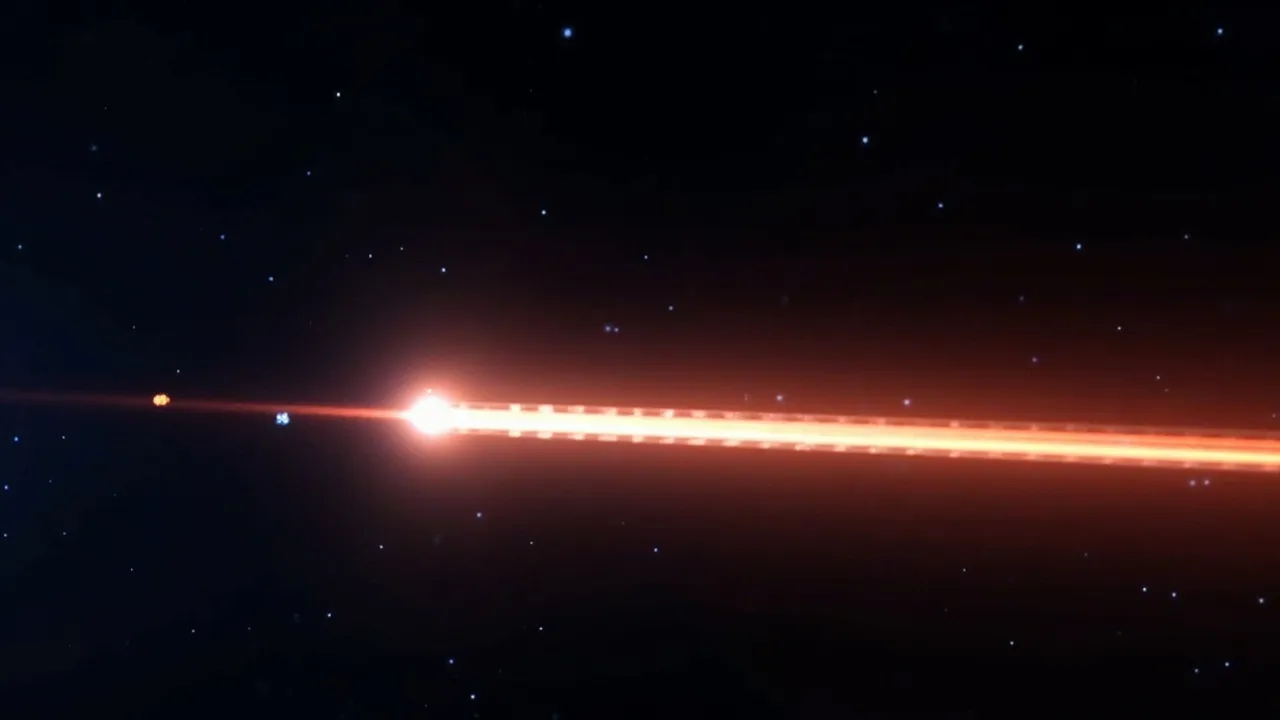
Now here's where it gets ambitious: some researchers want to use powerful lasers instead of just sunlight. By aiming extremely focused beams at a lightsail, we could theoretically accelerate a tiny spacecraft to a substantial fraction of the speed of light—potentially reaching nearby stars within our lifetime rather than waiting thousands of years.
But there's a catch. And it's a weird one.
When Light Starts Betraying You
The researchers figured out that there are actually three different ways light pushes on a sail:
First, you've got the raw impact of incoming photons hitting the sail—that's the main push. Second, there's the momentum from light bouncing off (perfect reflection gives you more push than messy bouncing). And third, there's something called diffuse scattering, where some light gets absorbed by the sail material and then re-emitted in random directions.
At normal speeds, all three of these help move you forward. But once you start getting really fast—approaching relativistic velocities—things get strange.
Here's the first problem: the Doppler effect. As the sail zooms away from the laser, the light reaching it gets redshifted—its frequency drops. That means each photon carries less oomph, so the push weakens. The faster you go, the harder it is for the laser to keep accelerating you.
But then there's a second effect that kicks in around 75% of light speed. This one is where it gets genuinely counterintuitive.
The Drag Problem at High Speeds
At 75% of lightspeed, something called relativistic light aberration becomes important. From our perspective watching from Earth, the diffusely scattered light starts getting beamed forward—toward the direction the sail is traveling—rather than scattering in all directions.
Remember how I said every action has an equal and opposite reaction? Well, when all that scattered light goes forward, it pushes backward on the sail. This creates drag—not enough to stop the spacecraft, but enough to make the whole system less efficient.
It's like if you were swimming and the water you were pushing backward suddenly started flowing around and pushing you forward instead. You'd still move, but your strokes wouldn't work as well.
Real Materials Would Make Things Even Harder
Now, I should mention that this research looked at an idealized perfectly-reflective sail. Real sails would have to deal with additional complications the paper doesn't cover.
For one thing, there's the actual interstellar medium—atoms and dust floating between stars. At these speeds, even sparse particles could cause damage or drag. There's also the small matter of thermal limits: pointing an incredibly powerful laser at a thin material might cause it to melt or vaporize.
Engineers are already thinking about advanced materials like metamaterials and photonic crystals that could be designed to handle specific laser wavelengths. Some designs might even turn the aberration effects to their advantage, helping the sail automatically stabilize its orientation.
Why This Still Matters
I know what you might be thinking: "Okay, so there's a problem at 75% of light speed. We'll just... go slower, right?"
But here's the thing—traveling between stars is hard enough without adding arbitrary speed limits. The whole point of these theoretical spacecraft is to reach relativistic speeds so that the journey takes decades rather than millennia. If we're trying to send a probe to Proxima Centauri, we want it to arrive within a human lifetime, not after civilization has risen and fallen multiple times.
So understanding these subtle effects matters. They're the kind of thing that could be the difference between a mission that barely works and one that actually reaches its destination.
It's also just a beautiful example of how physics gets stranger the faster you go. We think we understand light and motion from everyday experience, but once you start moving at meaningful fractions of the speed of light, new effects emerge that feel almost paradoxical.
The universe, it turns out, has some built-in speed bumps on the road to the stars. Figuring out how to work around them is what makes interstellar travel such a fascinating challenge.
Who knows? Maybe someday engineers will solve these problems and we'll watch a lightsail vanish toward Alpha Centauri, carrying our hopes to another star. Until then, we'll keep crunching the numbers and marveling at how much we still have to learn.