
You know how we always hear about exploring space, searching for life on other planets, scanning galaxies for signals? Well, sometimes the most mind-blowing discoveries happen right here on Earth, in places we're barely starting to understand.
Picture this: It's 2023, and a NOAA research vessel called Okeanos Explorer is slowly mapping the deep waters off Alaska's coast. The crew is doing their thing, streaming footage back to shore, when suddenly the cameras catch something that makes everyone on that ship collectively go "What the heck is THAT?"
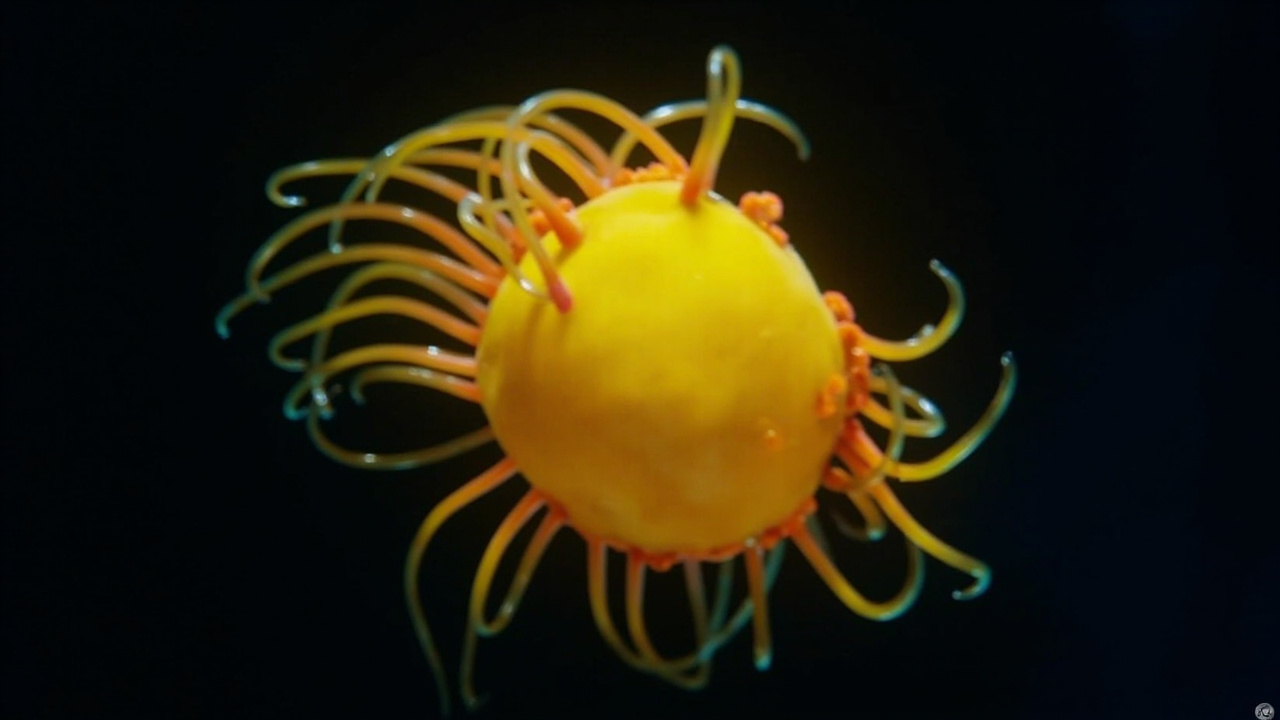
There, sitting on the ocean floor, is a shiny golden orb. And I mean genuinely golden — like someone dropped a mysterious egg into the deepest, darkest part of the ocean and forgot to pick it up. One researcher can be heard in the footage saying "I would love to poke it and see how hard it is." Honestly? Same.
For three years, this thing sat in labs while scientists scratched their heads. Was it an egg? Some kind of new species? A piece of alien technology that fell into our ocean? (Okay, probably not that last one, but you have to admit the thought crossed their minds.)
The answer, it turns out, is both simpler and stranger than any sci-fi scenario: it's part of a giant sea anemone. Not just any sea anemone, mind you, but Relicanthus daphneae — one of the most unusual creatures in our oceans.
This anemone is a beast. Its tentacles can stretch up to seven feet long. SEVEN FEET. That's not a sea anemone, that's basically a underwater nightmare monster (affectionately). Scientists have been going back and forth about how to classify this thing for decades. At one point, someone suggested it needed its own entirely new order of life. Then other researchers said "nah, let's put it in its own suborder instead." R. daphneae is basically the scientific community's complicated relationship — on again, off again, never quite sure what they are to each other.
So how did they figure out the golden orb was connected to this weird anemone? It took a village, folks. We're talking morphological analysis, genetic sequencing, deep-sea expertise, and some seriously sophisticated bioinformatics. One of the researchers, Allen Collins from NOAA, called it "a complex mystery" that needed "focused efforts and expertise of several different individuals." Basically, it took a scientific Avengers team to crack this case.
The breakthrough came when they did whole-genome sequencing, specifically looking at mitochondrial genomes. This revealed that the orb contained the DNA of R. daphneae. But here's the freaky part: the orb itself isn't actually part of the anemone's body. It's a secreted cuticle — essentially a protective coating that the anemone releases to stick itself to rocky surfaces. Think of it like the world's most disgusting mounting tape.
The orb had layered surfaces filled with cnidocytes, which are stinging cells found in corals and anemones. More specifically, these were spirocysts, which told researchers this thing belonged to the group Hexacorallia. But it wasn't until they matched the DNA that the full picture came together.
Now, here's a statistic that should honestly keep you up at night: we have better maps of Mars than we do of our own ocean floor. Let that sink in for a second. We've sent rovers to another planet, we've mapped its surface in detail, but we know more about a world 140 million miles away than we do about the vast majority of our own planet's oceans. That means there are probably hundreds — maybe thousands — of mysteries like the golden orb waiting down there for us to discover.
NOAA's William Mowitt put it beautifully when he said "This is why we keep exploring — to unlock the secrets of the deep and better understand how the ocean and its resources can drive economic growth, strengthen our national security, and sustain our planet."
And honestly? That's the takeaway here. Every time we send a camera or a submersible into the deep ocean, we're essentially rolling dice on what we might find. Sometimes it's a golden orb that turns out to be an anemone's sticky base. Sometimes it's something we genuinely have no framework to understand. But every single discovery teaches us something new about the incredible, alien world hiding in our own backyard.
The deep ocean isn't just some unexplored wilderness waiting to be discovered — it's a frontier that reminds us how much we still don't know. And personally? I find that both humbling and wildly exciting.
Source: https://www.popularmechanics.com/science/environment/a71486243/golden-orb-solved