
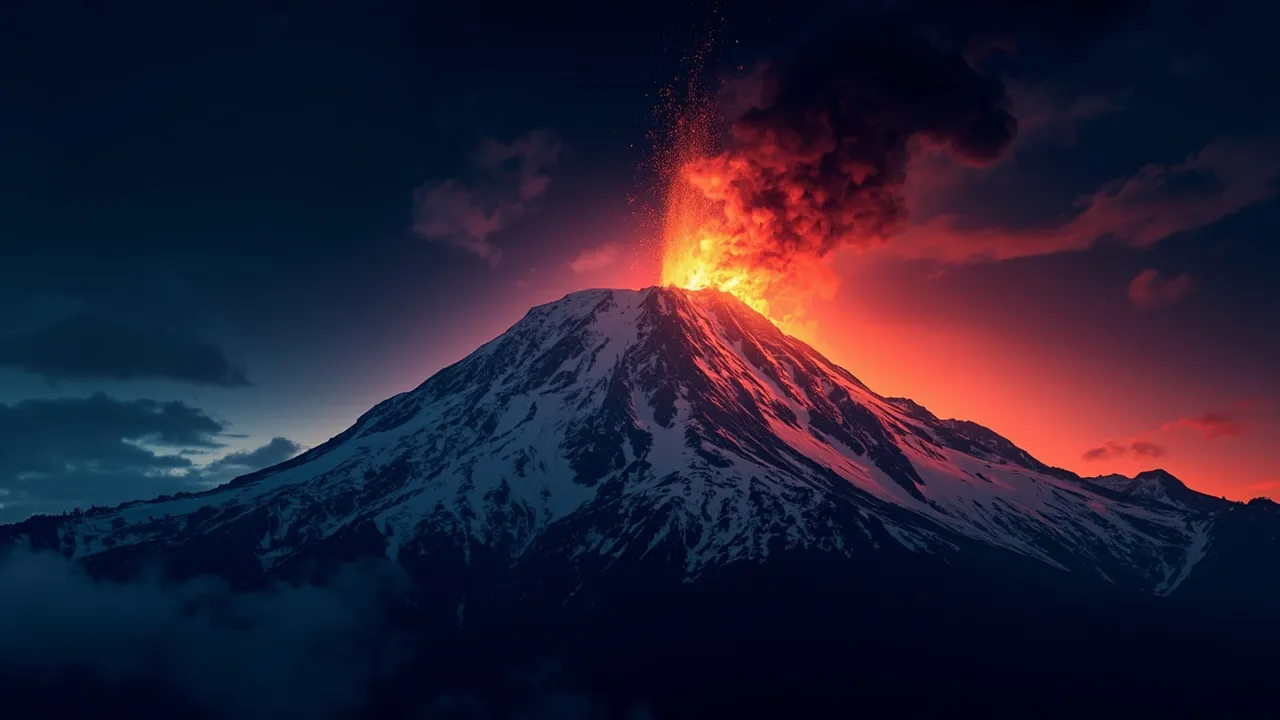
Okay, I need to share something with you that kept me up at night after reading about it.
Most of us probably assume that if a volcano decides to blow its top near a major American city, we'd get at least some warning. Maybe some seismic rumbling, some ominous smoke, a dramatic evacuation scene like in the movies.
Right?
Wrong. Dead wrong.
The biggest volcanic threat to the Pacific Northwest isn't actually an eruption — it's something that can happen without any warning at all. No earthquakes. No rumbling. No dramatic ash clouds. Just... destruction.
Meet the Lahar: Volcanic Hazard Nobody Talks About
I'm talking about lahars. Say it with me: lar-ar (or la-HAR, both work).
These are basically cement mixers from hell — a churning slurry of volcanic rock, sediment, and water that comes roaring down a mountainside at highway speeds. We're talking 60 miles per hour through a river valley, leveling everything in its path.
The thing that makes lahars absolutely horrifying? They don't care if the volcano actually erupts.
A lahar can be triggered by anything that destabilizes the mountain — a massive landslide, heavy rainfall, a dam failure, even an earthquake. The volcano just... sits there, looking innocent, while deadly mud races toward towns below.
Remember Mount St. Helens?
When Mount St. Helens blew its top in 1980, the eruption itself caused damage. But the truly devastating destruction came from the lahar it generated. Fifty-seven people died. Infrastructure worth nearly a billion dollars was destroyed.
Scientists looked at that disaster and realized: we need to prepare for the thing we can't see coming.
And here's what keeps volcanologists up at night: Mount Rainier.
The Seattle-Area Volcano Nobody Worries About (But Should)
Mount Rainier sits roughly 60 miles from Seattle. About 150,000 people live in Pierce County, right in the projected lahar path.
If a landslide triggered a lahar on Rainier's western slope, communities like Orting, Puyallup, and Sumner could be buried in just thirty minutes.
Thirty minutes.
That's not enough time for evacuation sirens. That's barely enough time to finish reading this sentence.
One scientist I read about called no-notice lahars "the thing that goes bump in the night." Another said they "creep him out." These are professionals who spend their lives studying volcanic hazards, and they're genuinely unsettled.
That tells you something.
So What Are Scientists Doing About It?
Good news: researchers aren't sitting idle waiting for disaster.
The USGS Cascades Volcano Observatory has built an extensive monitoring network throughout the region. They can detect lahar signals and relay warnings to emergency managers. Scientists in Oregon have even built custom flumes to replicate lahar flows and study how they behave.
The tricky part? Lahars are incredibly unpredictable. They can grow or shrink as they travel. They can change consistency, speed, and direction. One scientist described them as "complex phenomena that change a lot during transport."
In other words, modeling exactly what will happen is brutally hard.
Why This Matters to You
"But wait," you might be thinking, "I don't live anywhere near a volcano."
Fair point. But here's why this story matters beyond the Pacific Northwest:
First, it reminds us that nature's threats don't always announce themselves the way we expect. We're conditioned to think "volcano = eruption," but reality is messier and scarier than that.
Second, the science of prediction is hard. Scientists are working with incomplete data, complex systems, and the fundamental challenge that we can't run experiments on real disasters. Every lahar model is based on understanding past events and hoping the future behaves similarly.
Third, and maybe most importantly: this is a story about preparedness paying off. The monitoring networks, the research, the emergency planning — these exist because we learned hard lessons from Mount St. Helens. They exist because scientists and policymakers decided that "better safe than sorry" is actually a reasonable philosophy.
The Bottom Line
Will a catastrophic lahar hit the Seattle area tomorrow? Almost certainly not. The odds of any individual event in a given year are relatively low.
But "relatively low odds" and "can't happen" are very different things. Mount Rainier has produced massive lahars before. It will again.
The question isn't if — it's when. And whether we'll be ready.
So the next time you hear about volcanic activity in the Pacific Northwest, don't just think about dramatic eruptions. Think about the ground beneath your feet, the mountains above, and the invisible rivers of mud that could come screaming down without a single warning.
Sometimes the biggest disasters don't announce themselves at all.
What's your take on this? Does learning about "silent" natural disasters change how you think about emergency preparedness? Drop a comment below — I'd love to hear your thoughts!