
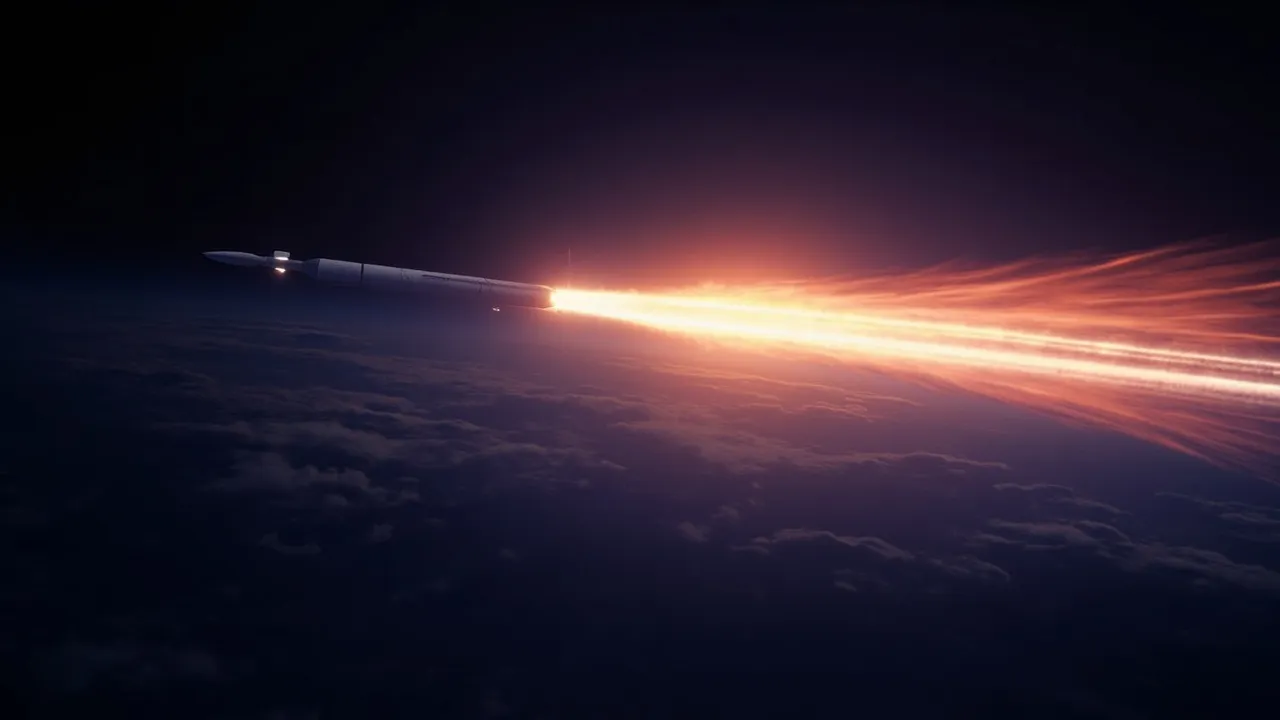
Okay, folks, gather 'round. I've got a story for you that sounds like it was pulled straight from a Cold War thriller, but apparently it actually happened. And the best part? Nobody has a clue what caused it.
The Setup
Picture this: It's 1988, and the Cold War is still chugging along. The U.S. and Soviet Union have signed this nifty little treaty called the Intermediate-Range Nuclear Forces Treaty (or INF Treaty for short), which basically said "hey, let's not point these intermediate-range missiles at each other anymore." But here's the thing—you can't just toss these things in the trash. You have to destroy them properly, which meant launching them into oblivion and watching where they land.
So the Soviets were like, "Fine, we'll shoot our SS-20 Saber missiles and you can watch if you want." And the Americans were like, "You bet we will."
Enter the Boeing RC-135S Cobra Ball. This wasn't your average plane. It was essentially a flying science lab, kitted out with sensors designed to track missile launches and scoop up every bit of data possible. Think of it as the ultimate nosy neighbor, except it was watching rocket launches from hundreds of miles away.
The Observation
Now, here's where things get weird.
Air Force pilot Robert Hopkins was in the cockpit during one of these observation missions. The Soviet missile had launched, everything was proceeding normally, when suddenly... the sky just... changed.
Hopkins described seeing what looked like a "translucent, milky white wall" that stretched from the ground all the way up as far as he could see. This thing was moving incredibly fast—way faster than any aircraft—and it passed right across their flight path before continuing eastward and vanishing into the night.
And here's the kicker: it covered the entire sky. Like, we're not talking about a small patch of light. This thing was an honest-to-goodness wall of luminous whatever-it-was stretching from horizon to horizon.
So What Was It?
Here's where my mind started doing somersaults. The experts had a few theories, and honestly, none of them are super satisfying.
Theory #1: Aurora weirdness. Maybe the missile's exhaust created some kind of atmospheric phenomenon that looked like an aurora? But here's the thing—Hopkins was a trained observer who had seen auroras before, and he said this was nothing like that.
Theory #2: Ion cloud magic. Perhaps it was some kind of ionization effect in the upper atmosphere? This one gets into some pretty technical territory involving how rocket exhaust interacts with the ionosphere, but even the scientists couldn't nail this down.
Theory #3: Intentional Soviet tomfoolery. And this is the one that keeps me up at night. What if the Soviets wanted America to see this? What if it was designed as some kind of anti-missile defense chicanery—maybe a way to blind sensors or confuse tracking systems?
Think about it. If you could create a massive, unpredictable light phenomenon on demand, that could seriously mess with anyone's ability to track your missile launches. Sabotage their data before they even get it.
The Conspiracy Theorist in Me
I have to admit, I love this story because it sits in that delicious gray area where science meets mystery meets international intrigue. We know it happened. Multiple trained observers saw it. But we have no idea why.
And what really gets me is the timing. This was right at the end of the Cold War. The Soviets were about to implode. If they had some secret atmospheric weapon or countermeasure technology, that would have been exactly the kind of thing they'd keep hidden until the very end.
The really unsettling part? Today, with hypersonic missiles becoming the new frontier of military technology, some form of atmospheric manipulation could be even more relevant. Imagine if you could create these kinds of effects to confuse enemy sensors in a real conflict. That's straight out of a sci-fi movie.
What Do We Do With This?
Honestly? I think the most honest answer is that we don't know. The Cold War produced countless mysteries, and this is one that might never be solved unless some former Soviet scientist decides to spill the tea decades later.
But I love that this story exists at all. It reminds us that even during the most intense technological competition in human history, there were still moments of genuine mystery. Not everything has a neat explanation. And sometimes, the truth is stranger than anything we could make up.
So the next time you look up at the night sky, maybe give a little nod to those pilots who saw something inexplicable in 1988. They witnessed a mystery that's still unsolved to this day.
And honestly? That might be the most fascinating thing about it.