
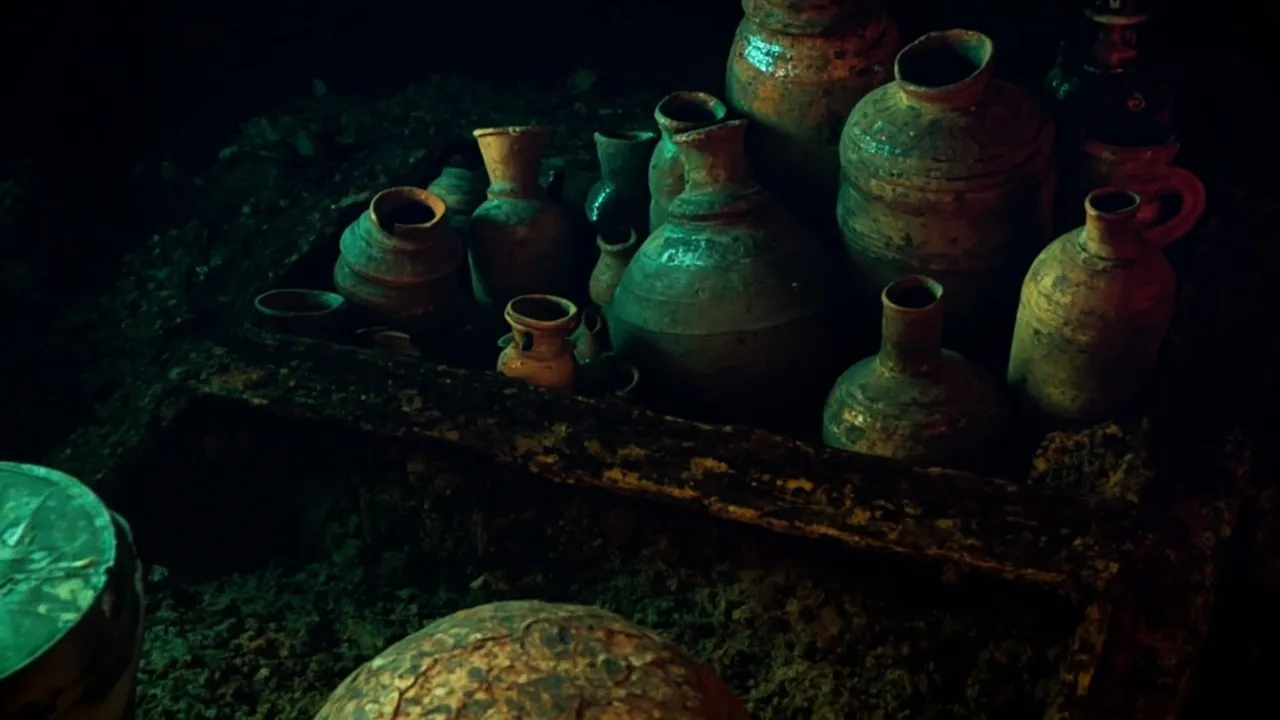
Okay, picture this: you're a diver exploring the Mediterranean Sea near Kekova Island in Turkey, about 100 feet below the surface. You expect to find... well, maybe some old coins or a rusted anchor. Nothing too exciting.
Instead, you stumble across something that makes your archaeologist brain short-circuit.
More than 30 ancient clay jars, just sitting there on the seafloor. And three heavy stone anchors. That's it. No wooden hull, no skeleton of a ship—just the cargo it was carrying.
So here's the million-dollar question: how do you know it's the oldest shipwreck on Earth when the ship itself is nowhere to be found?
The Jars Tell the Whole Story
Here's what gets me about this story. The researchers didn't find the ship. They found what the ship was carrying—and that turned out to be more than enough.
Those 30+ ceramic containers, called amphorae, are like time capsules. Based on their shape, design, and the materials used to make them, researchers dated this wreck to somewhere between 2600 and 2400 BCE. That makes it older than the famous Dokos shipwreck in the Aegean Sea and roughly contemporaneous with the construction of the Great Pyramid of Giza.
Let that sink in for a second. While the Egyptians were building one of the Seven Wonders of the Ancient World, some poor merchant ship was making its final voyage across the Mediterranean—and it didn't make it.
Where Did This Ship Come From? Where Was It Going?
The really cool part? The jars themselves are like breadcrumbs leading us along ancient trade routes.
These amphorae match vessels found in Jordan Valley workshops, Egypt, Troy, and Crete. The researchers call it a "100 percent match" to Early Bronze Age types. So this wasn't just a local fishing boat—it was part of a sophisticated trading network connecting distant civilizations.
Experts believe the ship likely launched from somewhere along the Levantine coast (that's modern-day Lebanon, Israel, or Syria) and was headed either toward Troy in northwestern Turkey or over to Crete. The strong currents around Kekova Island made—and still make—this stretch of water notoriously dangerous for sailors.
They estimate the vessel was probably around 33 feet long. Relatively small by today's standards, but perfectly sized for Bronze Age Mediterranean trade.
Wait, There's Cheese Residue?!
I saved the best detail for last, because this is where the story gets really fun.
Among all those jars, one stands out. It has nine different markings and two mysterious holes. And according to the researchers, this wasn't just a regular olive oil or wine container.
They think it was used to make butter or cheese.
How cool is that?
This suggests that sailors weren't just transporting goods—they were producing food during their voyages. One researcher from Macquarie University in Australia examined the residue inside one of the jars and said she "nearly fainted" when she looked inside because there was so much material still remaining.
Now, they still need to analyze exactly what substances are in there—olive oil, wine, tree resin, maybe something else entirely. There's also the possibility that these jars got reused for many years after their original voyage, which would complicate the picture.
But honestly? That's what makes archaeology so thrilling. Every question answered leads to three more.
Why This Matters
Turkey's Minister of Culture and Tourism called this discovery a showcase of the "deep-rooted history of maritime trade along the Anatolian coasts." And he's absolutely right.
We tend to think of ancient trade as these isolated, simple exchanges. But this wreck tells us that 4,700 years ago, there were established routes connecting the Levant to the Aegean, with merchants transporting goods across dangerous waters in relatively small wooden vessels.
That's not primitive. That's impressive.
The ship's wood may have completely disintegrated over the millennia, leaving behind only its cargo and anchors. But those humble clay jars? They're doing exactly what good evidence should do—they're asking us to imagine a vibrant, connected Bronze Age world that we never knew existed.
And honestly, I can't stop thinking about whoever was on that ship all those thousands of years ago. Did they see the storm coming? Did they try to beach it? We'll probably never know the full story.
But those jars? They're still here, waiting to tell us more.