
When "Going to the Market" Was a Spiritual Experience
Imagine walking through an ancient Maya marketplace 1,500 years ago. You're browsing handwoven textiles, fresh fish, and ceremonial pottery, but you're not just shopping—you're participating in something sacred. That's what researchers are now discovering about mysterious structures scattered throughout the Maya Lowlands of Mexico, and honestly, it's kind of blowing my mind.
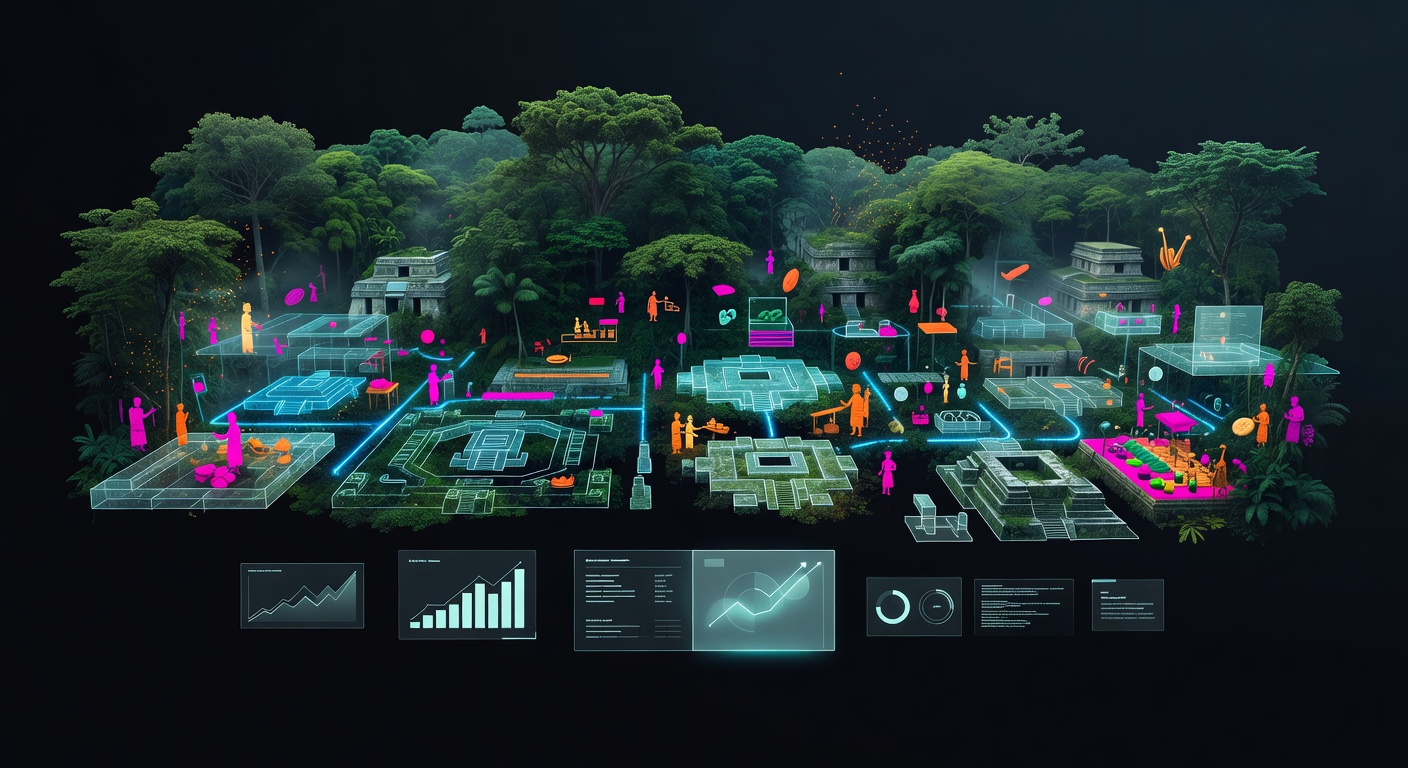
An archaeologist named Ivan Šprajc has been poking around in the jungle and found about 50 sites that all follow the same distinctive pattern: concentric circles of low platforms arranged like nested rings. If you've ever seen a concert venue with seating arranged in circles, imagine that, but for ancient commerce. And here's the wild part—these aren't just marketplaces. They're hybrid spaces that mixed shopping, worship, and community gatherings all in one.
The Architecture of Ancient Business
So what did these places actually look like? Šprajc thinks the low, elongated mounds were platforms that held stalls—basically ancient pop-up shops. The spaces between them? Those were walkways where customers strolled around, probably haggling over prices just like people do today at any market.
But here's what makes this discovery so interesting: mixed in with the marketplace structures, you'll often find:
- Stone altars and shrine areas for religious ceremonies
- Ceremonial buildings for rituals
- Ball courts (because the Maya were obsessed with this game)
- Storage facilities and administrative buildings
This tells us something really important about how the Maya actually lived. They didn't compartmentalize their lives the way we do. You didn't go to the mall, then go to church, then go to the stadium. All of that happened in the same place. Business, religion, and recreation were woven together.
Following the Evidence
What really convinces me these were markets is the supporting evidence. Archaeologists have found ancient paintings showing people buying and selling goods, which is basically Maya TikTok proof of what was happening. Plus, the architectural layouts match descriptions of markets from the time of Spanish conquest—so there's continuity there.
Šprajc also noticed something clever: these marketplace clusters tend to appear in two main areas. First, in regions that weren't great for farming. That makes sense, right? If you can't grow enough food locally, you need central trading hubs to redistribute goods from other areas. Second, around the La Rigueña River, where archaeologists think the Maya were doing serious fishing operations. So these waterside markets were probably packed with fish vendors—the ancient equivalent of a seafood district.
The Regional Variation Problem
Here's where it gets nuanced. Šprajc doesn't think every single Maya marketplace looked the same or followed this concentric-circle design. Different regions probably had their own versions, adapted to local geography and culture. Some marketplaces might have been temporary or made from materials that didn't leave archaeological traces—which means we're probably only seeing the tip of the iceberg.
That's actually humbling to think about. We're finding evidence of 50 marketplace sites, but there could have been hundreds more that just didn't survive in ways archaeologists can detect today.
What This Actually Means
This discovery matters because it shows the Maya weren't just monumental builders obsessed with temples and pyramids (though they definitely were). They were sophisticated economists who understood the importance of trade networks, distribution systems, and creating central hubs for exchange. They built infrastructure for commerce the same way they built infrastructure for religion.
It also humanizes them in a way that's easy to forget. When you think about these bustling marketplaces—the noise, the negotiating, the mixing of sacred and everyday life—you're thinking about people not so different from us. They cared about good deals, fresh produce, and gathering in shared spaces. They just did it with more ceremony than we typically do at the grocery store.
The jungle is still full of secrets, and I have a feeling there's way more to learn about how the Maya actually lived their daily lives. These marketplace discoveries feel like we're finally getting the real story.