
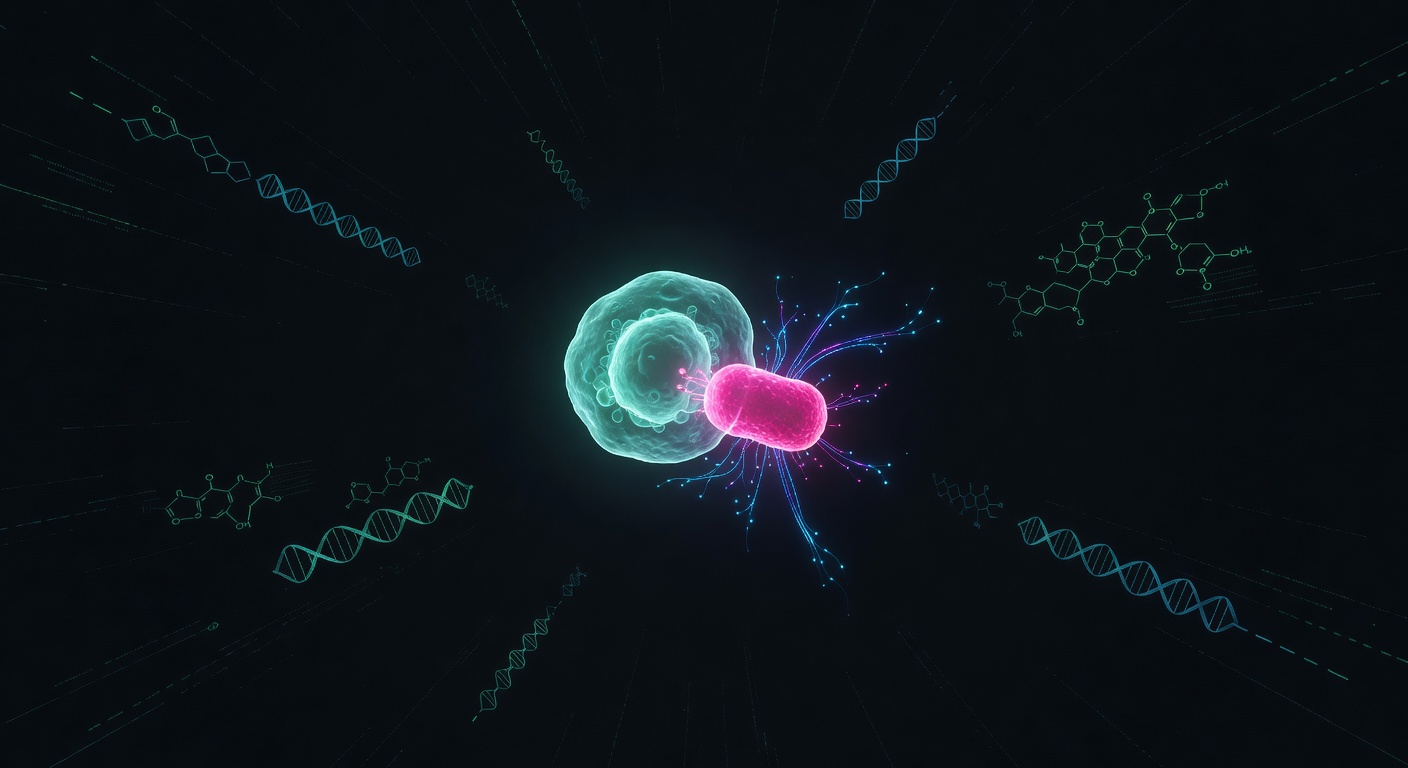
The Ultimate Ancient Partnership
You know how some of the best things in life happen when two different worlds collide? Well, that's exactly what happened around 2 billion years ago when Earth witnessed the most important merger in biological history.
Every complex living thing on our planet—from the tiniest mushroom to blue whales to you and me—exists because two completely different types of microbes decided to team up permanently. This wasn't just any casual partnership; it was a full-blown cellular fusion that scientists call endosymbiosis.
The Puzzle That's Been Bugging Scientists
Here's where things get interesting (and where scientists have been scratching their heads for decades). We knew that this ancient merger involved two main characters:
- Asgard archaea: Ancient microbes that lived in oxygen-free environments like deep-sea vents
- Alphaproteobacteria: Microbes that absolutely loved oxygen and needed it to survive
But here's the problem that kept researchers up at night: How do two microbes that live in completely different neighborhoods—one that hates oxygen and one that can't live without it—ever meet, let alone move in together?
It's like trying to explain how a deep-sea creature and a bird became roommates. It just didn't make sense!
The Game-Changing Discovery
A brilliant team at the University of Texas just dropped some major news that solves this ancient mystery. They discovered that our microscopic ancestors weren't quite as picky about oxygen as we thought.
After analyzing over 13,000 new microbial genomes (talk about dedication!), they found something amazing: some of these ancient Asgard archaea could actually handle oxygen just fine. In fact, they could even use it to their advantage!
This is huge because it means these two very different microbes could have actually lived in the same neighborhoods—shallow coastal waters where oxygen levels were just right for both to thrive.
Why This Matters for Your Morning Coffee
You might be wondering, "That's cool and all, but why should I care about some ancient microbe romance?"
Well, here's the thing: you literally wouldn't exist without this merger. Those alphaproteobacteria that joined the party? They evolved into mitochondria—the tiny powerhouses inside every cell in your body that help you extract energy from your breakfast, power your thoughts, and keep your heart beating.
Every time you take a breath, every time your muscles move, every time your brain processes these words, you're benefiting from that ancient partnership forged billions of years ago.
The Bigger Picture
What I love most about this discovery is how it shows that life is incredibly adaptable. When Earth's atmosphere started filling up with oxygen during the Great Oxidation Event, these ancient microbes didn't just survive—they thrived and innovated.
As researcher Brett Baker put it, "Oxygen appeared in the environment, and Asgards adapted to that. They found an energetic advantage to using oxygen, and then they evolved into eukaryotes."
It's a reminder that major environmental changes, while challenging, can also lead to incredible evolutionary breakthroughs. These microbes turned what could have been an extinction event into the foundation for all complex life on Earth.
The Norse Connection
I have to give props to scientists for their naming choices here. They called this group of archaea "Asgard" after the realm of the gods in Norse mythology. The specific group that could handle oxygen? Heimdallarchaeia—named after Heimdall, the Norse god who could see across all realms.
It's pretty fitting when you think about it. These microbes were like ancient gods bridging different worlds—the oxygen-free depths and the oxygen-rich shallows—making complex life possible for all of us.
What's Next?
This discovery opens up so many new questions about early life on Earth. Scientists are now wondering: How many other evolutionary partnerships are we missing? What other environmental challenges led to major biological innovations?
The more we learn about these ancient cellular mergers, the more we appreciate just how interconnected and resilient life really is. It's pretty amazing to think that some of the most important events in Earth's history happened at a scale so small we need powerful microscopes to study them today.
Next time you're feeling grateful for being alive, maybe spare a thought for those pioneering microbes who figured out how to work together billions of years ago. Without their ancient teamwork, there'd be no morning coffee, no sunset walks, and no fascinating science stories to share.
Source: https://www.popularmechanics.com/science/animals/a70449475/eukaryogenesis-puzzle