
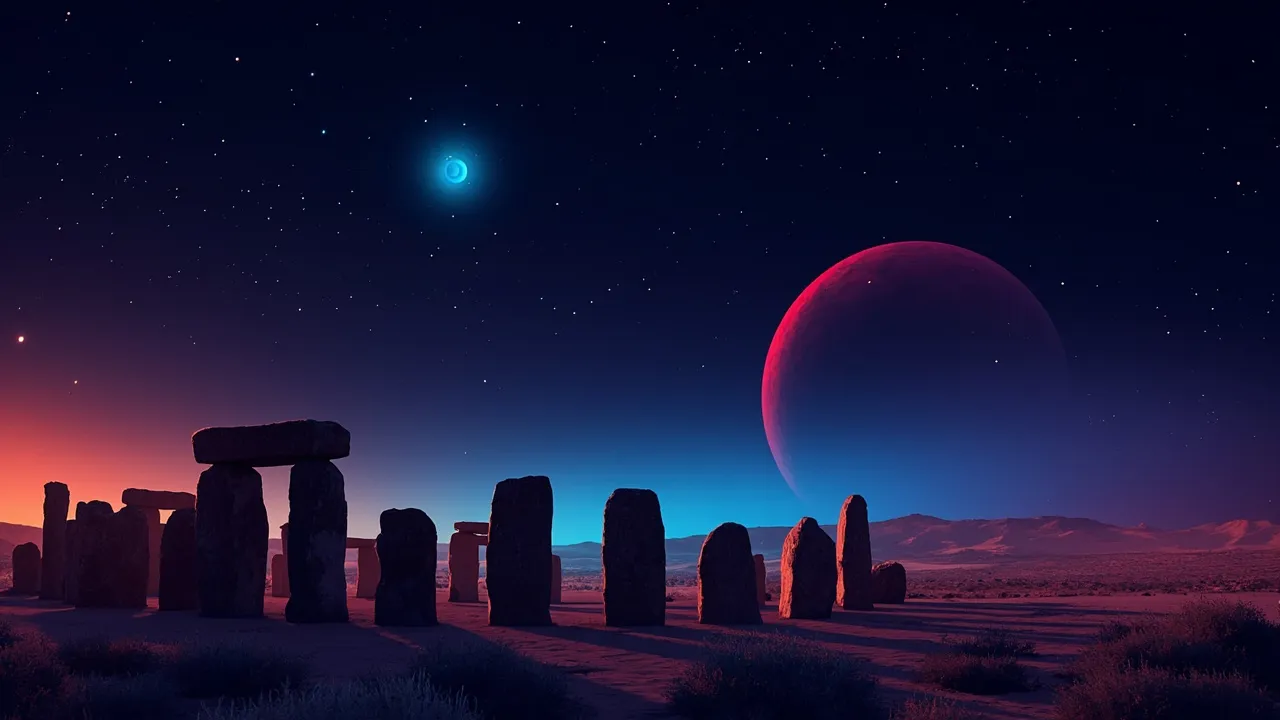
Have you ever heard of Nabta Playa?
If you haven't, don't worry — most people haven't. And honestly, that kind of blows my mind. Because this place is absolutely wild. It's an ancient stone circle hidden in the Egyptian desert, and it's roughly 7,000 years old. That's older than the pyramids at Giza by about 2,000 years. Older than Stonehenge, too. And yet, when most people think about ancient stone monuments, their minds jump straight to England or Egypt's famous tombs — completely missing this incredible piece of human history sitting right there in the Sahara.
Let me paint you a picture of what this place must have looked like back when it was built.
The Sahara Was Once... Green?
I know, I know. The Sahara Desert is literally the last place you'd expect to find a thriving human community. But here's the thing — it wasn't always a desert. Around 10,000 years ago, after the last Ice Age ended, this whole region was much greener. Think savanna. Think grasslands dotted with trees, lakes full of water, and animals wandering through. The people who lived there weren't stuck in a barren wasteland — they were living in a surprisingly habitable landscape.
Archeologist Fred Wendorf figured this out after spending decades in the 1960s and beyond, literally walking through the desert looking for clues. And what clues he found. Stone tools. Pottery. Beads. Animal bones. Evidence of cooking fires. These people weren't just passing through — they had settled, adapted, and built something remarkable.
Then, slowly, the rains stopped coming.
A People Who Worshipped Cattle
The nomads who built Nabta Playa were called the Ru'at El Baquar, and they had a deep, spiritual connection to cattle. We're talking worship-level devotion. Cattle weren't just animals to them — they were sacred. And when the rains stopped and the land began to dry up, these people faced an impossible choice: sacrifice your most precious resource to plead with the gods, or watch everything you've built disappear.
Archaeologists have found burial mounds at the site filled with cattle bones. In one grave, they discovered a fully articulated cow skeleton — clearly sacrificed, not just eaten. Every single one of those animals represented wealth, food, and survival. Giving them up during a drought would have been an act of desperation and faith all at once.
And here's what gets me: the stones at Nabta Playa weren't just randomly placed. They were positioned with intention.
The World's Oldest Astronomical Observatory
When researchers took a closer look at the stone arrangement, they realized it was designed to align with specific stars — Arcturus, Sirius, parts of the Alpha Centauri system, and even Orion's Belt. There were two sets of stones pointing north and south, and two more positioned so that during the summer solstice, someone standing in the right spot would have a direct line of sight to the horizon.
But here's what really got me. Back then, there was no North Star to guide travelers. So how did these ancient people navigate? They looked down, not up. They watched the stars reflect in the water of Nabta Playa's lake. The reflections showed them where to go.
Think about that for a second. These people were using a lake bed as a giant mirror to read the night sky. They had turned their environment into a navigation system. That's not just clever — that's genius.
What's particularly amazing is that the structure is considered the oldest known astronomical observatory on Earth. Stonehenge gets all the fame, but this circle in the Sahara came first — by a couple thousand years.
The End of an Era
Around 5,000 years ago, the last of the water disappeared from Nabta Playa. The lake dried up, the grasslands turned to sand, and the Ru'at El Baquar were forced to move. Most evidence suggests they traveled east toward the Nile Delta, where water was still plentiful.
And here's what makes me a little sad about this story: as they left, they left behind this incredible monument to their ingenuity, their faith, and their connection to the cosmos. For thousands of years, the desert buried it, keeping it hidden from the world. It wasn't until the 1970s that anyone even found it.
So Why Don't We Know About This?
Honestly? I think it's a combination of things. The pyramids are flashier. They're massive, they're in a place people visit, and they have an air of mystery that's been romanticized for centuries. Nabta Playa is smaller, more subtle, and hidden deep in one of the most inhospitable places on Earth. It's not exactly a tourist destination.
But I think we should care about it. Maybe even more than Stonehenge. Because Nabta Playa tells us something important: ancient humans weren't primitive. They weren't ignorant. They were observers, thinkers, and engineers — long before we ever gave them credit for it.
Somewhere in the Sahara, there are stones that watched the first stars rise over a green and living land. Those stones are still there, waiting for us to understand what they mean.
And personally, I think that's pretty incredible.